
Or call us at 209-879-9367 — we'll answer Mon–Fri, 8 AM to 4:30 PM.📍 1973 N. Tracy Blvd., Tracy, CA 95376
Schedule OnlineLast reviewed: August 2026. Written from daily surgical work at The Pet Advocate in Tracy, California, including Dr. Michael Wesselink, DVM.
A routine dog spay usually costs $250 to $700 in the United States. The national average sits near $455, and California averages about $607. At The Pet Advocate in Tracy, a high-volume spay and neuter clinic, published cash prices for a female dog start at $200 and scale by weight to $350.
Low-cost clinics often charge $75 to $350. That is the band most owners mean when they search for a low-cost dog spay near them in the Bay Area or Central Valley.
Those national figures come from the 2025–2026 Synchrony Average Procedural Cost Study reported by CareCredit and from 2026 guides published by PetMD, U.S. News, and Forbes Advisor.
The Tracy numbers come from the live prices and rates page.
This guide shows what a typical bill includes, why two clinics can quote four times apart for the same dog, and what you will actually pay at the clinic.

The average cost to spay a dog is about $455 in private practice. California sits higher, near $607. Owners who call The Pet Advocate after collecting Bay Area quotes are usually trying to decide whether a number in that range is fair.
The honest answer is a range. It changes with the hospital and with the female dog on the table.
A laparoscopic spay uses small ports and a camera instead of one abdominal incision, and that technique sits well above these ranges. The Pet Advocate does not offer it. The procedure in this guide is a traditional ovariohysterectomy.
If a quote lands far outside these bands, ask what is bundled into the fee. Exam fees, required bloodwork on a young healthy dog, overnight stays, and specialty monitoring explain most of the outliers the front desk hears.
Clinic type moves the price more than almost any other factor. Two licensed veterinarians can quote four times apart for the same healthy female dog.
Clients who drive to The Pet Advocate from Manteca, Stockton, and the East Bay regularly report full-service quotes of $1,200 or more for a dog spay. Owners who leave Google reviews describe the same spread.
One family said full-service vets charged three to four times what they paid at the clinic. Another wrote that the total was one-fourth of every other quote they collected. Outside invoices cannot be audited one by one, but that $1,200-versus-published-price spread is what the desk hears most weeks.
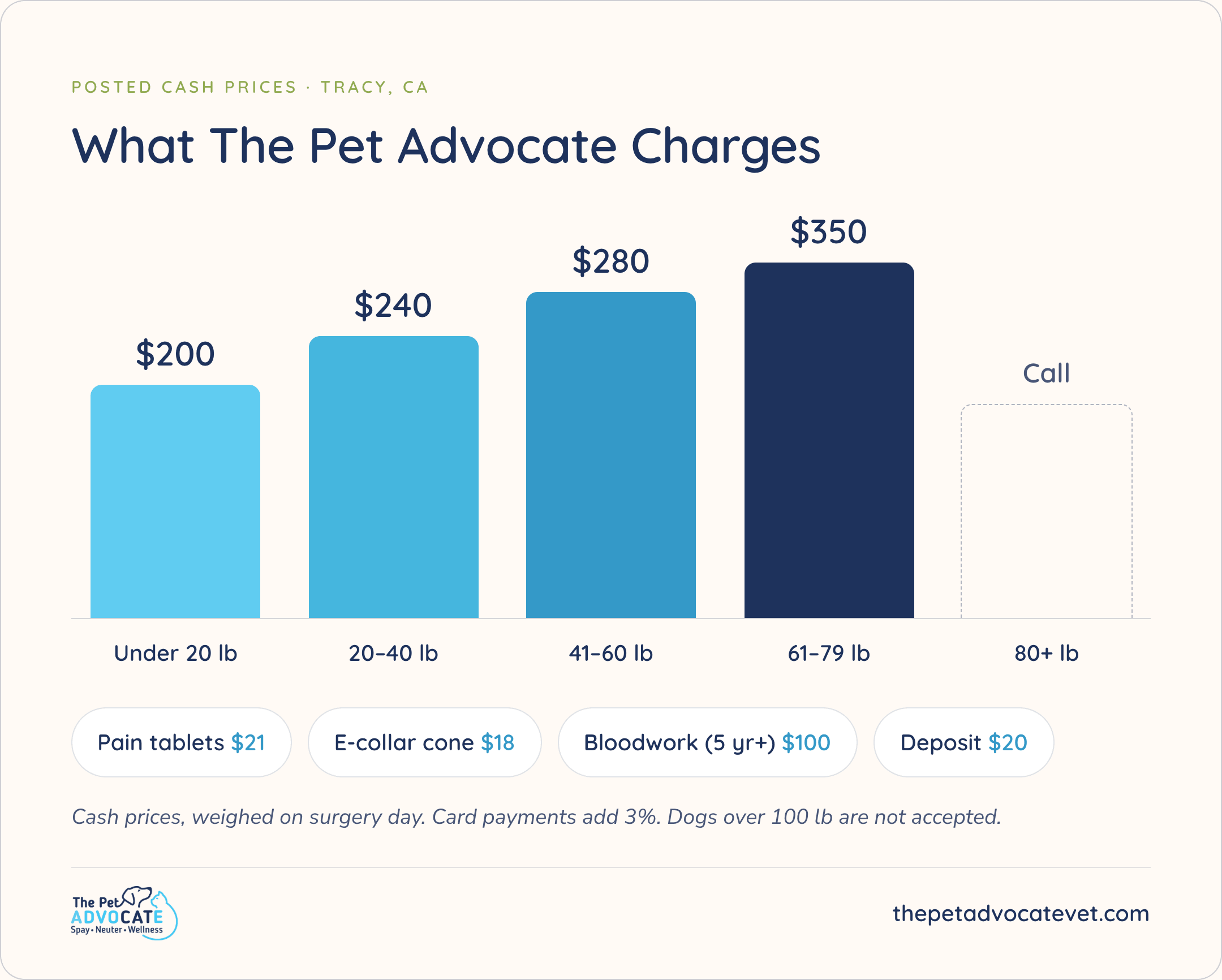
The Pet Advocate publishes cash prices by weight, from $200 under 20 pounds to $350 at 61–79 pounds. You should be able to plan the bill before you book a low-cost dog spay.

These are the cash prices The Pet Advocate publishes for a female dog. Card payments add 3 percent.
A $20 non-refundable deposit is due at booking and is applied to the total on surgery day. You can reschedule up to 72 hours ahead without paying a second deposit.
No-shows forfeit the deposit.
Weight is taken on the day of surgery. If a puppy has grown into the next tier since booking, the higher tier is the price that applies.
For the matching male procedure, see how much it costs to neuter a dog. Current totals for every service live on the prices and rates page.
You can schedule a low-cost dog spay once you know the weight class.
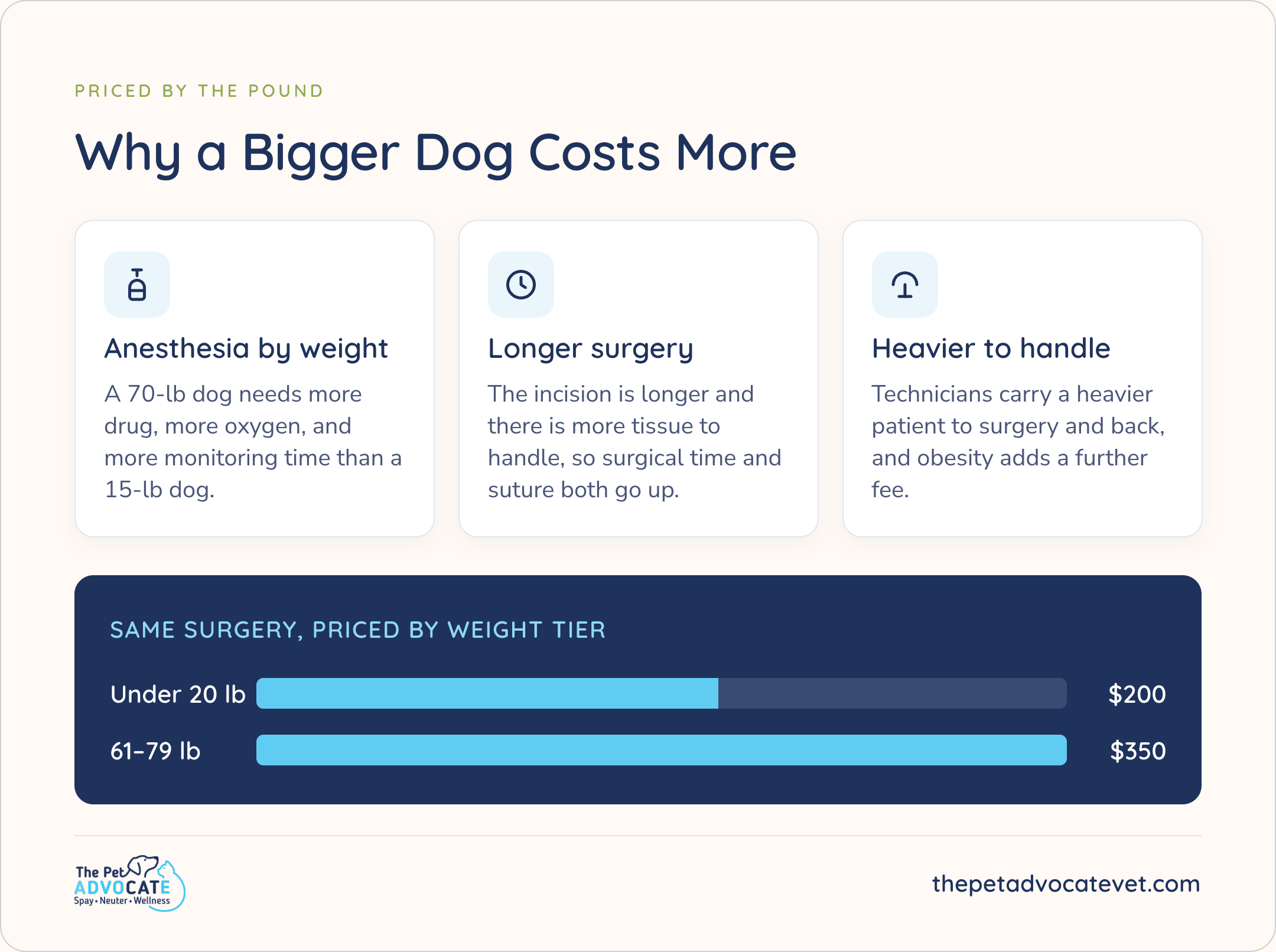
Anesthesia is dosed by body weight. A 70-pound dog at The Pet Advocate needs more drug than a 15-pound dog, plus more time on oxygen and monitoring.
The incision is longer. There is more tissue to handle, so suture material and surgical time both go up.
Heavier dogs are also harder to move through the hospital. That extra handling is part of why the 61–79 pound tier is $350 while the under-20-pound tier is $200.
I give the same answer when owners ask why a 60-pound dog is not priced like a 20-pound dog. More anesthetic time. A harder procedure.
Technicians also carry a heavier patient from the kennel to surgery and back.
Obesity adds a further fee because fat obscures landmarks and lengthens the procedure. That assessment happens on exam rather than from a photo.
Dogs over 100 pounds are outside the clinic protocol. Those patients are referred rather than stretching a high-volume anesthetic plan past the size the hospital is set up to serve safely.
The published dog spay fee at The Pet Advocate is the surgery line. This table shows what sits in that line and what does not.
The published fee covers the morning exam, general anesthesia and monitoring, the ovariohysterectomy itself, recovery in an individual kennel, and same-day discharge with verbal and written aftercare.
Take-home pain tablets, an E-collar, and bloodwork on young healthy dogs are not automatic. Those items are listed separately so the base price stays honest.
The clinic recommends the pain tablets and the cone. They are not required.
Rescue groups and TNR caregivers often opt out so they can cover more animals on a fixed budget. The anesthetic plan already includes pain control that covers the procedure itself.
The take-home tablets cover the days after discharge. The cone keeps the dog from licking the incision open.
Most complications the surgical team sees start with a cone that came off overnight. That is why both add-ons are still recommended for household pets.
The extra $39 for tablets and a cone is cheaper than a second surgery.

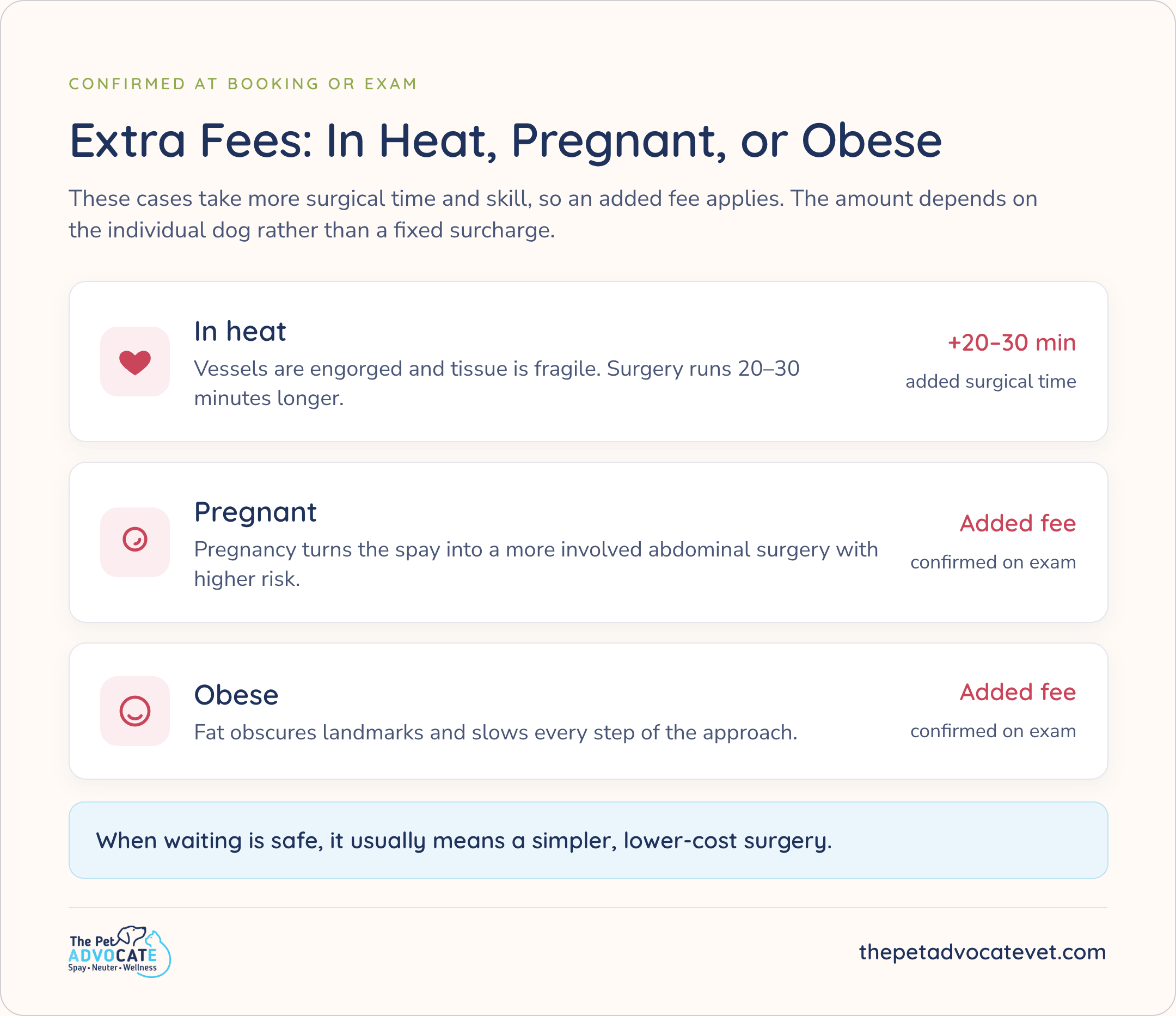
A female dog in heat can still be spayed at The Pet Advocate. Blood vessels around the ovaries and uterus are engorged, and tissues are more fragile.
The surgery typically runs 20 to 30 minutes longer. Additional fees apply for that extra time and technical demand.
The amount is confirmed at booking or on exam. The clinic does not publish a one-size surcharge because the fee depends on the individual case. Current base prices and add-ons stay on the prices and rates page.
If she can be kept away from intact males, waiting until the cycle ends produces a simpler, lower-cost surgery. We usually book about one month after visible heat signs resolve.
The full walkthrough is in Can You Spay a Dog in Heat.
Pregnant and obese patients also carry additional fees. Pregnancy turns the procedure into a more involved abdominal surgery, and obesity slows every step of the approach.
Both remain candidates when the exam supports it and the owner understands the higher risk and cost.
Waiting is preferred when waiting is safe. When it is not, the extra surgical time is built into the case.
Full-service hospitals price a spay as one item inside a broad practice. Those hospitals carry inventory and staff for dozens of other services.
Many now sit inside corporate groups that set standardized fees across acquired clinics.
Exam fees of $60 to $130, required bloodwork on every patient, IV catheters, overnight stays, and bundled pain-and-cone packages all stack onto the surgical line.
That hospital model is a different business. A general practice that treats spay as one of many weekly surgeries cannot spread fixed costs the way a clinic built around this procedure can.
The Pet Advocate keeps a finite low-cost spay and neuter menu, plus dental cleanings, vaccines, and a short list of wellness tasks. Volume on those services is what holds the published prices where they are.
The individual patient still receives a full anesthetic protocol and surgical monitoring. Lower cost comes from how the clinic is organized.
Clients in the Bay Area often say the same procedure runs three to four times higher thirty minutes from Tracy. That matches what the front desk hears more days than not.

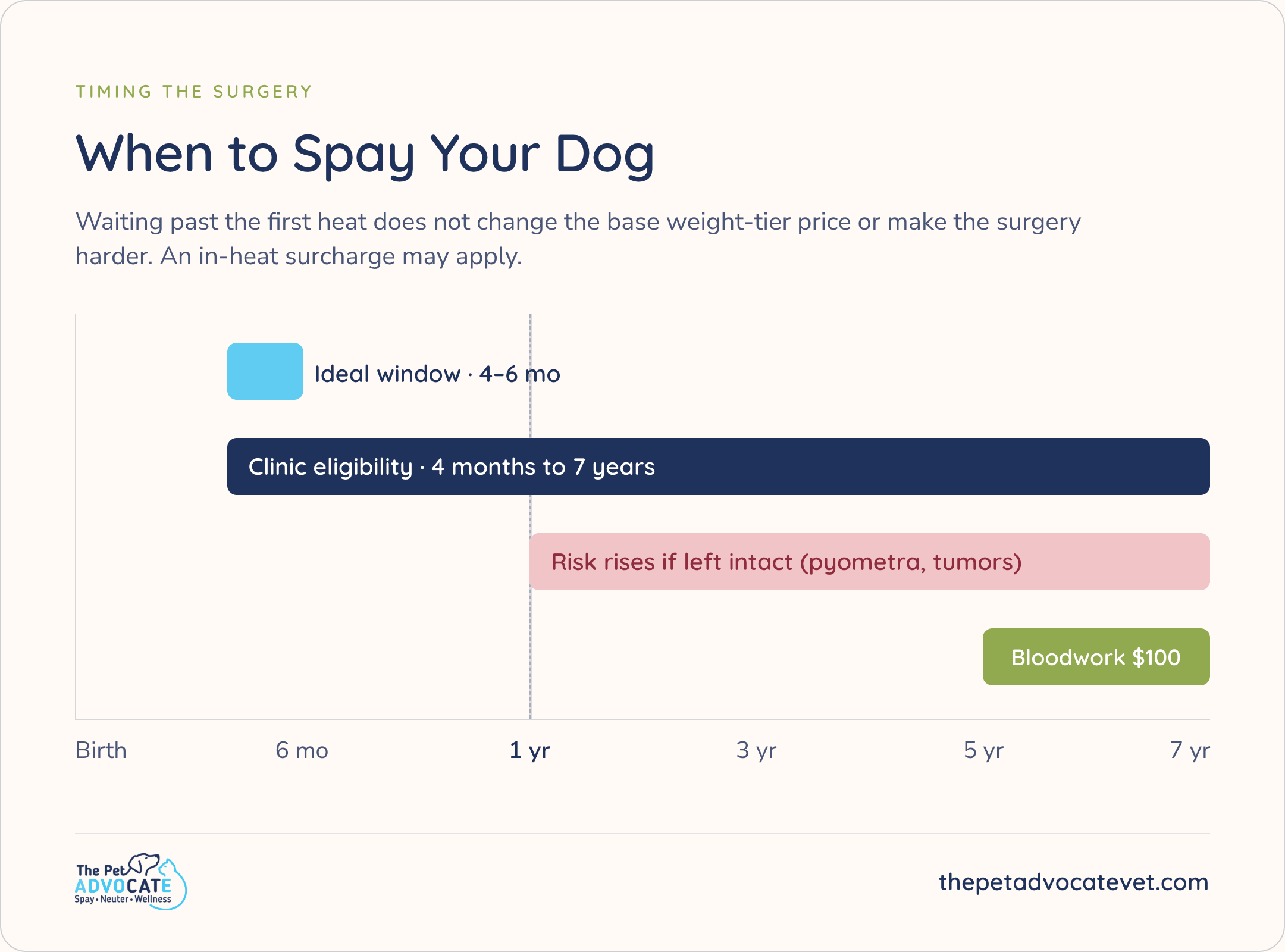
Standard accident-and-illness policies do not cover elective spay surgery at The Pet Advocate or anywhere else. Insurers treat it as planned preventive care.
Some wellness add-ons reimburse a set amount, commonly $100 to $150. ASPCA Pet Health Insurance preventive care lists spay or neuter reimbursement on its Prime add-on, often capped near $150, and other carriers publish similar caps.
Run the math before buying an add-on only for this surgery. At clinic prices the add-on can cost more over a year than the spay itself.
The clinic does not accept CareCredit. Cash and major credit or debit cards are the payment methods on file.
Card transactions add 3 percent to the listed cash price.
If a wellness rider is already in place, bring the details on surgery day so the front desk can give a receipt that matches what the carrier needs.
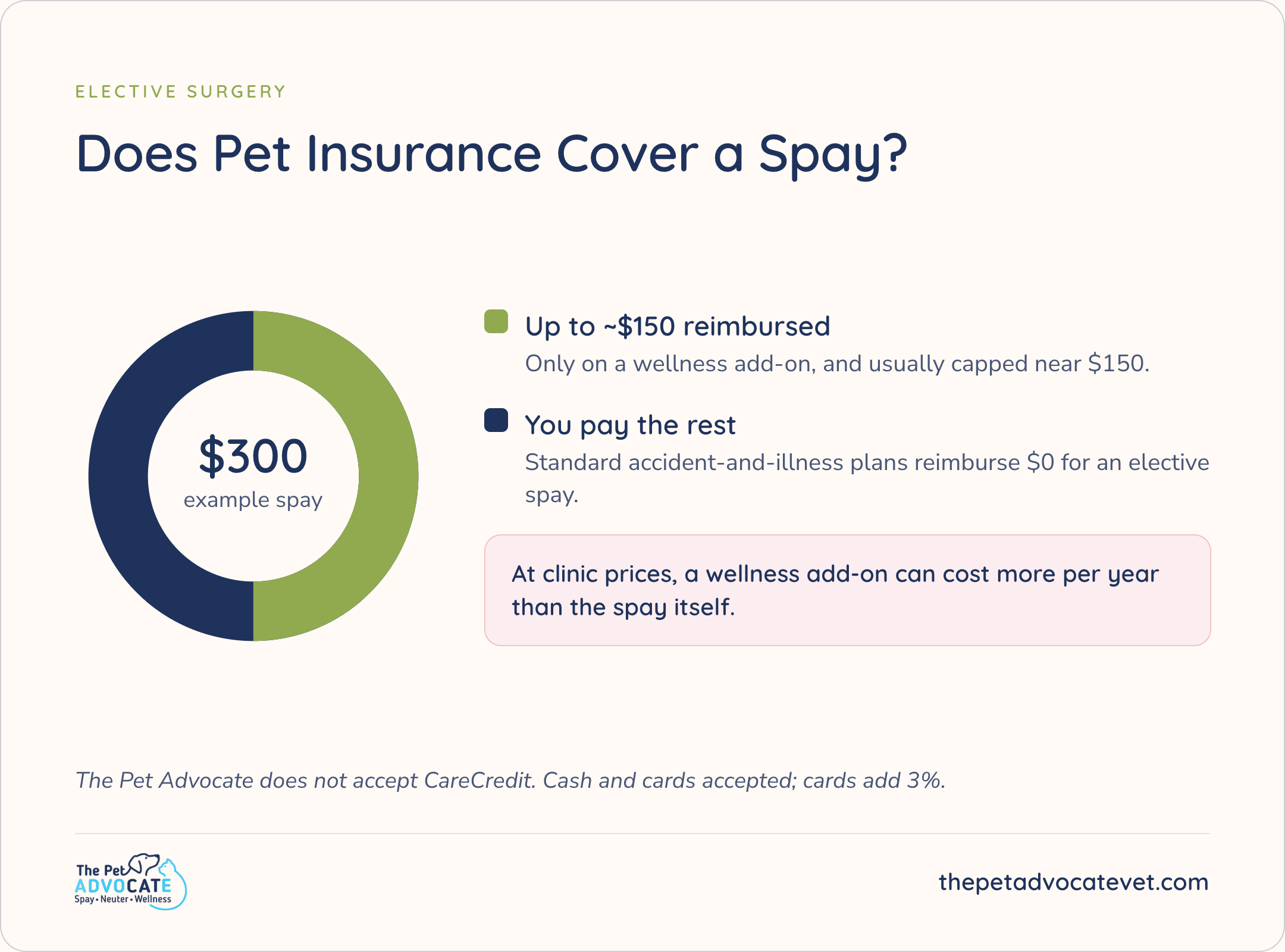
Ask every clinic the same five questions and compare all-in totals, not headline numbers. That is the process The Pet Advocate recommends when owners call after shopping full-service quotes.
Then call one low-cost dedicated clinic, one full-service hospital, and any shelter program you qualify for. The spread will tell you whether a quote is an outlier.
Do not choose a price so low that monitoring is skipped or the dog goes home with no plan for pain.
A low-cost dog spay at a dedicated high-volume clinic is how most families close the gap between a $1,200 full-service quote and a published cash fee.
If you are looking for a low-cost dog spay near you in Tracy, the Lathrop corridor, Manteca, Stockton, Antioch, Brentwood, or the wider Bay Area and Central Valley, compare the all-in number to The Pet Advocate’s $200 to $350 weight-tier cash price.
Schedule the appointment once the weight class and add-ons are clear.
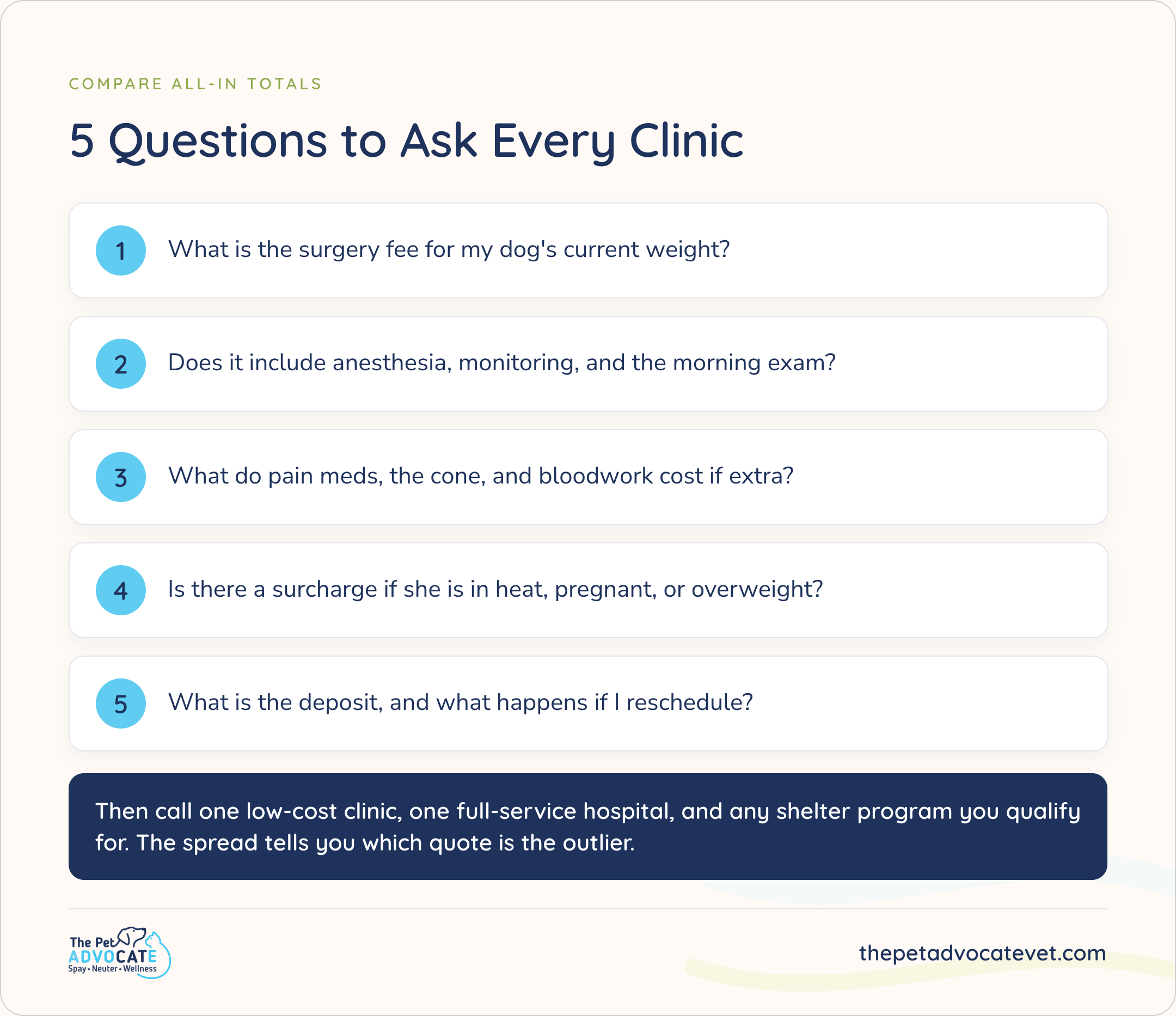
For most dogs The Pet Advocate recommends four to six months. That window prevents the first heat and virtually eliminates mammary and uterine cancer risk.
The AVMA overview of spaying and neutering lists those same health benefits. AAHA’s proposed sterilization ages put small-breed females before the first heat and leave a wider window for large breeds.
The general timing guide on when to spay or neuter your dog walks through the size and breed exceptions.
Waiting also has a medical cost. Intact females can develop pyometra, a uterine infection that becomes an emergency abdominal surgery. The Merck Veterinary Manual recommends ovariohysterectomy for that disease.
Dogs must be at least 4 months and no older than 7 years for spay or neuter at the clinic. Those surgery requirements also cover weight, health screens, and breed limits.
Pre-anesthetic bloodwork is required at 5 years and older ($100). Physical exam findings still decide candidacy. Age alone is not treated as a disease.
Waiting past the first heat does not usually change The Pet Advocate’s base weight-tier price of $200 to $350. An in-heat or pregnant surcharge can still apply if she arrives mid-cycle.
Waiting does not make the surgery harder, and it does not change whether we can do it. A mature dog can be harder to keep quiet during recovery, so activity restriction takes more effort at home.
Owners of giant breeds who want to delay for orthopedic reasons should form that plan with their primary-care veterinarian. The clinic still performs the surgery inside its published rules: 4 months to 7 years, exam clearance, and $100 bloodwork at 5 years and older.
See when to spay or neuter a large or giant breed dog for the research trade-offs.
A 3-year-old dog that is otherwise healthy is a routine candidate at the clinic, as long as she is 7 or under and clears the exam. Adult timing does not by itself multiply the fee the way weight and heat status do.
Dogs for spay at The Pet Advocate drop off between 8:30 and 9:00 a.m. Food and water are withheld from midnight. Pickup is the same afternoon after a recovery call.
The published price is the price at the front desk, plus any add-ons chosen and any surcharge confirmed on exam. There is no separate office-visit fee stacked on top of the surgery.
Plan on 14 days of activity restriction and cone use. Primary healing is usually in place by day 7.
The cone stays on for the full two weeks because a licked-open incision means a second procedure. Day-by-day expectations are in the dog spay recovery guide and on the what to expect page.
Offer half the usual amount of food and water the night of surgery. Many dogs skip that first meal, and that skipped meal is the phone call the clinic gets most often.
A quiet first night is almost never an emergency.

Most owners in the United States pay $250 to $700. The national private-practice average is about $455. California averages about $607.
Dedicated low-cost clinics often charge $75 to $350. At The Pet Advocate the published range is $200 to $350 by weight.
California’s private-practice average is about $607. Full-service Bay Area quotes the Tracy desk hears often run $1,200 or more.
A low-cost dog spay at The Pet Advocate in Tracy is $200 to $350 by weight, which is why Central Valley and East Bay families make the drive.
Yes. Dedicated high-volume clinics usually charge $75 to $350. Private hospitals cluster between $361 and $829, and specialty hospitals go higher.
Compare the all-in total, including exam, bloodwork, pain tablets, and the cone, before you decide the headline fee is the real bill.
A puppy under 6 months is priced by weight on surgery day, not by a separate puppy fee. At The Pet Advocate that is $200 under 20 pounds and $240 at 20 to 40 pounds.
Forbes Advisor’s Banfield analysis lists packaged under-6-month spays near $453, which is the chain-hospital comparison most owners see.
A spay is abdominal surgery. The veterinarian enters the body cavity, locates the ovaries and usually the uterus, and ligates major vessels.
A routine neuter is external and often takes 4 to 10 minutes of surgical time. More time, more monitoring, and a higher skill demand produce a higher fee.
The spay vs neuter guide walks through the rest of that comparison.
Small dogs cost less because they need less anesthetic drug and a shorter procedure. At The Pet Advocate a dog under 20 pounds is $200, and dogs 20 to 40 pounds are $240.
National private-practice ranges for small dogs commonly sit between $250 and $400.
At The Pet Advocate, a 61–79 pound dog spay is $350. Dogs 80 pounds and up require a phone quote.
The clinic does not accept dogs over 100 pounds. Full-service hospitals often quote $500 to $900 or more for the same size.
Yes. The Pet Advocate will spay a female dog in heat, but tissues are more vascular and the surgery runs about 20 to 30 minutes longer, so additional fees apply.
If the heat cycle can be managed at home, waiting until vessels return to normal size usually produces a simpler, lower-cost procedure.
Most accident-and-illness plans do not cover an elective dog spay. Some wellness add-ons reimburse $100 to $150.
Compare that cap with the add-on premium before you buy coverage only for this surgery.
Yes, if she is 7 or under and clears the exam at The Pet Advocate. Bloodwork is required at 5 years and older.
Adult age does not automatically multiply the fee the way weight and heat status do.
Most dogs need about 14 days of cone and rest after a dog spay. Appetite and energy usually return within one to three days, and incision redness should fade by days three to five.
Primary healing is typically done by day 7. The cone stays on the full two weeks as a precaution. Day-by-day care is in the dog spay recovery guide.
Look up your dog’s current weight, decide whether you want the $21 pain tablets and $18 cone, and check whether she is in heat. That is enough to know the number you will pay at The Pet Advocate before you book.
Review current prices, then schedule a low-cost dog spay on the low-cost spay and neuter service page.
Surgery requirements, drop-off times, and fasting rules are on the what to expect page.
Families coming from Tracy, Lathrop, Manteca, Stockton, Antioch, or Brentwood use the same clinic at 1973 N. Tracy Blvd.
If you are still comparing procedures, start with spay vs neuter and the new puppy checklist for the rest of the first year.