
Or call us at 209-879-9367 — we'll answer Mon–Fri, 8 AM to 4:30 PM.📍 1973 N. Tracy Blvd., Tracy, CA 95376
Schedule OnlineMost dog owners pay between $80 and $700 to neuter a male dog in 2026. Owners who qualify for subsidy or voucher programs pay less than $50. At a specialty hospital, you'll often pay past $1,200 once bloodwork and overnight monitoring get added.
Where you go and how much your dog weighs account for most of the cost. A 15-pound terrier at a low-cost clinic might be $170. A 90-pound shepherd at a private vet usually pays $400 to $600.
The pricing below comes from our clinic, The Pet Advocate Spay Neuter & Wellness in Tracy, CA. We've performed thousands of spay and neuter surgeries since opening, and we hold a 4.8-star average across 876 Google reviews as of April 2026.
Clinic type does more to set the price than any other single factor. Two licensed vets can charge a 4x difference for the same surgery on the same dog.
| Clinic Type | Price Range | What's Included |
|---|---|---|
| Low-cost nonprofit or dedicated spay/neuter clinicLike us | $80–$300 | Surgery, anesthesia, basic monitoring |
| Standard private veterinary practice | $300–$700 | Surgery, anesthesia, exam fee, pre-op bloodwork |
| Specialty or 24-hour hospital | $600–$1,500 | Above plus extended monitoring, IV catheter, overnight stay |
| Subsidized rescue, TNR, or income-qualified program | $0–$50 | Surgery only, owner often supplies recovery items |
Several 2026 pricing references match these ranges. U.S. News & World Report puts the typical private-vet neuter at $300 to $500. CareCredit's national average is $487.
CostHelper's range for low-cost nonprofit pricing is $45 to $250. Rover reports $150 to $400 as the typical private-practice range, with low-cost clinic starting points around $50 once subsidies factor in.
Low-cost clinics reach lower prices through volume and a narrower scope of services, not through lower quality. They run more surgeries per day on a tighter inventory of drugs, and they skip work that falls outside wellness care. Both clinic types use licensed veterinarians and standard surgical protocols.
Quotes vary inside each tier. One of our reviewers, Cindy Johnson, drove from San Jose to Tracy for her dog's neuter. Her family vet had quoted her $1,582, a.
Most private vets charge between $400 and $900 for a routine case. Quotes outside that range come up often enough that calling for an itemized estimate is worth the time.
We run a wellness-only model and don't provide services outside spay/neuter, vaccinations, dental cleanings, and basic preventive care. Our full price list is on the site, and it works as a benchmark for what low-cost neutering looks like in 2026.
| Weight | Neuter Price |
|---|---|
| Under 20 lbs | $170 |
| 20–40 lbs | $195 |
| 41–60 lbs | $230 |
| 61–79 lbs | $260 |
| 80+ lbs | Call for quote |
| Item | Price |
|---|---|
| Canine pain tablets | $21 |
| E-collar (cone) | $18 |
You can opt out of the pain tablets and the cone if you want to keep costs down. Most private practices bundle both into the base price.
Additional fees apply for obese dogs, pregnant dogs, dogs over 100 lbs (we don't accept these), and cryptorchid cases. National pricing guides confirm that pre-existing conditions, in-heat status, and complex cryptorchid cases all push the price up at any clinic.
A 60-pound dog costs more than a 20-pound dog because anesthesia gets dosed by weight. A heavier dog needs more anesthetic, longer monitoring time, and more staff to move from the kennel to the surgical table and back.
The surgery itself is the same. The cost difference comes from the supporting work around it.
A few notes on size-related pricing:
Two clinics can give the same dollar figure for very different bundles. Always ask what the quote covers before you book.
Owners run into sticker shock at check-in when something they assumed was bundled wasn't. The line items below show up in some packages but not others.
One of the questions we hear most often is about the $35 difference between the base neuter and the bundle that adds pain meds and a cone. Some owners assume those items are part of the procedure. We talk through it up front so the price stays clear.
Our approach to that $35 add-on differs from most other clinics. Most clinics treat pain meds and the e-collar as required. We treat them as recommended.
This matters for two groups. Trap-neuter-return volunteers, who work to reduce feral cat populations on a fixed budget, want the surgery only so the dollars stretch across more animals. Budget-conscious owners with a calm dog who won't bother the incision sometimes decline as well. We don't require either item.
But most clients take both. The pain meds cost $21 and cover three to five days of recovery. The cone costs $18 and protects the incision until the staples or sutures heal. Together, that's a $39 add-on.

The line items above account for part of the price difference. Most of the 3-4x spread on the surgery itself comes from something else.
Low-cost clinics charge $80 to $300 for the same surgery a private practice charges $300 to $700 for. The procedure is identical. The pricing difference comes from how the clinic is built.
Volume. A dedicated spay/neuter clinic might run 15 to 30 surgeries a day on a single surgical line. A general practice doing two or three a week can't spread equipment and staff time the same way. At our clinic, we're able to keep costs lower because this is specifically what we are doing. And we do volume.
A narrower scope of services. Wellness-only clinics don't carry inventory for drugs or services outside that lane. We're not maintaining inventories for drugs that we don't use. We're not providing services that are outside the scope of what we do.
Nonprofit subsidy. Some clinics operate as nonprofits and receive grants from animal welfare organizations to keep prices low for the community. ASPCA-affiliated low-cost programs and shelter partnerships receive this kind of subsidy.
No exam fee bundling. Walk-in vaccination and procedure clinics skip the exam fee that general practices add to every visit. That alone is $60–$130 in savings.
Corporate consolidation on the high end. There is a structural shift in clinic ownership behind rising prices at general practices: Corporations have driven up the cost of veterinary care because they've been purchasing vet practices and setting higher prices. When private practices get acquired by national corporate groups, pricing often standardizes upward across the portfolio.
Volume and scope discipline explain the low end of the price range. Three situations account for most of the $800 to $2,000 quotes on the high end.
Complex cryptorchid (undescended testicle) cases. A dog with one or both undescended testicles needs an abdominal incision to locate and remove the internal testicle. This brings the procedure up to the complexity of a spay, which can double the base price.
At our clinic, if we can feel the retained testicle under the skin, we'll do the surgery. If it's internal, we refer to a specialty practice for an abdominal ultrasound first.
Pre-existing health conditions. Heart murmurs, history of seizures, ongoing steroid use, or respiratory disease all push a dog out of the standard low-cost protocol. These cases need a cardiac workup or a tailored anesthesia plan. Both come from a full-service vet.
Specialty hospital pricing. A teaching hospital or 24-hour facility carries higher overhead, and the same surgery costs a premium there. Specialty hospitals add 40 to 70% on top of standard private vet pricing.
For a senior dog with a heart condition, the extra cost buys real value through specialized monitoring. For a healthy 1-year-old, a standard private vet covers the same procedure at a lower rate.
Most owners ask whether insurance covers any of the cost. For routine neutering, the answer is usually no.
Standard accident-and-illness pet insurance policies don't cover routine neutering. Spaying and neutering are elective procedures, so base policies treat them as out-of-pocket.
Some insurers offer wellness add-ons that reimburse part of the cost. Lemonade's Preventative Care add-on covers spaying and neutering up to $100. Fetch and Trupanion offer wellness riders with similar caps. These caps fall short of full reimbursement, so a wellness add-on only pencils out for owners paying private-practice prices.
For low-cost clinic pricing ($170 to $260 at our clinic), a wellness insurance add-on often costs more in annual premiums than it saves on the surgery.
Most owners find a low-cost option through one of three paths.
The ASPCA maintains a state-by-state directory of low-cost spay/neuter programs at aspca.org. Their resource page on cutting pet care costs is one of the more established directories for finding subsidized clinics.
Low-cost clinics work well for most healthy young dogs. Some health conditions need a clinic with more diagnostic capability and individualized anesthesia planning.
Use a full-service vet instead if your dog has any of the following:
These cases need a cardiac workup or a tailored anesthesia plan that low-cost clinics aren't equipped to provide. We use one set anesthetic plan for dogs and one for cats. A dog with cardiac issues needs a custom workup.
We do accept aggressive dogs if the owner can muzzle the dog. If not, we decline for staff safety.
The neuter takes 20 to 45 minutes for a healthy young dog. Plan for the full appointment to run 3 to 6 hours including check-in, pre-op prep, anesthesia recovery, and discharge. Most clinics use a drop-off model in the morning with pickup in the afternoon.
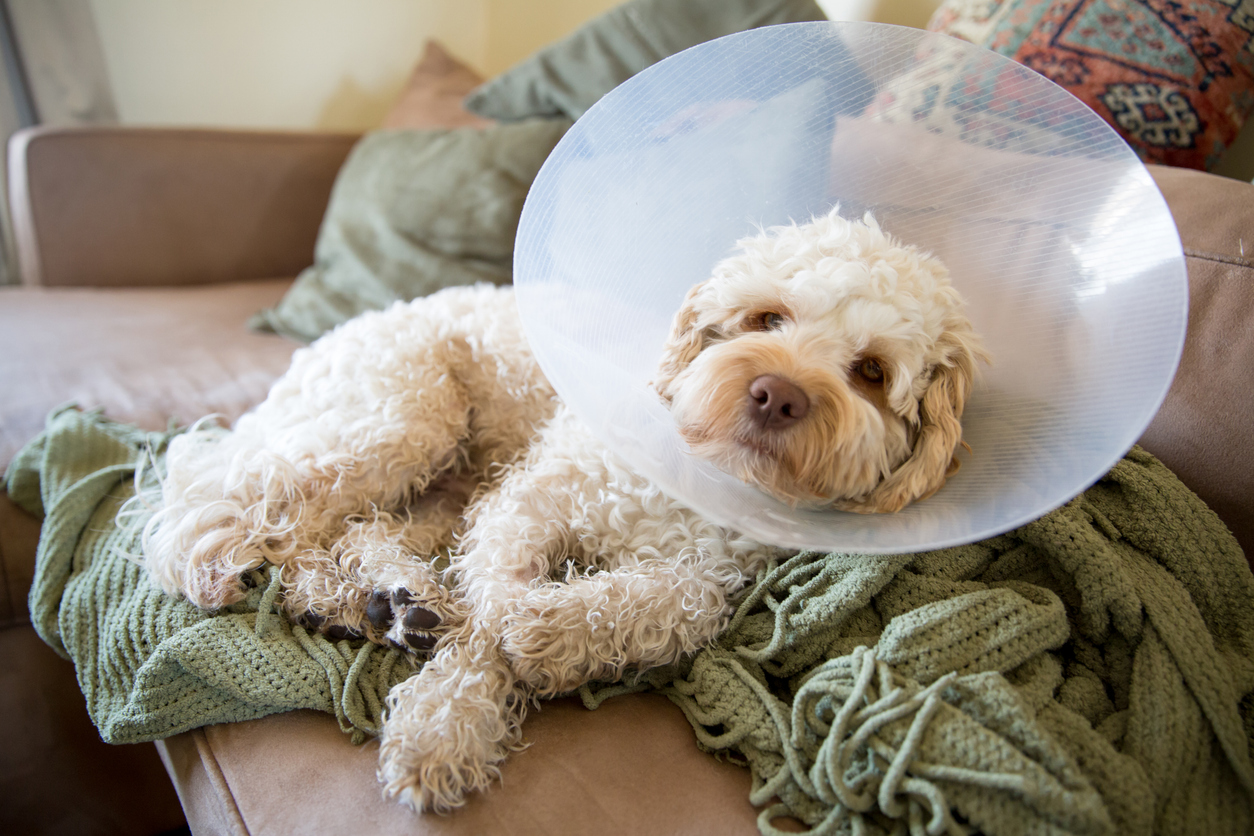
Recovery takes 10 to 14 days. The cone stays on the whole time to keep the dog from licking the incision. Pain medication, if you choose to add it, lasts 3 to 5 days.
Veterinary guidance on age has shifted over the past decade, especially for larger breeds.
For small and medium breeds, 4 to 6 months has been the recommendation for decades. Most dogs handle surgery well by this age.
For large breeds over 50 lbs, we still recommend 4 to 6 months. Some research, like a 2020 UC Davis study (Hart et al., Frontiers in Veterinary Science) on Golden Retrievers, has made the case for waiting longer in certain breeds. We cover that debate in when to spay or neuter a large or giant breed dog, and your primary vet can help with breed-specific timing.
We accept dogs between 4 months and 7 years for neutering, as long as they're healthy and meet the weight cutoff at the appointment. For females, we prefer to spay before the first heat, when the risk of mammary cancer is virtually zero.
Overhead pushes the price up. Corporate-owned general practices bundle several items into a single quote. That includes an exam fee ($60 to $130), pre-op bloodwork ($80 to $150), pain meds, a cone, IV fluids, and a post-op recheck.
The same surgery at a low-cost wellness clinic strips out the bundled items and lets you add what you need. One of our clients had a $1,582 quote from a family vet before deciding to drive to our clinic for the procedure. When private vets stack bundles together, owners can see quotes well above the $400 to $900 median.
A male dog over 60 lbs runs $260 to $600 at a low-cost clinic and $400 to $900 at a private practice. Pricing scales because anesthesia gets dosed by weight. Dogs over 100 lbs often get referred to a specialty hospital and may cost $500 to $1,500. Most low-cost clinics, including ours, don't accept dogs over 100 lbs because our standard anesthetic plan isn't built for that weight class.
Yes, by a small margin. Younger, smaller dogs need less anesthesia. The difference is $25 to $75. Forbes pricing data shows an average of $425 for dogs under six months and $496 for dogs over six months.
Cryptorchid surgery (one or both undescended testicles) costs 1.5x to 2x the standard neuter price because it requires an abdominal incision similar to a spay. At a low-cost clinic, expect $300 to $500 if the retained testicle can be felt under the skin. If it's internal, plan for a specialty referral with an abdominal ultrasound first, which can push the total cost to $800 to $1,500.
At some clinics, yes. At our clinic, both items are itemized and optional, and many TNR groups and budget-conscious owners decline them.
Our philosophy is to recommend and educate, then let you make the call. At most private practices, these items are bundled into the base price and not separable.
Most low-cost clinics decline several categories. That includes dogs with heart murmurs, seizure histories, active respiratory disease, or recent vomiting and diarrhea. They also decline dogs over 100 lbs, dogs in the four-month postpartum window, and aggressive dogs whose owners can't muzzle them.
Dogs with seizure history get declined for life because the anesthetic risk doesn't go away with medication. These cases get referred to full-service veterinarians.
No. Routine neuters aren't covered by base pet insurance, and wellness add-ons that do cover them cap reimbursement around $100. A low-cost clinic neuter at $170 to $260 is often cheaper than the annual cost of a wellness add-on. Insurance makes more sense for accident and illness coverage than for elective surgery pricing.
Get three quotes before booking. Call a low-cost spay/neuter clinic, a standard private vet, and your current vet. Ask each one for the all-in price including pain meds, cone, exam fee, and bloodwork. The spread will show you what you're paying for.
If you're in the Tracy, Manteca, Stockton, or Bay Area, we're at 1973 N. Tracy Blvd., Tracy, CA 95376. Our full pricing is published at thepetadvocatevet.com/prices-and-rates, and a $20 deposit secures your appointment slot.