Or call us at 209-879-9367 — we'll answer Mon–Fri, 8 AM to 4:30 PM.📍 1973 N. Tracy Blvd., Tracy, CA 95376
Schedule OnlineLast updated: July 2026
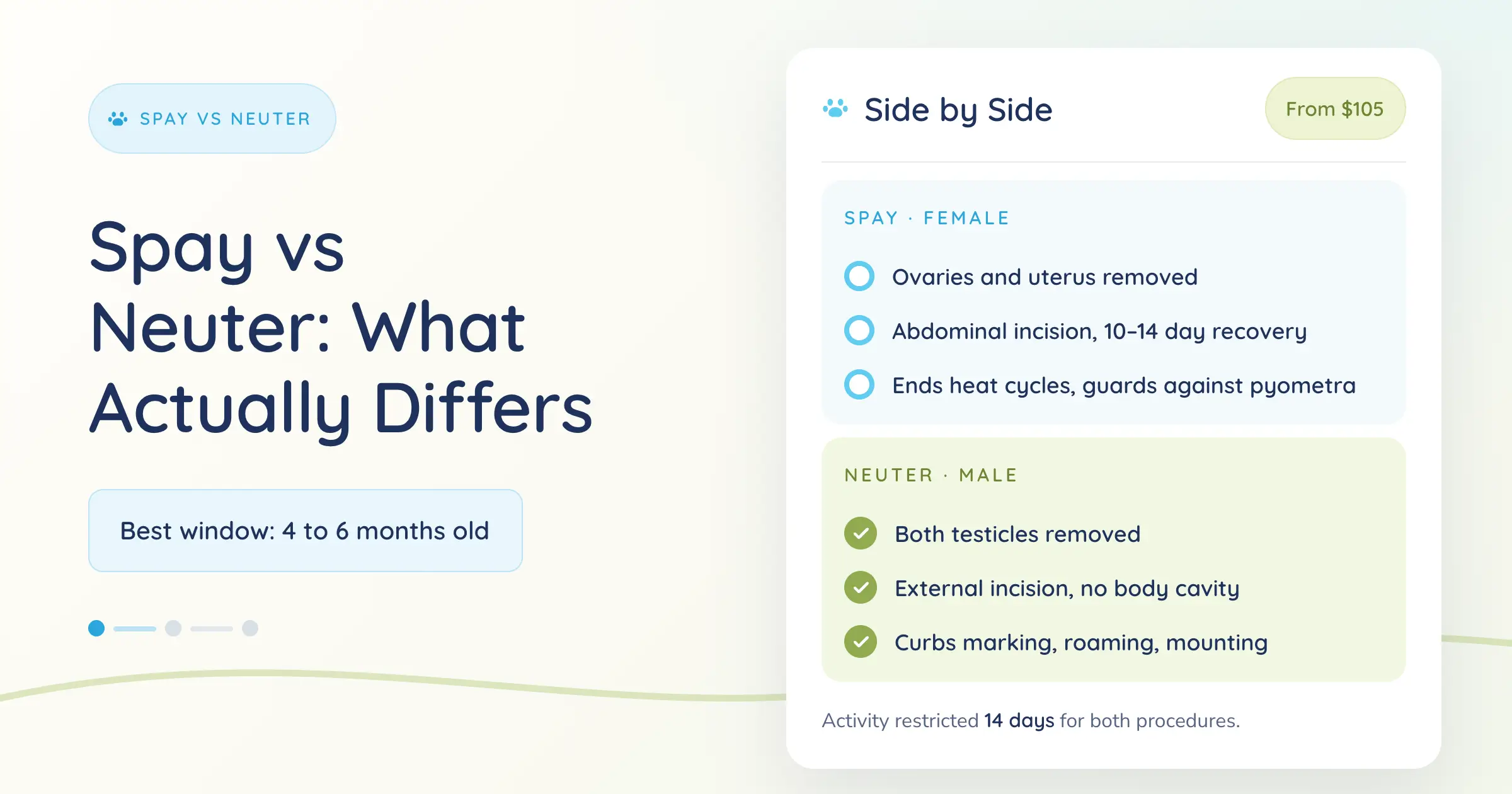
Owners often use “spay” and “neuter” as if they mean the same thing. They do not. One is performed on females. The other is performed on males. The surgical approach, recovery, and some of the benefits differ.
This guide comes from daily work at a high-volume low-cost clinic that performs these procedures every day. It covers the concrete differences, the timing that protects both health and population control, what recovery really looks like, and when a late procedure may or may not fix behavior.
Written from the daily practice of Dr. Michael Wesselink, DVM, and the team at The Pet Advocate in Tracy, California.
Both procedures sterilize the pet permanently and remove the main source of reproductive hormones. Both are performed under general anesthesia. You can review current options and schedule once you know which procedure your pet needs.
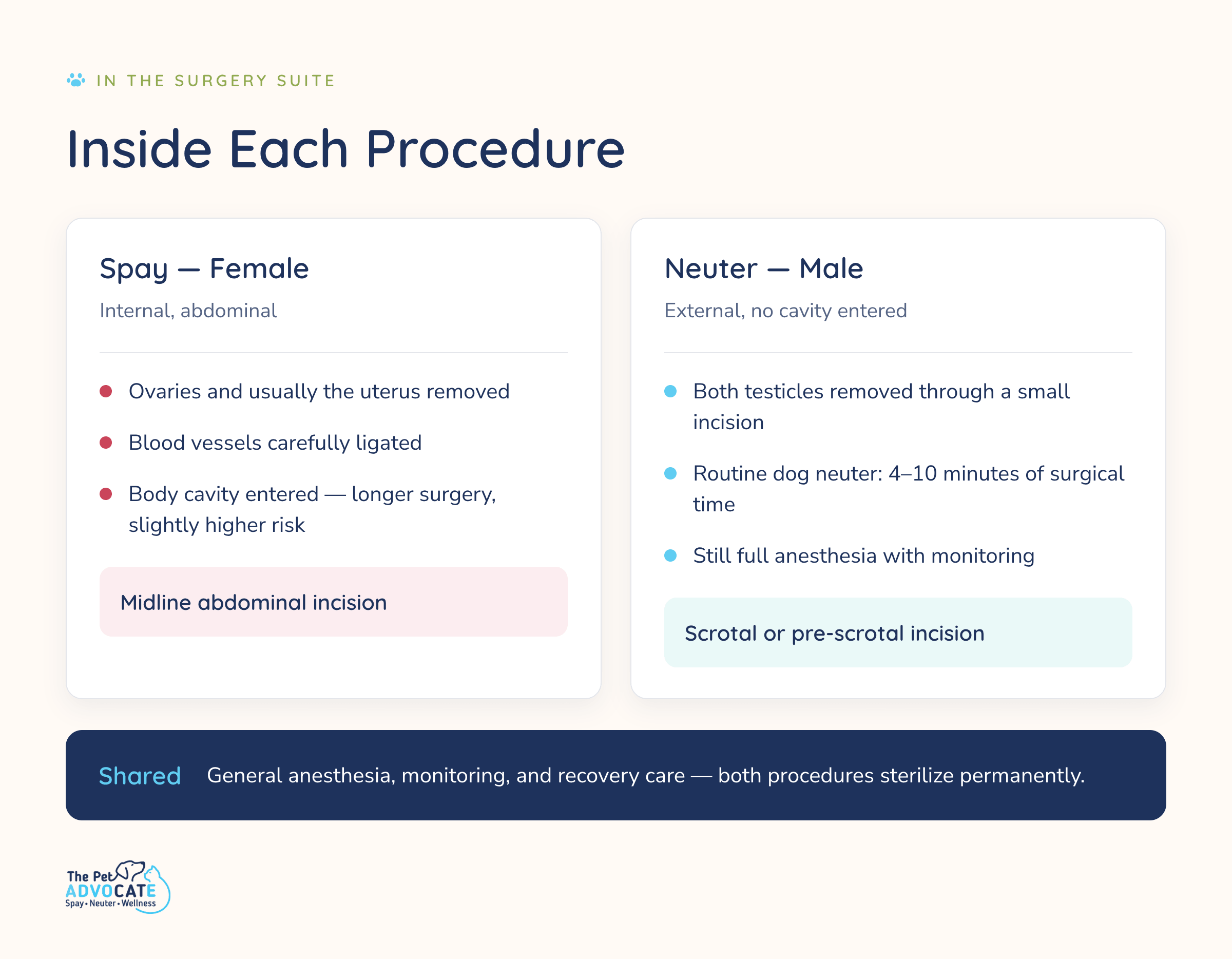
A spay requires an abdominal incision so the surgeon can locate and remove the ovaries and usually the uterus. Blood vessels are carefully ligated. Because the surgeon enters the body cavity, the procedure takes longer and carries a slightly higher risk profile than a neuter.
A neuter is external. The testicles are removed through a small incision near or on the scrotum. No body cavity is entered. A routine dog neuter often takes 4 to 10 minutes of surgical time. The pet is still under full anesthesia with monitoring, but the surgical portion is shorter and less invasive.
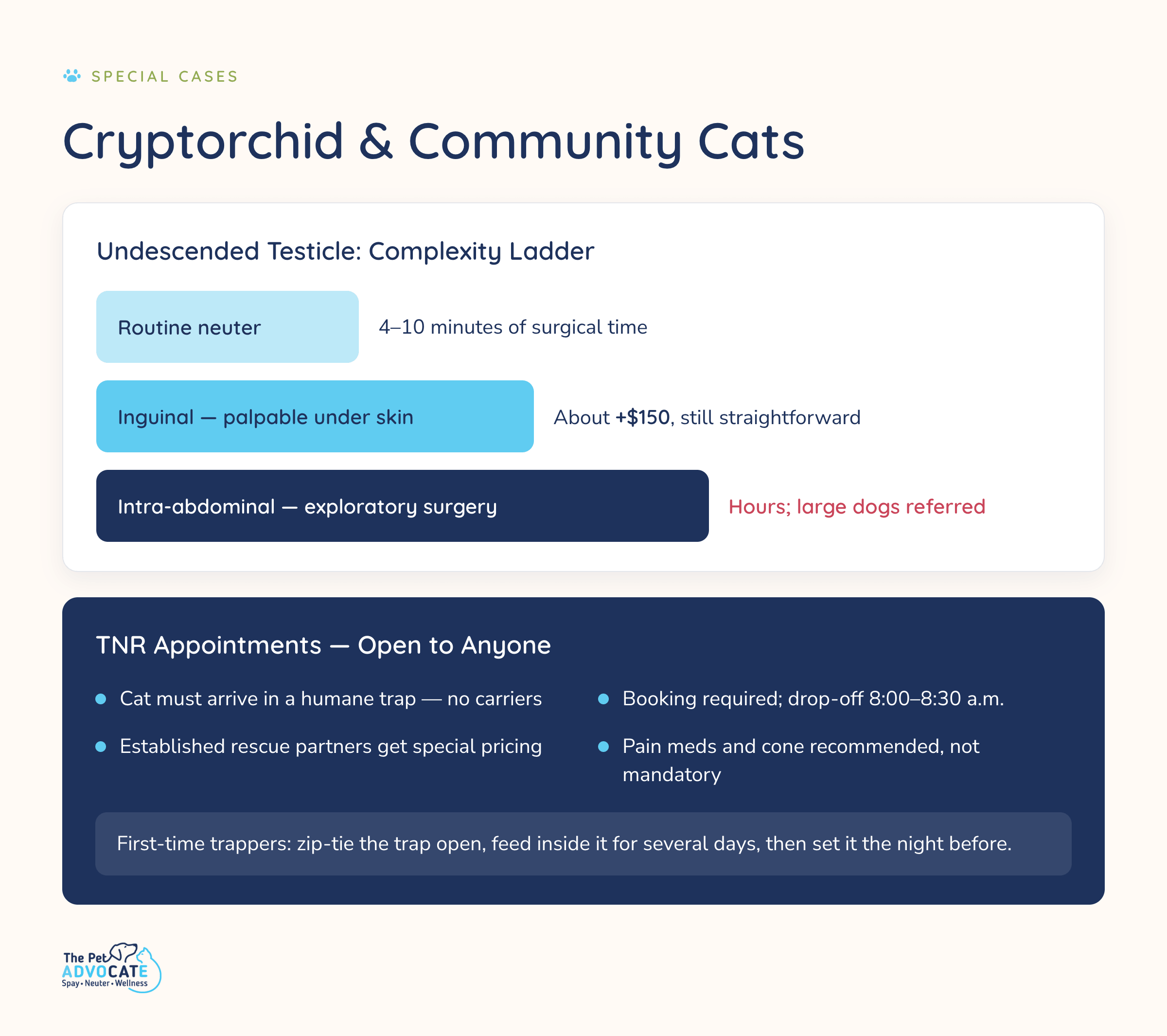
Cryptorchid cases (one or both testicles undescended) change the neuter. If the missing testicle is able to be felt under the skin (inguinal), the procedure adds roughly $150 and remains relatively straightforward. If it is intra-abdominal, the surgery becomes an exploratory and can take several hours. Larger dogs with an abdominal testicle are often referred for ultrasound and specialist care.
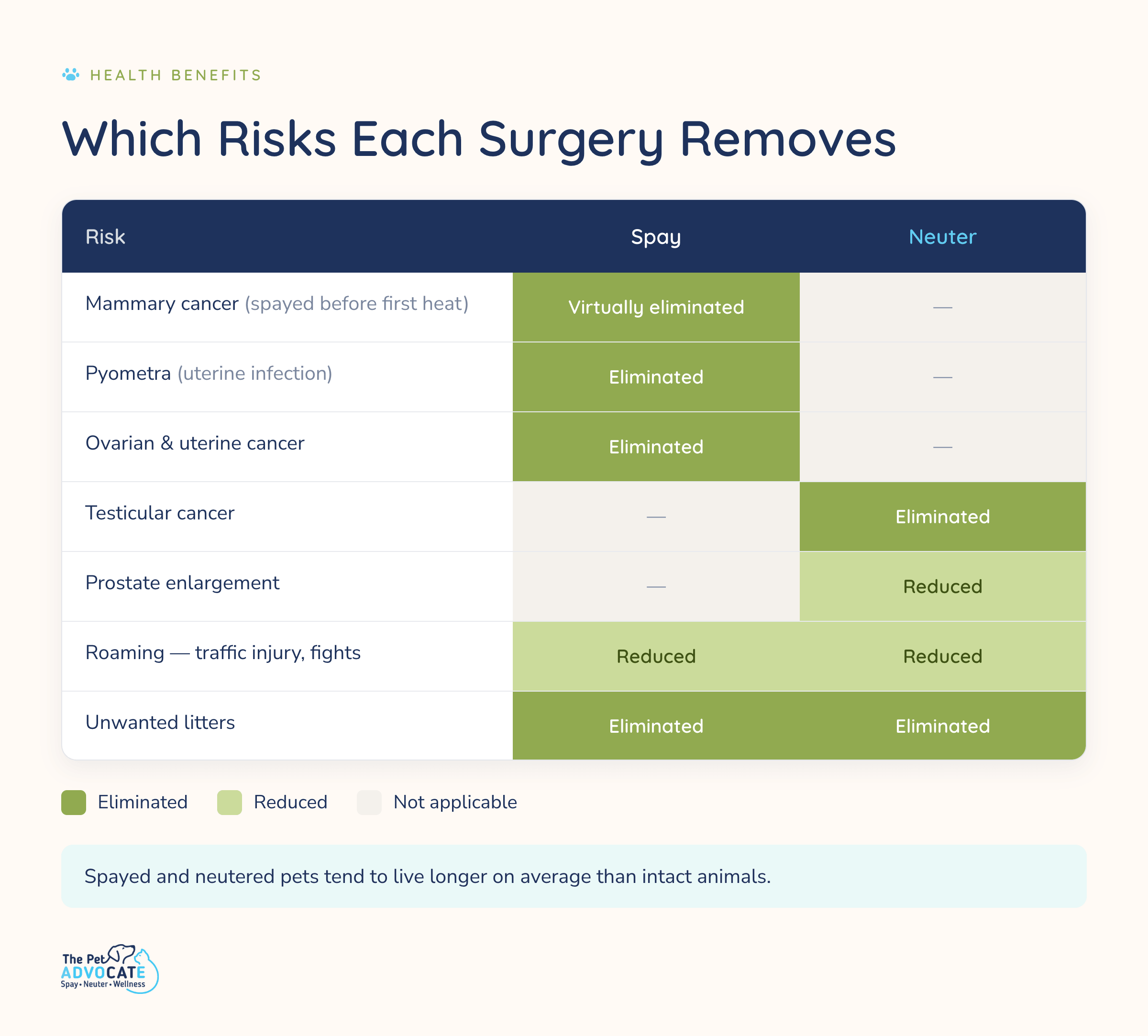
Spaying a female before her first heat cycle virtually eliminates the risk of mammary cancer and removes the risk of uterine infection (pyometra) and ovarian or uterine cancers. Pyometra is a life-threatening emergency that becomes more common as intact females age.
Neutering a male eliminates the risk of testicular cancer and reduces the likelihood of prostate enlargement and related problems later in life.
Both procedures reduce the drive to roam in search of mates. That lower roaming risk translates into fewer traffic injuries and fights. Studies show that spayed and neutered pets tend to live longer on average than intact animals. The American Veterinary Medical Association (AVMA) outlines these established health and behavioral benefits.
Our primary mission is preventing pet overpopulation. That reproductive goal sits alongside the individual health benefits.
Removing the ovaries stops heat cycles. Females no longer yowl, restlessly seek mates, or produce the associated discharge and odor.
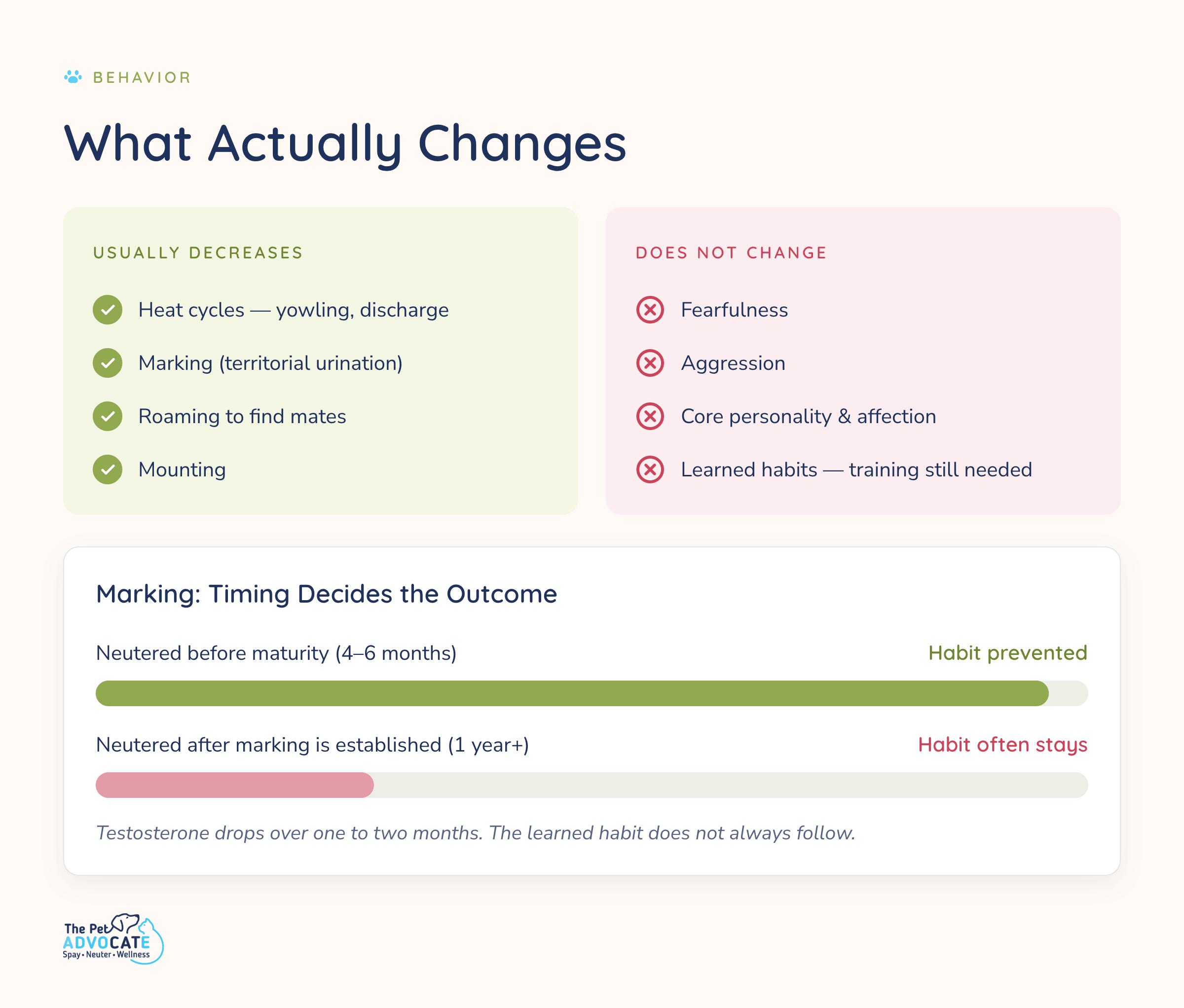
Removing the testicles reduces testosterone-driven behaviors. Marking (territorial urination), roaming, and mounting often decrease, especially when the procedure is done before those behaviors become established habits.
Timing matters for marking. I see this question often. When a dog is already a year old and marking regularly, neutering rarely eliminates the behavior completely. Testosterone drops over the next month or two and some improvement can appear, yet the habit itself often stays.
The reliable way to prevent marking is to neuter before the dog reaches sexual maturity, which we usually place at four to six months. The procedure does not turn a fearful dog into a confident one or an aggressive dog into a passive one. It targets hormone-driven behaviors. Training and socialization still matter.
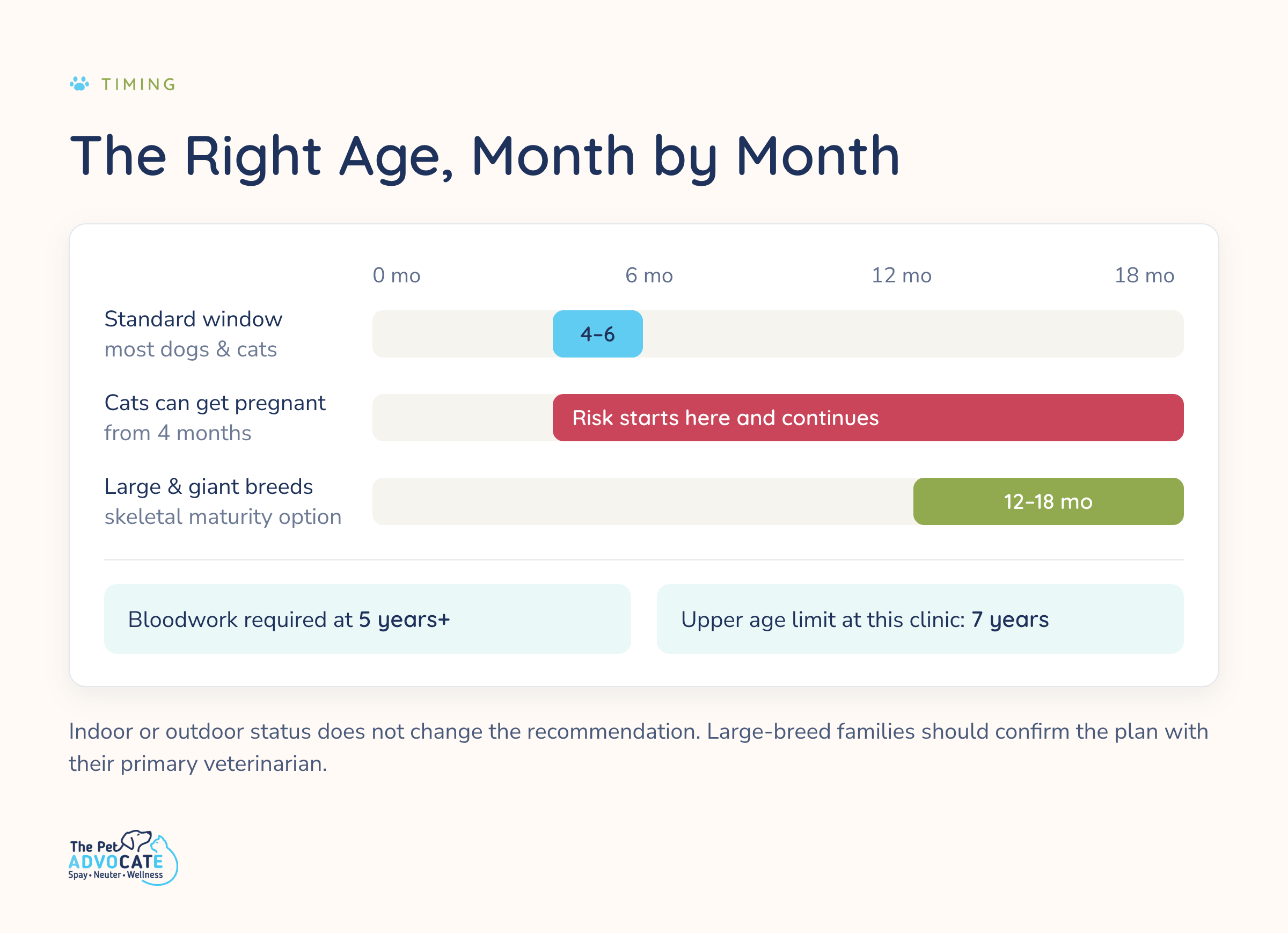
At our clinic we schedule most dogs and cats for spay or neuter between four and six months of age. That window prevents unwanted litters and, for females, lets us perform the surgery before the first heat. Doing so virtually eliminates the risk of mammary cancer later.
Our primary goal remains preventing pet overpopulation. Cats can become pregnant as early as four months, more commonly around six months in the right season. Indoor versus outdoor status does not change the recommendation. You can schedule the procedure online once your pet reaches the appropriate age.
Large and giant breeds such as Mastiffs, Saint Bernards, or Great Danes present a more nuanced conversation. Some research focused on joint health and certain cancer outcomes suggests waiting until skeletal maturity, around 12 to 18 months. Those studies answer a health-outcome question rather than the reproductive one.
When owners of these breeds ask about waiting, we acknowledge the studies and recommend they discuss the plan with their primary-care veterinarian. We still offer the procedure at the standard age for families who prioritize the reproductive and early cancer benefits.
Pets must be 7 years of age or younger for spay or neuter at this clinic. Pre-anesthetic bloodwork is required for any patient 5 years or older. Physical exam findings remain the most important factor; age alone is not treated as a disease.
Owners receive a phone call about two hours before pickup with their exact time. Discharge instructions are reviewed with a technician before the pet is brought out so attention stays on the instructions rather than the excited reunion.
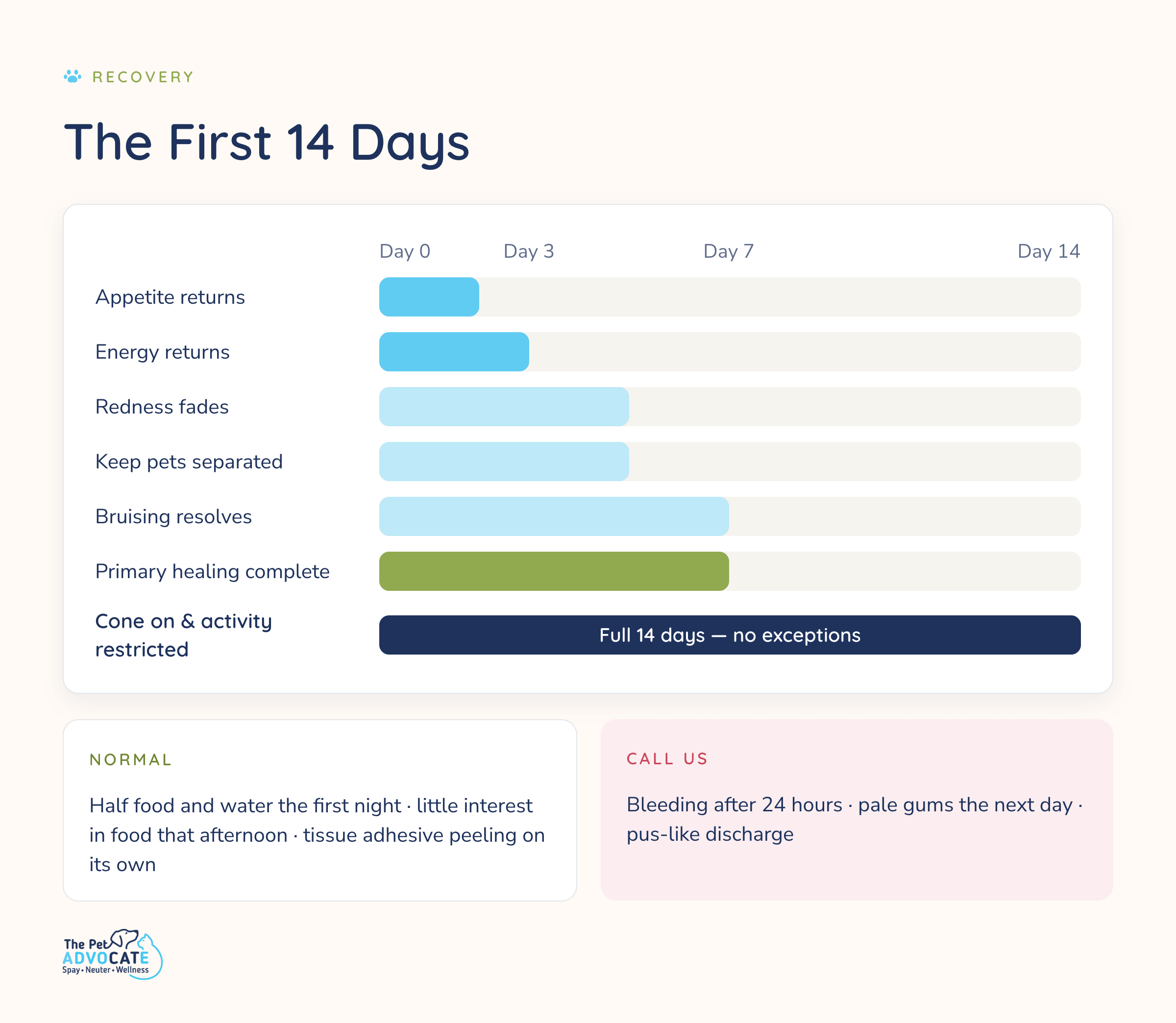
Activity is restricted for 14 days. Large mature male dogs often need longer restriction because they can develop scrotal swelling if they run or play too hard within the first two weeks. Keep the pet separated from other household animals for 3 to 5 days to prevent licking and extra activity.
The night of surgery we recommend half the usual amount of food and water. Many pets show little interest that afternoon. That is the call we receive most often and it is almost never an emergency.
Incision edges may look slightly red or swollen the day of and the day after surgery. Redness should fade within 3 to 5 days. Any bruising typically dissipates in 3 to 7 days. Tissue adhesive over the incision will begin to peel on its own; that is expected and not a problem.
Appetite usually returns the following day. Desire to be active returns by day 2 or 3. Primary healing is largely complete by day 7, yet the cone stays on the full 14 days as a precaution.
The most frequent actual complication is a female cat that gets the cone off (or has it removed) and licks the incision open. Cats have backward-facing barbs on the tongue that can damage tissue quickly.
The second most common issue is scrotal swelling in an overactive mature male dog.
True red flags that warrant a call include bleeding from the incision more than 24 hours after surgery, pale gum color the day after (possible internal bleeding), or any pus-like discharge from the incision. Our overall recheck rate for post-surgical complications sits under 1 percent. Full aftercare details are provided at pickup and outlined on our low-cost spay and neuter page.
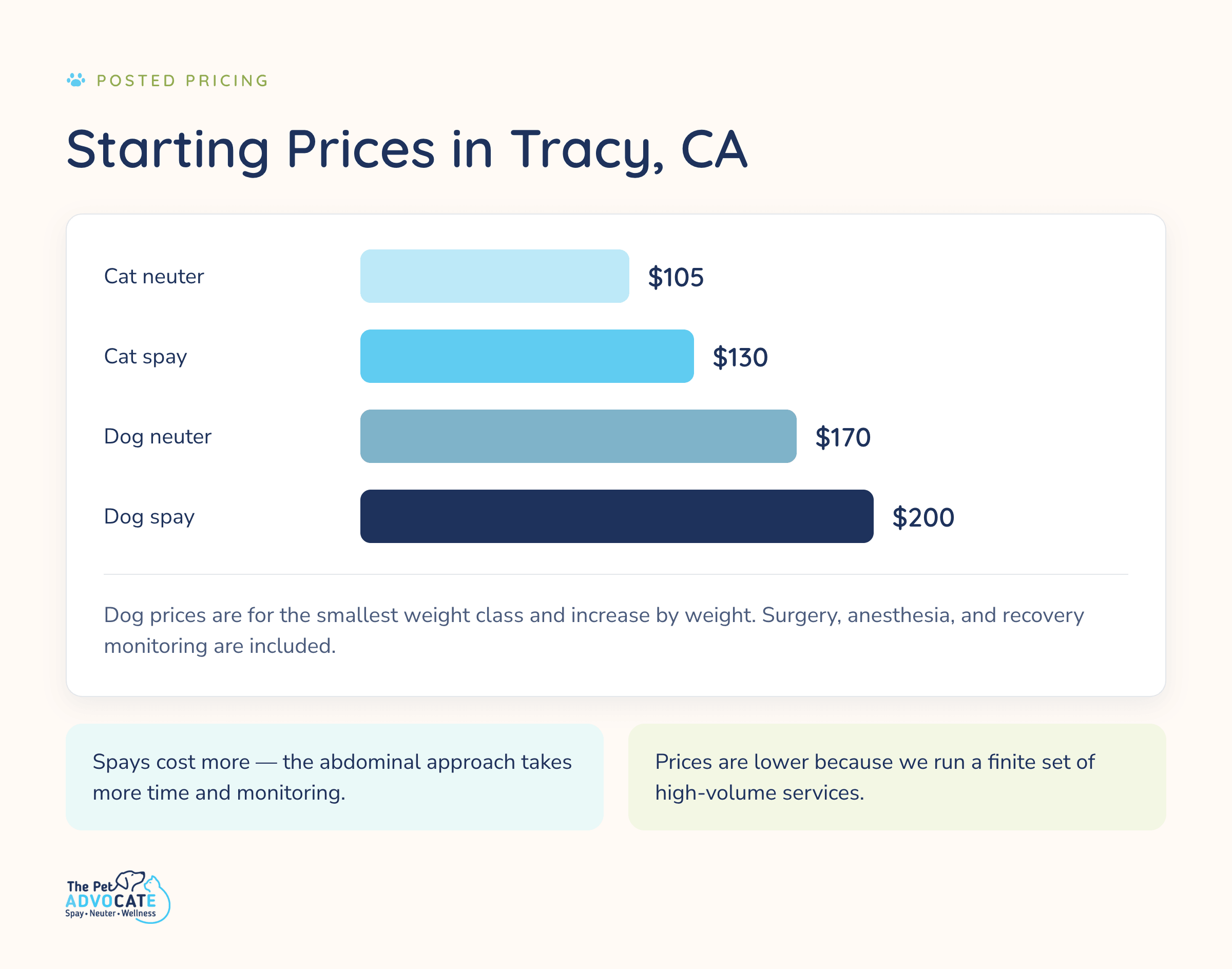
Spays cost more than neuters because the abdominal approach requires more time, skill, and monitoring. Larger dogs require more anesthetic drugs and longer handling, so dog pricing scales with weight.
At this clinic, cat neuters start at $105 and cat spays at $130. Dog neuters start at $170 and dog spays at $200 for the smallest weight class, then increase by weight. Prices include the surgery, anesthesia, and recovery monitoring.
Pain medication and an Elizabethan collar are available as optional add-ons. You can see the full current pricing on our prices and rates page.
We keep costs lower than full-service practices because we are organized around a finite set of high-volume services. We do not carry inventory for procedures we do not perform. Volume allows fixed costs to be spread across many patients.
The difference is how the business is structured, not the care the individual patient receives. Clients often tell us the same procedures in the Bay Area run three to four times higher.
Cryptorchid (undescended testicle) cases follow the pricing and time notes above. Abdominal cases in large dogs are often referred after an exam.
Trap-neuter-return (TNR) appointments are accepted from anyone. The cat must arrive in a humane trap; carriers are not accepted. Booking is still required. Drop-off runs 8:00–8:30 a.m.
Existing rescue organizations with an established relationship receive special pricing; individual caregivers and new groups pay the standard low-cost rate. First-time trappers are coached to zip-tie the trap open, feed inside it for several days, then set the trap the night before the appointment.
Pain medication and the cone are recommended but not mandatory. We educate and recommend, then respect the owner’s final decision. This approach is especially important for TNR groups working at scale to reduce community cat populations.
More details on scheduling, including for community cats, are on our low-cost spay and neuter page.
Spay is the surgical sterilization of a female pet and removes the ovaries and usually the uterus through an abdominal incision. Neuter is the surgical sterilization of a male pet and removes the testicles through a smaller external incision. Both prevent reproduction and reduce hormone-driven behaviors.
Most dogs and cats are scheduled at 4 to 6 months of age. This timing prevents heat cycles and unwanted litters and gives the strongest protection against mammary cancer in females. Large and giant breeds may warrant a conversation with the primary veterinarian about waiting for skeletal maturity while still balancing overpopulation and early-cancer goals.
If the dog has already started marking after sexual maturity, neutering often does not fully stop the behavior. Some improvement may appear after testosterone drops, but the habit frequently remains. Neutering before puberty (commonly 4 to 6 months) is the most reliable preventive approach.
Activity is restricted for 14 days for both procedures. Primary healing is usually solid by day 7, yet the cone stays on the full two weeks. Large mature male dogs often need extra activity restriction to avoid scrotal swelling. Appetite and energy typically return within 1–3 days.
Yes. The abdominal surgery of a spay requires more time and monitoring than the external neuter, so the fee is higher. Larger body weight also increases cost for dogs because more anesthetic drugs and handling are required.
Hormone-driven behaviors (heat cycles, marking, roaming, mounting) usually decrease. Core personality, affection level, and learned behaviors remain. Training and socialization still shape the adult animal.
Owners who want the clearest path forward schedule the procedure at 4 to 6 months for most pets, keep the cone on the full recovery window, and use the normal-versus-red-flag list above. Transparent pricing and same-day service make the decision practical for families across the Central Valley and East Bay.
Book online or call to reserve a spot. Bring any prior medical records. The team walks through discharge instructions before the pet is returned so every owner leaves with a clear plan.
You can schedule your appointment directly, or review the full low-cost spay and neuter options first. If you are planning the first year for a new puppy or kitten, our first-year checklists cover the full medical timeline that includes the ideal window for these procedures.