Or call us at 209-879-9367 — we'll answer Mon–Fri, 8 AM to 4:30 PM.📍 1973 N. Tracy Blvd., Tracy, CA 95376
Schedule OnlineUpdated August 2026 by Dr. Michael Wesselink, DVM
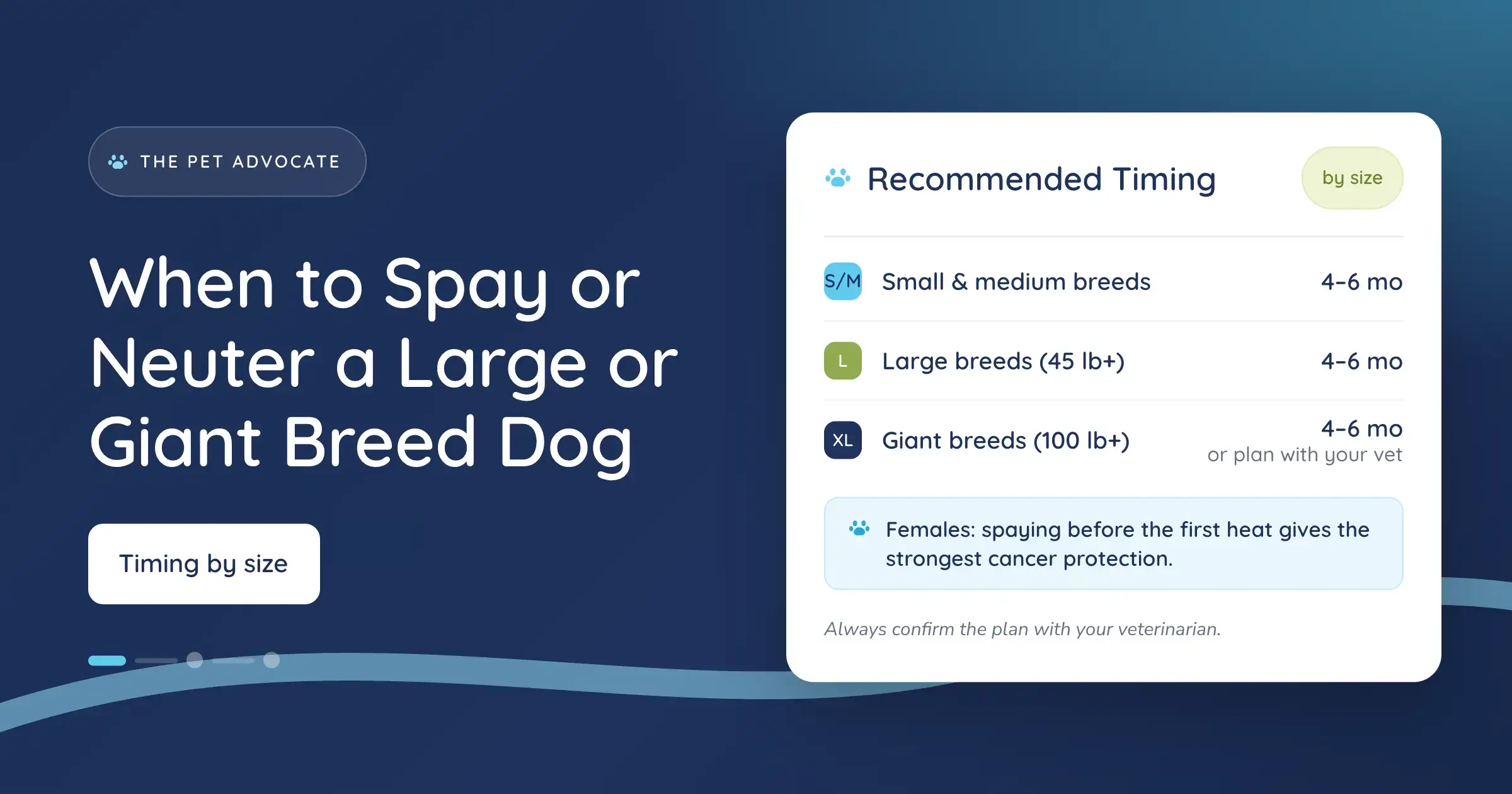
Owners of large and giant breed puppies often hear two different recommendations. One is the traditional four-to-six-month timing that prevents unplanned litters and protects against mammary cancer. The other is the newer research that points toward waiting until growth plates close, sometimes as late as eighteen to twenty-four months.
Both sides have data behind them. At The Pet Advocate we perform these surgeries every day in a high-volume setting. Our recommendation for large dogs is still four to six months. This article explains why, what the studies actually measure, and when we send a worried giant-breed owner back to their primary veterinarian.
The Pet Advocate recommends spay or neuter at four to six months for large dogs, not only for small and medium breeds. That timing virtually eliminates mammary and uterine cancer risk in females and prevents unplanned litters.
UC Davis research and the 2019 AAHA Canine Life Stage Guidelines look at a different set of outcomes. Those sources associate early gonadectomy in some large and giant breeds with higher rates of certain joint disorders and cancers. AAHA often places large-breed males after growth stops (commonly nine to fifteen months) and gives large-breed females a five-to-fifteen-month clinical window. Some primary veterinarians wait until eighteen to twenty-four months in giant breeds.
We do not recommend that later window as clinic policy. The studies optimize for long-term health outcomes. Our work is built around reproductive outcomes: stopping unplanned litters and removing mammary-cancer risk before the first heat. Waiting does not make the surgery itself harder. It does allow heat cycles, and each one raises a female’s mammary-cancer risk.
If you own a Mastiff, Great Dane, Saint Bernard, or similar giant breed and you are specifically worried about the orthopedic or cancer literature, talk with your primary-care veterinarian and form a plan there. We will not override that conversation.
Once timing is decided, families can use our low-cost spay and neuter services.
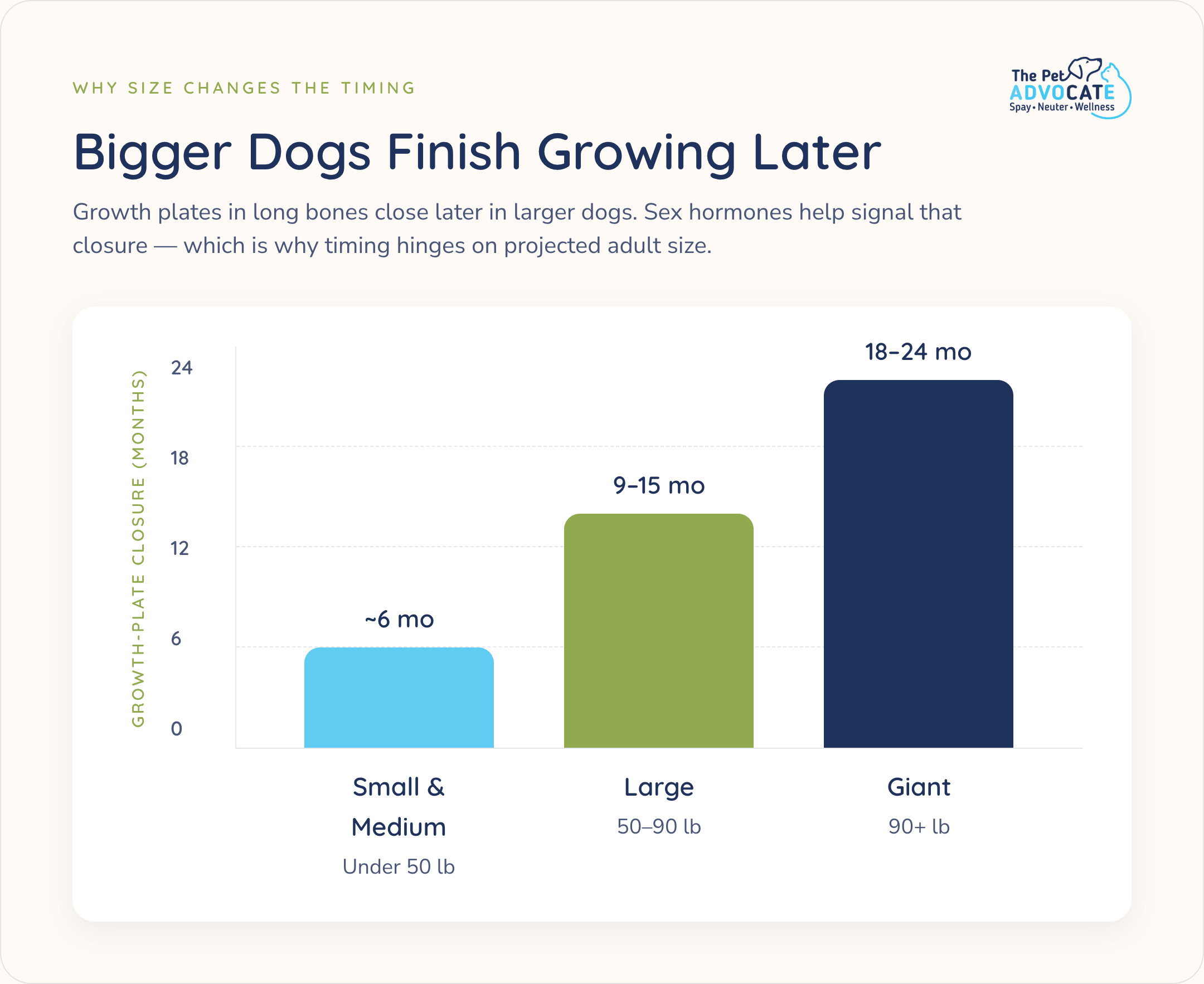
Size changes the timing conversation because growth plates in long bones close later in larger dogs. Sex hormones help signal that closure. Removing the gonads before the plates close can allow slightly longer bone growth and altered joint angles. That mechanism is linked to higher rates of hip dysplasia and cranial cruciate ligament tears in many large breeds.
Giant breeds (projected adult weight over roughly ninety to one hundred pounds) have the longest growth windows. Their plates may not close until eighteen to twenty-four months.
Small and medium breeds mature earlier and show little to no increase in these orthopedic risks with traditional six-month timing. The published debate therefore centers on dogs that will weigh fifty pounds or more as adults. At The Pet Advocate that debate does not change our default recommendation. We still schedule large dogs at four to six months unless a giant-breed owner has already made a different plan with their primary veterinarian.
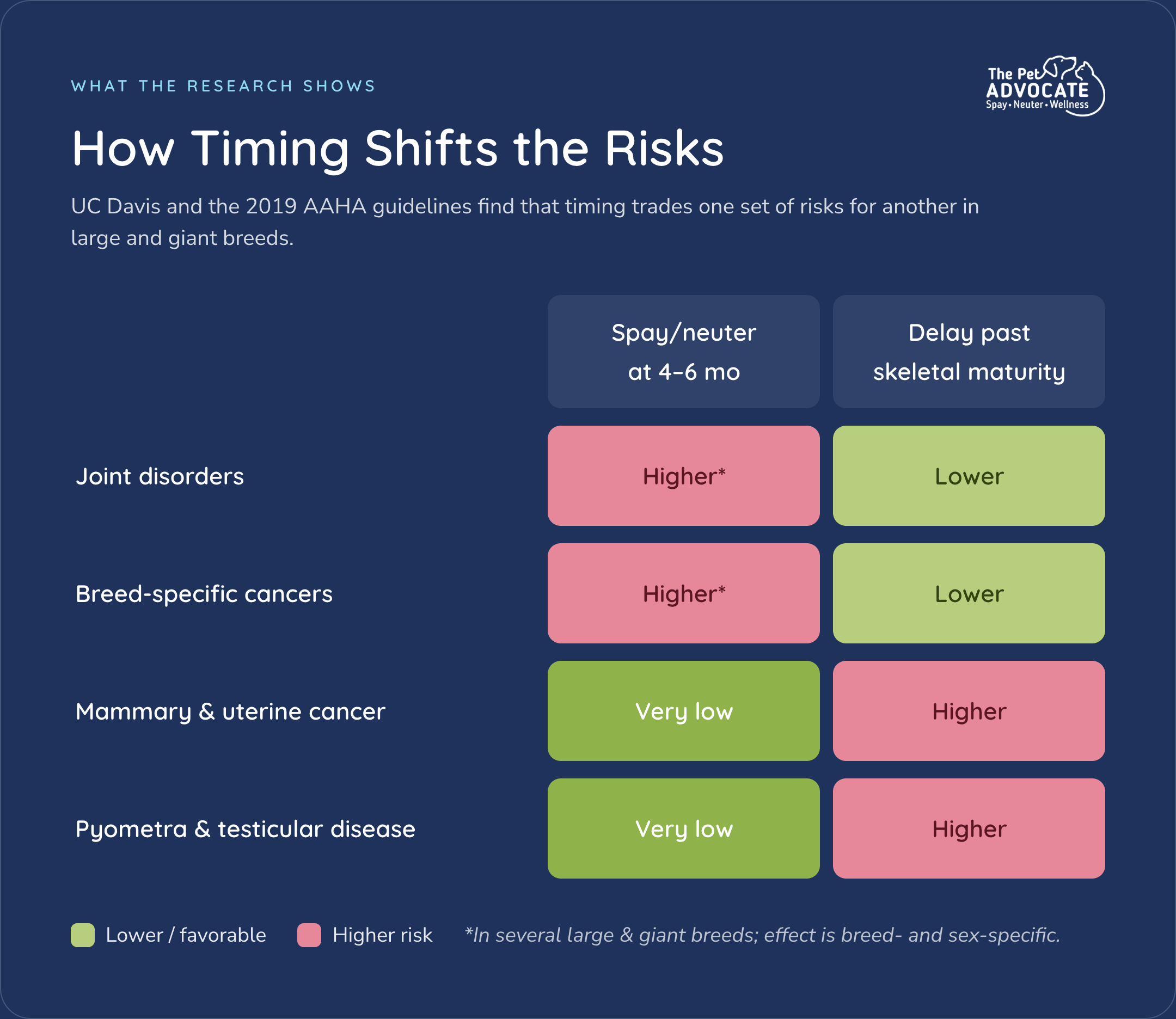
UC Davis researchers have tracked thousands of dogs across more than forty breeds. Early gonadectomy (before twelve months in most analyses) is associated with elevated joint disorders. In several large breeds it is also linked to higher rates of lymphoma, hemangiosarcoma, osteosarcoma, and mast-cell tumors. Golden Retrievers provide some of the clearest data. You can review the UC Davis summary of the updated guidelines.
The 2019 AAHA Canine Life Stage Guidelines align with this pattern. For dogs projected to weigh forty-five pounds or more, males are often recommended after growth stops, commonly nine to fifteen months. Females receive a five-to-fifteen-month window that balances mammary-cancer protection against orthopedic disease, incontinence, and other cancer risks. Clinical discretion is explicit.
The AVMA emphasizes that there is no single recommendation appropriate for every dog and that the decision should be individualized by breed, sex, and lifestyle.
These studies optimize for long-term health outcomes. They do not primarily measure reproductive outcomes such as unplanned litters or the near-elimination of mammary cancer achieved by spaying before the first heat. Both sets of outcomes matter. They simply answer different questions.
The Pet Advocate is organized around the reproductive question, which is why our timing advice stays at four to six months.
We published a broader timing overview that places these findings in daily high-volume practice: When to Spay or Neuter Your Dog.
Benefits of earlier timing (four to six months or before first heat)
What the later-timing research is aiming at
Costs of delay that owners often under-estimate
That last cost is the one we weigh most at The Pet Advocate. Mammary-cancer risk is virtually zero before the first heat and goes up after each cycle. Waiting does not make the surgery harder. Past the first heat the uterus is larger, which can make it easier to find in a big dog, and it does not change whether we can do the procedure. A large adult dog is still harder to keep quiet during recovery, so activity restriction takes more effort at home.
Our primary goal remains preventing pet overpopulation. We do not recommend waiting as the default for a large dog. When an owner of a giant breed raises the orthopedic literature and wants a later date, we defer that timing decision to their primary-care veterinarian rather than arguing them out of it. You can review our current low-cost pricing while you decide.

The research case for delay is stronger in males. Testosterone supports growth-plate closure and muscle development, which is why some primary veterinarians hold large-breed males until twelve to eighteen months, or eighteen to twenty-four months for giants.
Females face a tighter trade-off. Each heat cycle raises lifetime mammary-cancer risk. Spaying before the first heat remains the strongest protective factor against mammary tumors. That is a large part of why The Pet Advocate keeps the four-to-six-month recommendation for large-breed females instead of asking owners to manage a heat cycle first.
Marking and roaming are the behaviors we discuss most often with owners of intact males at The Pet Advocate. Early neutering prevents those habits from setting in for many dogs. Once the behaviors are established, surgery may reduce them but does not always eliminate them. You can read more about that distinction in our article on whether neutering calms a dog.

Every conversation here starts with the same baseline. Four to six months is what we recommend for large dogs. It aligns with our mission to reduce unplanned litters and with the mammary-cancer protection of spaying before the first heat.
If the dog is a giant breed (Mastiff, Saint Bernard, Great Dane, or similar) and the owner is specifically concerned about the joint and cancer literature, we walk through what those studies measure and what they leave out. We then recommend the owner form a plan with their primary-care veterinarian.
We still perform the surgery for large and giant breeds that arrive within our age window (seven years and under), including dogs whose primary veterinarian has already set a later date. Pre-anesthetic bloodwork is required for any dog five years or older. Physical examination remains the most important safety screen.
Families traveling from Tracy, Lathrop, Manteca, Antioch, or Brentwood can schedule an appointment at four to six months, or later if that is the plan already set with their primary veterinarian. Our spay and neuter services remain available for dogs that fall within those age and health guidelines.
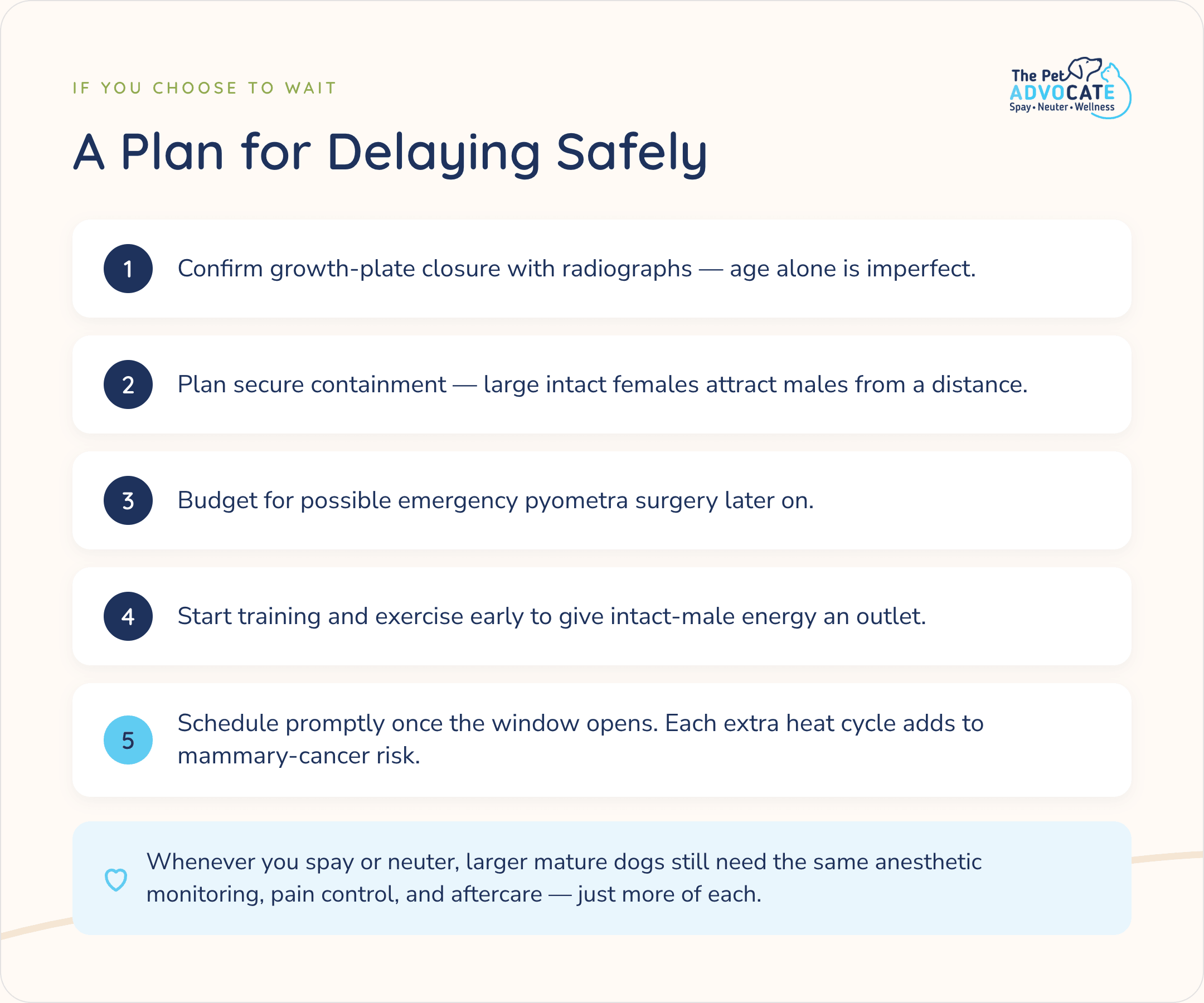
Some giant-breed owners will still choose a later date after talking with their primary veterinarian. If that is your plan, confirm growth-plate closure with radiographs if your veterinarian offers that option. Age alone is an imperfect proxy.
Plan secure containment for heat cycles. Large intact females attract males from a distance. Budget for possible emergency surgery if pyometra develops later.
Address training and exercise needs early so intact-male energy has an outlet. Schedule the procedure promptly once the agreed window opens. Each extra heat cycle adds to a female’s mammary-cancer risk.
Owners who wait still need the same anesthetic monitoring, pain control, and aftercare that every patient receives at The Pet Advocate. A one-hundred-pound dog simply requires more of each than a forty-pound dog, which is why early activity restriction matters so much. You can review current pricing and schedule the appointment once timing is settled. Our what to expect page walks through the day-of process and first-night recovery.
At The Pet Advocate the recommendation is four to six months, including for large breeds. Some studies and some primary veterinarians delay large breeds until nine to fifteen months, and giant breeds until eighteen to twenty-four months, to reduce joint-disorder risk. That is their health-outcome framing. Ours is reproductive: prevent litters and protect against mammary cancer. If you own a giant breed and those studies worry you, form the plan with your primary veterinarian. We can still perform the procedure once that plan is set and the dog is within our age and health guidelines.
UC Davis data show elevated rates of certain cancers (lymphoma, hemangiosarcoma, osteosarcoma, mast-cell tumors) in several large breeds when gonadectomy occurs before twelve months. The effect is breed- and sex-specific, not universal. Mammary-cancer risk in females, by contrast, rises with each heat cycle that occurs before spay. That contrast is why The Pet Advocate keeps four-to-six-month timing for large dogs and only defers when a giant-breed owner wants the health-literature path handled by their primary veterinarian.
Yes. The mammary-cancer benefit is strongest before the first heat but remains meaningful after one cycle. At The Pet Advocate we usually book that spay about one month after her heat ends. Discuss that window with your primary veterinarian if you are choosing to wait. We will still do the procedure at The Pet Advocate if the dog is within our age and health guidelines.
No. Waiting does not make the spay or neuter harder or riskier, and it does not change whether we can do it. Past the first heat the uterus is larger, which can make it easier to find in a big dog. We still prefer four to six months because waiting brings heat cycles, the chance of an accidental litter, and a mammary-cancer risk that is virtually zero before the first heat and rises after it.
Estimate adult weight from the parents or from growth charts at four to five months. The Pet Advocate still recommends four to six months for mixed-breed puppies. If the projected adult weight is in giant-breed range and you want the later-timing literature applied, take that question to your primary veterinarian. We use projected adult size the same way when we are advising mixed-breed owners here.
If you are following our recommendation, schedule the procedure at four to six months. If you own a giant breed and you want the later-timing research applied to your individual dog, make that plan with your primary-care veterinarian first. Once timing is set either way, The Pet Advocate can perform the procedure within our standard age and health guidelines (seven years and under, with pre-anesthetic bloodwork required at five years or older).
You can schedule a low-cost spay or neuter or review current pricing. For recovery expectations after the procedure, see our what to expect guidance. Owners of younger puppies will also find the new puppy checklist useful for the full first-year timeline. We serve families driving from Tracy, Lathrop, Manteca, Antioch, Brentwood, and the surrounding Central Valley and Bay Area communities. Full details are available under areas we serve.
If you are still comparing the two procedures themselves, our spay vs neuter overview covers the surgical differences and recovery details. Our low-cost spay and neuter services are ready when you are.