
Or call us at 209-879-9367 — we'll answer Mon–Fri, 8 AM to 4:30 PM.📍 1973 N. Tracy Blvd., Tracy, CA 95376
Schedule OnlineUpdated August 2026
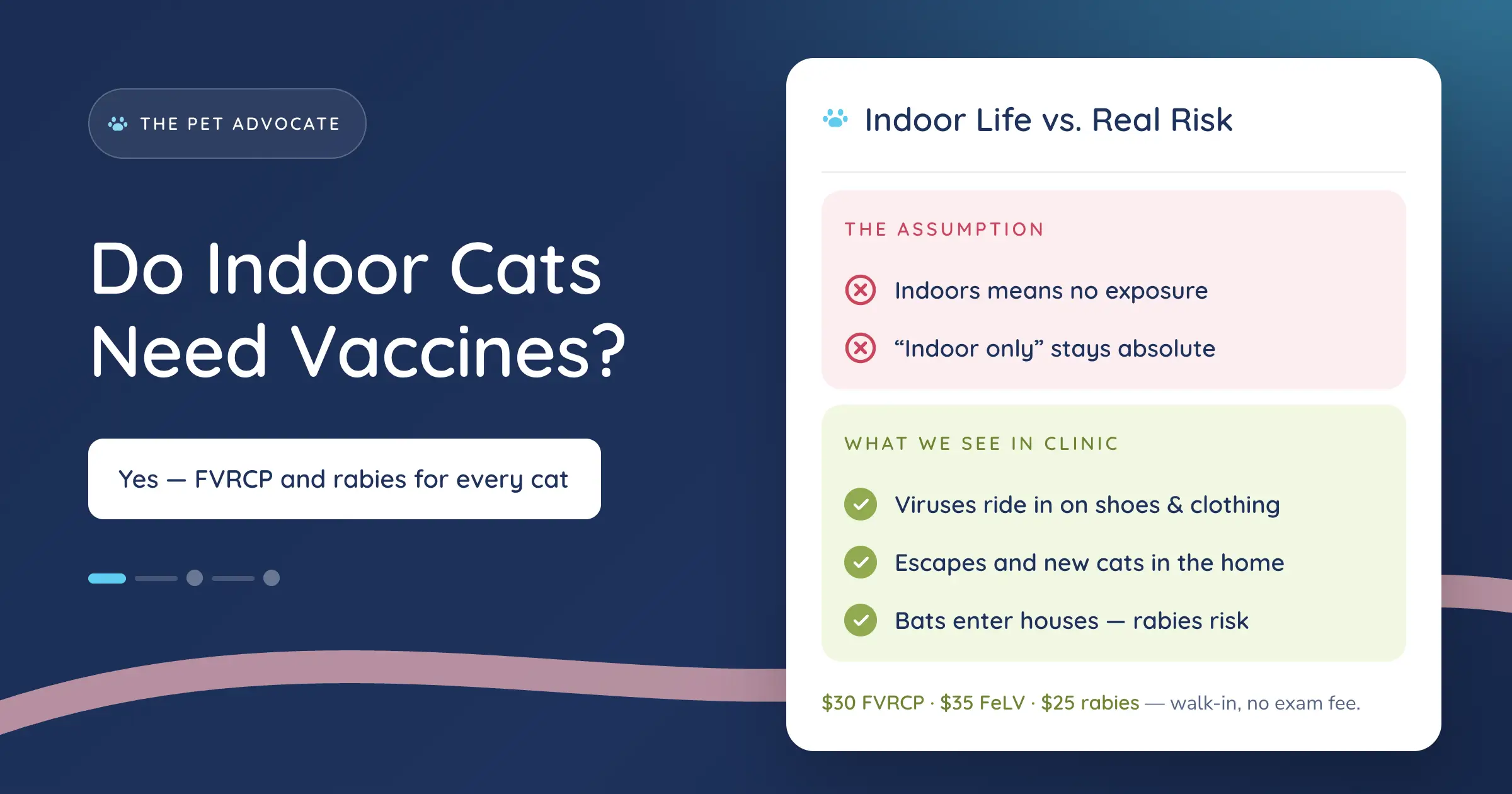
Yes. Indoor cats still need core vaccines. At The Pet Advocate Vet we see diseases reach indoor cats through shoes, clothing, open doors, and the occasional bat that enters a house. The FVRCP combination and rabies vaccine protect against those risks. FeLV is recommended for all kittens and for adult cats with any exposure risk.
This guide covers the real risks, the exact vaccines we recommend at The Pet Advocate, the schedule we use for kittens and adults, California rules, and what the shots cost with no exam fee on our pet vaccinations page.
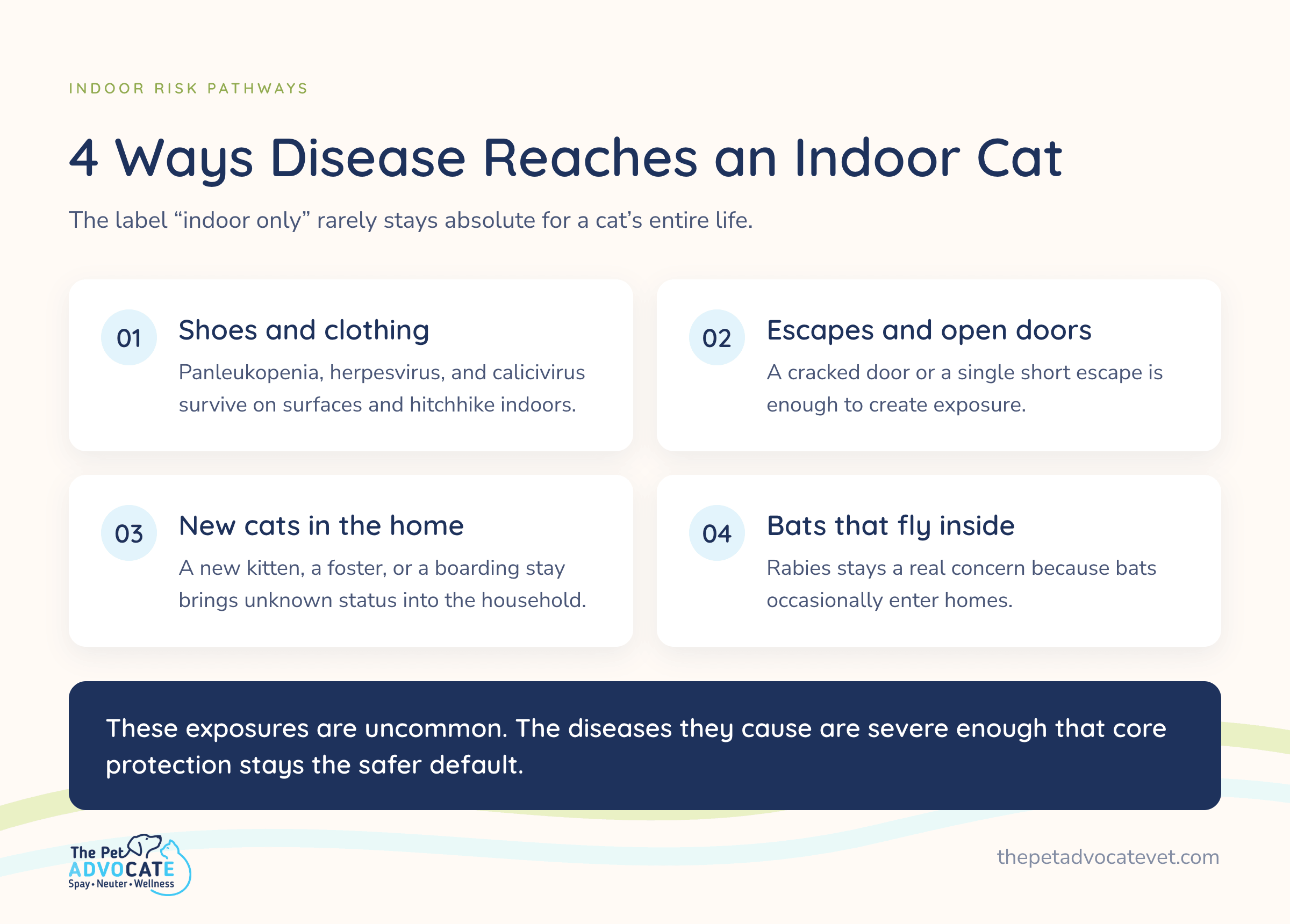
Many owners assume an indoor life removes every disease risk. In practice at The Pet Advocate Vet we see indoor cats that escape through a cracked door, meet a new kitten brought into the household, or pick up upper-respiratory viruses that hitchhike on clothing.
Feline panleukopenia, herpesvirus, and calicivirus survive on surfaces and can be carried indoors. Rabies remains a concern because bats occasionally enter homes. These exposures are uncommon, yet the diseases they cause are severe enough that core protection stays the safer default.
We see this pattern often with multi-cat households and cats that started life outdoors or in rescue. The label “indoor only” rarely stays absolute for the entire life of the pet. Even a short escape or a single boarding stay can create risk that the vaccines are designed to cover. In our high-volume clinic in Tracy we talk with owners every day who are surprised their “strictly indoor” cat still faces these pathways. That is why we treat core vaccines as standard for nearly every cat that comes through our doors.
The FVRCP vaccine covers feline viral rhinotracheitis (herpesvirus), calicivirus, and panleukopenia. These three viruses spread easily on surfaces and clothing and can cause serious respiratory or gastrointestinal disease. Because those pathways still reach indoor cats, at The Pet Advocate Vet we give FVRCP to every cat, indoor or outdoor.
The combination is given as a series in kittens and then as periodic boosters in adults. For low-risk indoor adults the booster interval is typically every three years after the first-year booster. Full details on the kitten series appear in our new kitten checklist.
Rabies is almost always fatal once symptoms appear and can pass to people. Even a strictly indoor cat can encounter a bat that flies into the house. At The Pet Advocate Vet we recommend the rabies vaccine for all cats for that reason.
The first dose is given at about four months of age and lasts one year. Subsequent doses can last three years when the previous vaccine remains current. See our full rabies vaccine for cats page for more detail on timing and California rules.
Feline leukemia virus spreads through close contact—grooming, shared bowls, or bite wounds. According to the 2020 AAHA/AAFP Feline Vaccination Guidelines, FeLV is listed as core for every kitten under one year because lifestyle can change. These guidelines remain the current standard used by most feline practitioners. For adult cats that live alone or only with known FeLV-negative housemates and never go outside, the ongoing risk is low and boosters may not be needed.
At The Pet Advocate Vet we still discuss FeLV with every owner and recommend the series for all kittens. Many of the cats we see that owners describe as indoor-only still share homes with other cats or have occasional outdoor access. In those households the protection is worth the extra step.
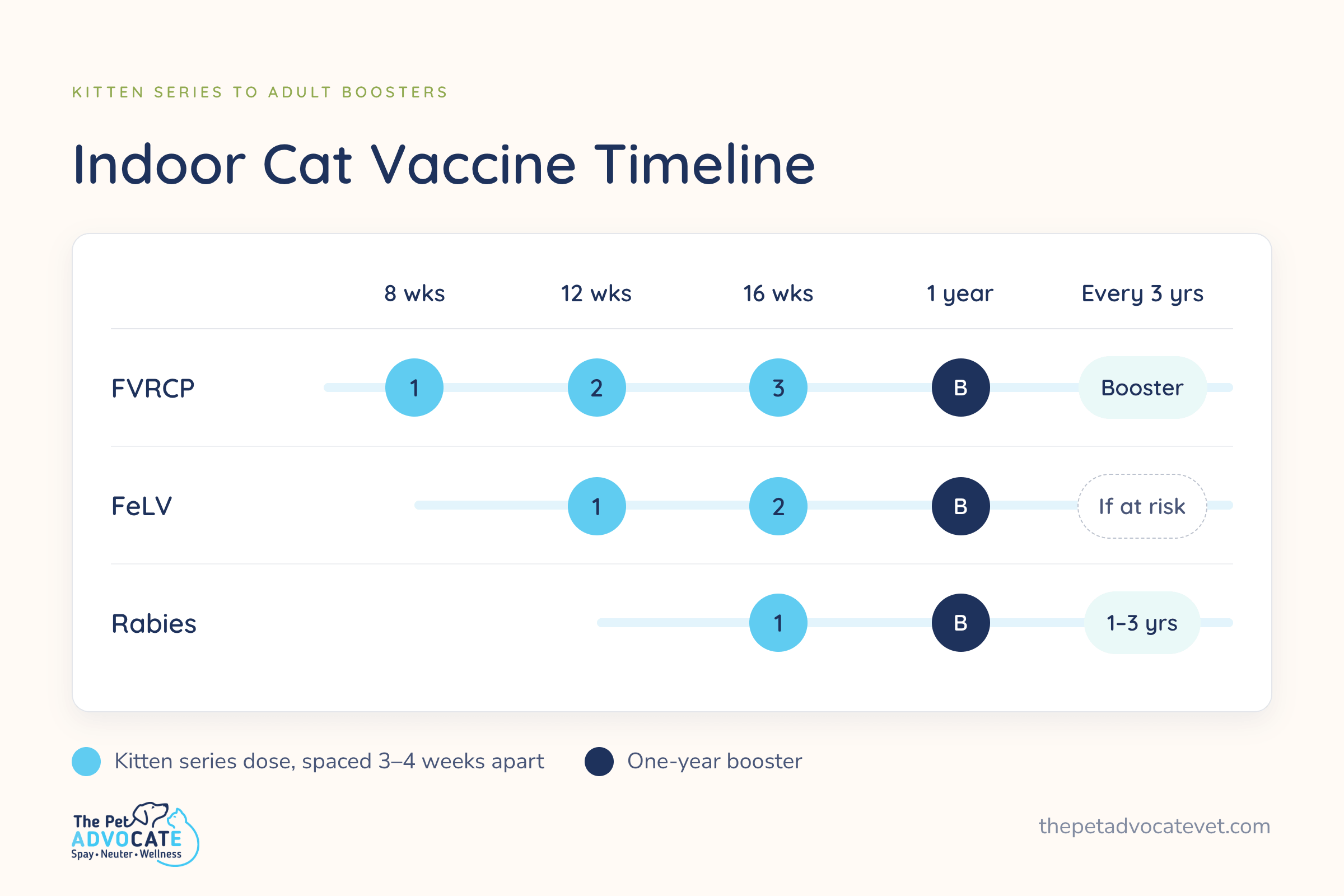
Kittens start around 8 weeks of age. At The Pet Advocate Vet we space doses 3–4 weeks apart and finish the series after 4 months of age. That final vaccination is usually the one that creates the solid, lasting response once the antibodies the kitten received from its mother have faded.
Adult cats that completed the kitten series receive a booster one year later. After that, FVRCP is typically given every three years for low-risk indoor adults. Rabies follows the product label—often every three years after the first annual booster. FeLV continues only when exposure risk remains.
We prefer pets to be fully vaccinated before spay or neuter, though we do not require it. Completing the series first makes recovery simpler for the cat and gives the owner one less variable to manage. For the complete first-year timeline that includes vaccines, deworming, and surgery timing, see our new kitten checklist.
California state law requires rabies vaccination only for dogs. Cats are not required by statewide statute. Some cities and counties have local ordinances, so owners should confirm their own jurisdiction. The California Department of Public Health confirms there is no statewide requirement for cats while still recommending vaccination for all cats.
At The Pet Advocate Vet we still recommend the rabies vaccine for every cat, indoor or outdoor, because of the public-health risk and the possibility of unexpected exposure. The first dose lasts one year; subsequent doses can last three years when given on schedule.
In the Tracy and Central Valley areas we serve, the recommendation remains the same as the statewide AAFP and AVMA guidance: vaccinate. We also serve clients driving from Stockton, Manteca, Lathrop, Antioch, and Brentwood.
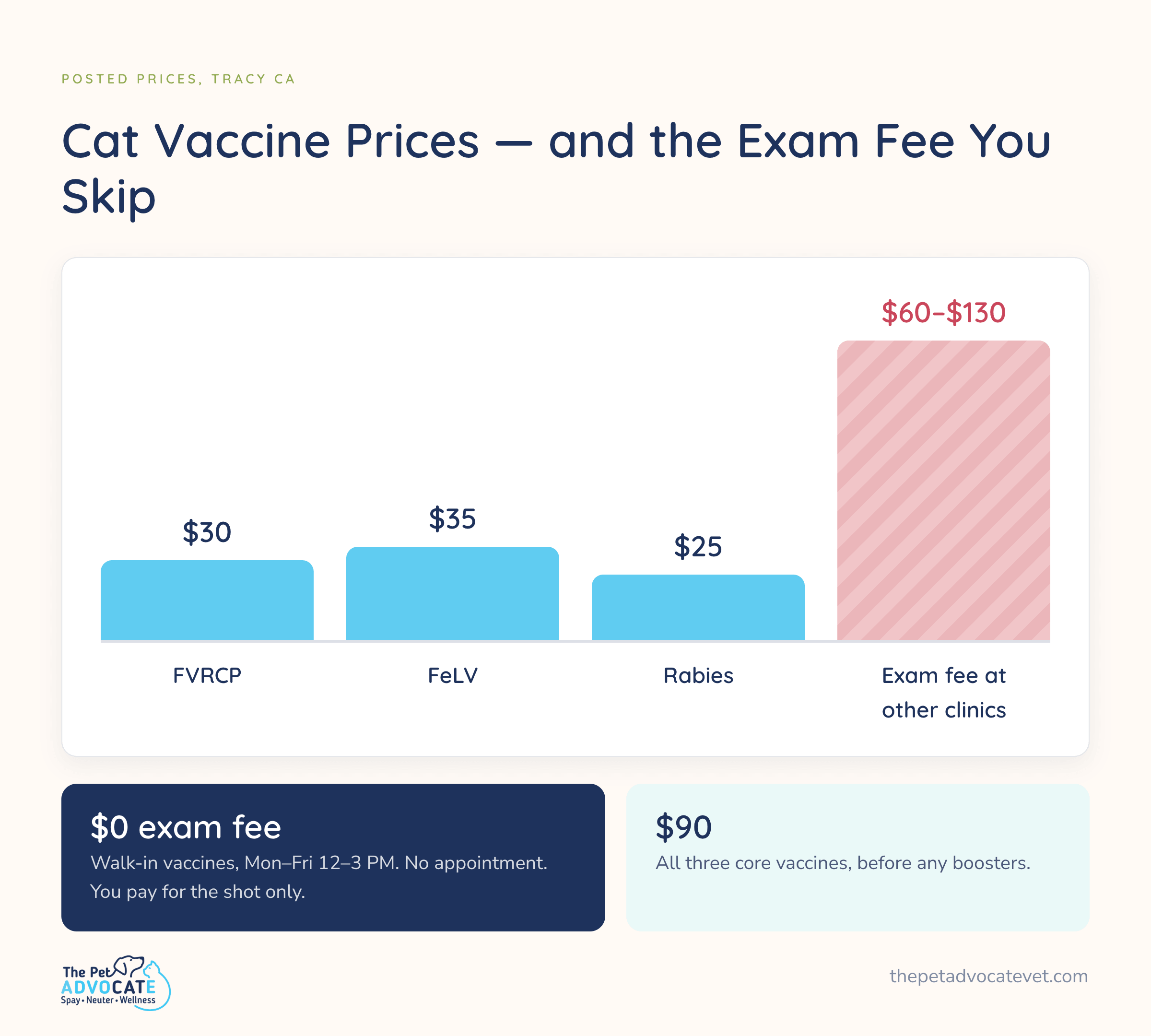
At The Pet Advocate Vet, walk-in vaccines are available Monday–Friday from 12:00 to 3:00 p.m. with no appointment and no exam fee. You simply pay for the vaccines you choose. Current options and pricing are listed on our pet vaccinations page.
A full kitten series of core vaccines costs far less than the same series at most full-service clinics that add a $60–$130 exam fee on every visit. You pay only for the vaccine itself. Full current pricing is also listed on our prices and rates page.
Owners who bring multiple cats or who are working through a rescue group appreciate the straightforward pricing and the open drop-in window. The same transparent approach applies whether the cat is a brand-new kitten or an adult due for boosters. For a deeper breakdown of typical costs across different providers, see how much do cat vaccines cost.
At The Pet Advocate Vet we look at age, current household, any history of outdoor access or boarding, and whether new cats enter the home. A single adult cat that has never left the house and lives alone usually needs only FVRCP and rabies boosters on a three-year cycle. A multi-cat household or a cat that occasionally slips outside receives FeLV as well.
Owners make the final choice after we explain the risks and the schedule. We educate and recommend, but the decision stays with the person who knows the cat best. This approach works well for the high volume of clients who come to us specifically for straightforward, low-cost preventive care.
Yes. Core vaccines (FVRCP and rabies) protect against viruses that can still reach indoor cats through clothing, shoes, open windows, escapes, or new pets brought into the home.
Most indoor cats need FVRCP and rabies. FeLV is recommended for all kittens and for any adult cat that has contact with other cats of unknown status.
It is core for kittens under one year. For strictly indoor adult cats living alone or only with FeLV-negative companions, ongoing boosters are often unnecessary once the initial series and one-year booster are complete.
After the kitten series and the one-year booster, low-risk indoor adults typically receive FVRCP every three years and rabies every one to three years depending on the product and local rules.
Yes. Panleukopenia, herpesvirus, and calicivirus can be carried indoors on people or objects. Bats can enter homes and create a rabies risk.
At The Pet Advocate Vet in Tracy, California, walk-in cat vaccines are available Monday–Friday from 12:00 to 3:00 p.m. with no appointment and no exam fee. Current prices are $30 for FVRCP, $35 for FeLV, and $25 for rabies. You can start with our pet vaccinations page for current options.
You can also review full pricing and schedule a wellness visit on our prices and rates page. Fully vaccinated cats recover more smoothly from spay or neuter, so many owners complete the vaccine series first.
For a complete first-year plan that includes vaccines, deworming, and timing of surgery, see our new kitten checklist. If you have questions about rabies specifically, our rabies vaccine for cats page covers the details. Cats coming from multi-cat or community situations may also benefit from the process details on our feral cat spay and neuter page.
We keep the process simple so more cats stay protected.