
Or call us at 209-879-9367 — we'll answer Mon–Fri, 8 AM to 4:30 PM.📍 1973 N. Tracy Blvd., Tracy, CA 95376
Schedule OnlineBy Mike Wesselink, DVM (UC Davis School of Veterinary Medicine, 2015). Owner of The Pet Advocate, a high-volume low-cost clinic in Tracy, California. Last updated: July 2026.
Bringing a kitten home is exciting and a little overwhelming. Most checklists stop at bowls and litter. The items that actually shape the next 15 years are the vaccine series, deworming schedule, spay timing, and early training.
This checklist comes from the daily work at our high-volume low-cost clinic in Tracy. We see the kittens that settle in smoothly and the ones that struggle later because the first-year medical and behavior pieces were skipped. Use it as a working plan from the day before arrival through the first year. Learn more about our clinic and team.
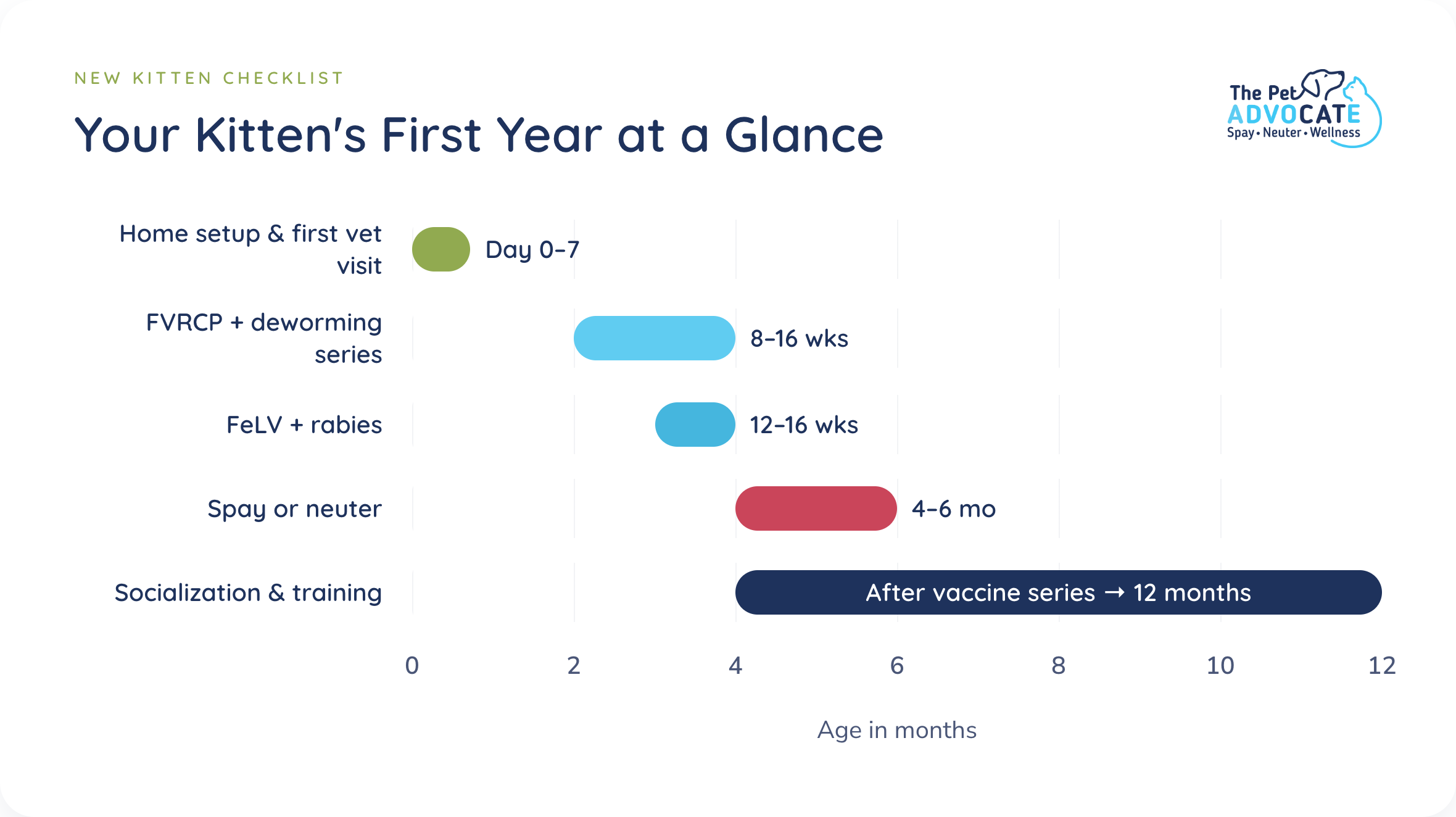
Print or screenshot this list and work through it in order.
Before the kitten arrives
First week
First 4–6 months (medical core)
First year (behavior core)
This single list covers supplies, the medical series, and the behavior window that most checklists leave out.
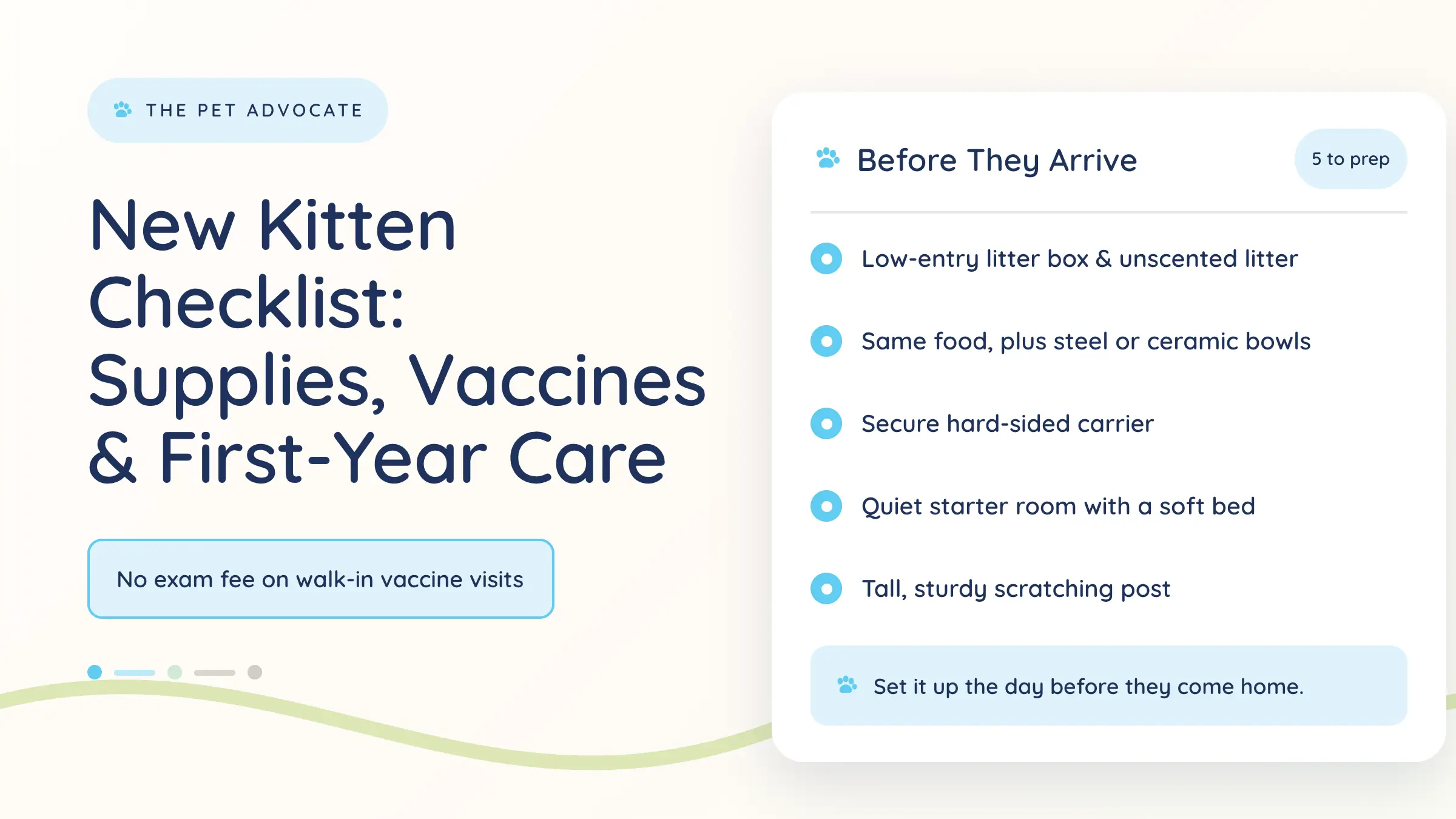
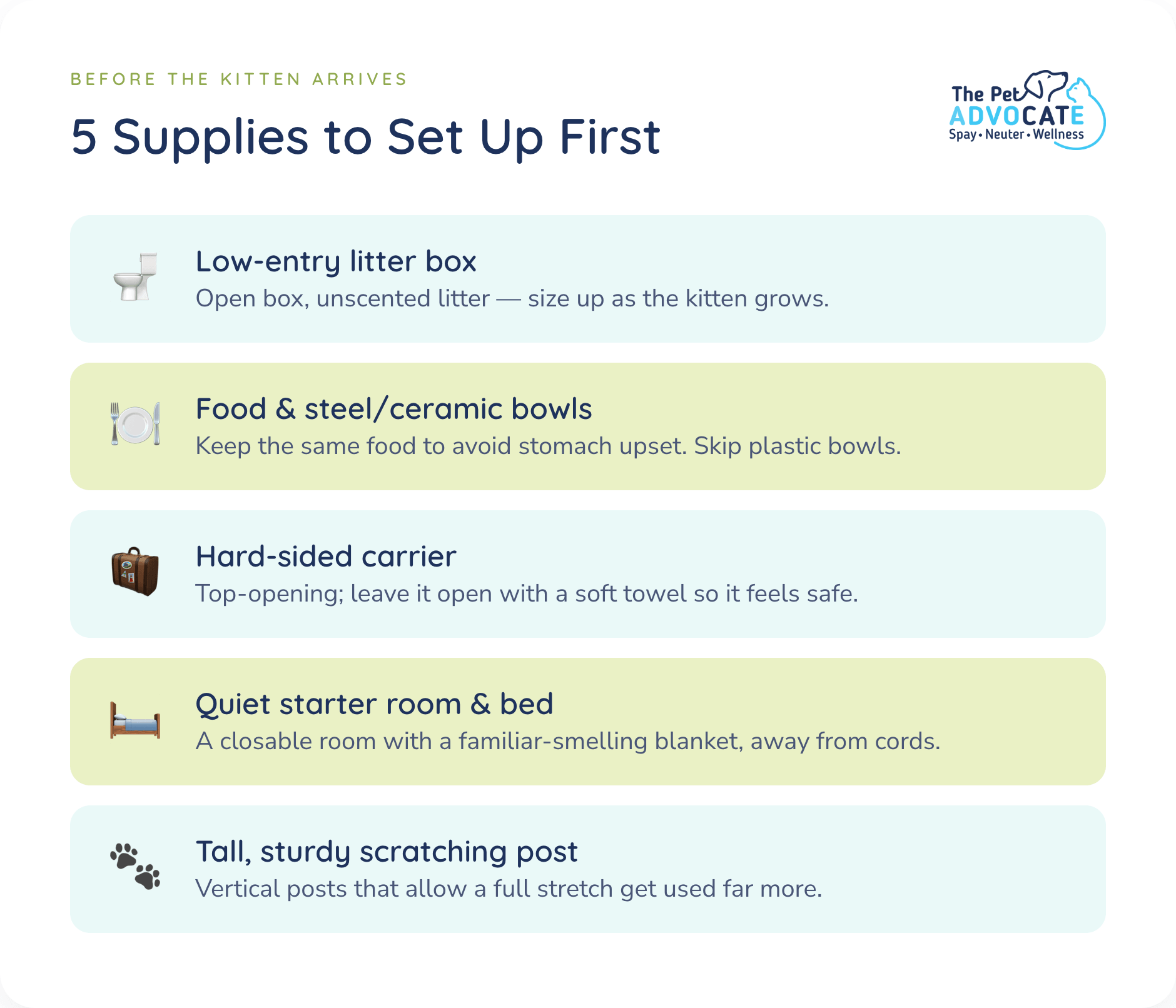
Set these items up the day before the kitten comes home. A prepared room reduces stress for both of you.
Choose a quiet starter room with a door that closes. Place the litter box in one corner, food and water in another, and a soft bed or carrier with a familiar-smelling towel or blanket. Keep the room free of cords, toxic plants, and small objects a kitten can swallow.
Litter box: start with a low-entry open box. Kittens grow fast. An undersized box is a common reason for “accidents” that are not accidents. Use unscented litter.
Food and water: buy the same food the kitten has been eating. Sudden changes cause stomach upset. Use stainless steel or ceramic bowls. Plastic can harbor bacteria and contribute to chin acne.
Carrier: a hard-sided carrier with a top-opening option makes future vet visits less stressful. Leave it open in the starter room with a soft towel inside so the kitten learns it is safe.
Scratching post: choose one that is tall and sturdy. Vertical posts that let the kitten stretch fully are used more consistently than short pads.
That is enough for the first 24–48 hours. Toys, extra beds, and fancy cat trees can wait until the kitten is settled and eating reliably.
Once the starter room is ready, walk the rest of the home with a kitten’s curiosity in mind.
Secure or cover electrical cords. Remove or hang houseplants that are toxic to cats. Lilies are especially dangerous. Close off spaces behind appliances and inside cabinets where a kitten can get stuck. Keep human food, medications, and string or yarn out of reach.
Many owners let a new kitten roam the entire house on day one. That often leads to hiding, missed litter boxes, and overwhelmed kittens. Keep the kitten in the starter room until it is eating, drinking, and using the litter box consistently. Then expand access one room at a time.
Most kittens spend the first day or two exploring, hiding, and deciding whether the new place is safe. Offer food and water, then give space. Sit quietly in the room without forcing interaction.
Watch for normal patterns: regular eating, drinking, and litter-box use. Call a veterinarian the same day if the kitten refuses food for more than 24 hours, has diarrhea or vomiting that does not stop, or seems unusually lethargic.
Schedule the first veterinary visit within the first week. Bring any records from the shelter, rescue, or previous owner. At that visit the veterinarian performs a full physical exam, screens for parasites, and starts the core vaccine and deworming series if the kitten is old enough.
At our clinic a typical first visit for an 8-week kitten runs about $65–70. That usually covers the first FVRCP vaccine and pyrantel deworming. Optional flea, tick, and heartworm prevention can be added the same day.
We do not charge a separate exam fee for walk-in vaccine visits. See current prices and rates for the latest numbers.
Kittens need a series of vaccines because maternal antibodies from the mother’s milk can neutralize early shots. Those antibodies usually wear off between 8 and 12 weeks, but the exact timing varies. Starting around 8 weeks and finishing after 4 months of age gives the best chance of solid protection. This approach is consistent with the 2020 AAHA/AAFP Feline Vaccination Guidelines.
Typical schedule we use:
The final doses given after 4 months of age produce the strongest, longest-lasting response. That is why the series is not finished early.
Deworming rides along with every vaccine visit. We assume every kitten has the ability to carry gastrointestinal parasites because one of the common worms is passed through the mother’s milk. Pyrantel is the product used at each visit. This aligns with Companion Animal Parasite Council (CAPC) recommendations for early and repeated deworming in kittens.
Cats also get tapeworms by grooming and swallowing a flea that carries the larval stage. Tapeworms require a different dewormer, praziquantel, which we give by injection. We recommend it at least once during the kitten series (usually the last visit) or any time an owner sees rice-grain segments around the base of the tail or rectum.
If a kitten is already on a product such as Revolution Plus, the separate pyrantel dose is usually not needed because that preventive already covers comparable deworming.
FeLV (feline leukemia) is given at the 12- and 16-week visits. At our clinic we treat it as a core vaccine for all cats, indoor or outdoor. Even indoor cats can be exposed through open windows or items brought in from outside.
Rabies is given at the final visit, once the kitten is at least 3 months old and usually closer to 4 months. California law requires rabies vaccination for dogs. It is not legally required for cats, but we still recommend it.
Full details and the reasoning behind the timing live on our kitten vaccine schedule page. Our complete vaccination guidelines also cover both kittens and adult cats.
Plan for spay or neuter between 4 and 6 months of age. This aligns with the AVMA-endorsed recommendation to sterilize cats by five months of age and the broader Feline Fix by Five initiative.
Cats can become pregnant as early as 4 months. Waiting past the first heat cycle increases the risk of mammary and uterine cancer later. Spaying before the first heat virtually eliminates that risk.
Indoor versus outdoor status does not change the timing recommendation. The goal is the same: prevent unplanned litters and the health risks that come with intact status.
At a high-volume clinic the procedure is efficient and the recovery is usually straightforward when the kitten is still young. Larger or older animals carry higher surgical and recovery risks.
You can learn more about our spay and neuter services and current pricing on the site.
Vaccines and spay timing protect the body. Early socialization and training shape the adult cat’s temperament.
Once the core vaccine series is complete, start controlled exposure to new environments, sounds, people, and (when appropriate) other vaccinated pets. The more a young cat experiences while it is still flexible, the more well-rounded and less fearful it tends to become as an adult.
Simple daily routines and gentle leadership matter just as much. The first year is when an owner establishes that they are the leader. That foundation makes the cat more responsive to basic cues for the rest of its life. It is similar to children: habits formed early are far easier than trying to change them later.
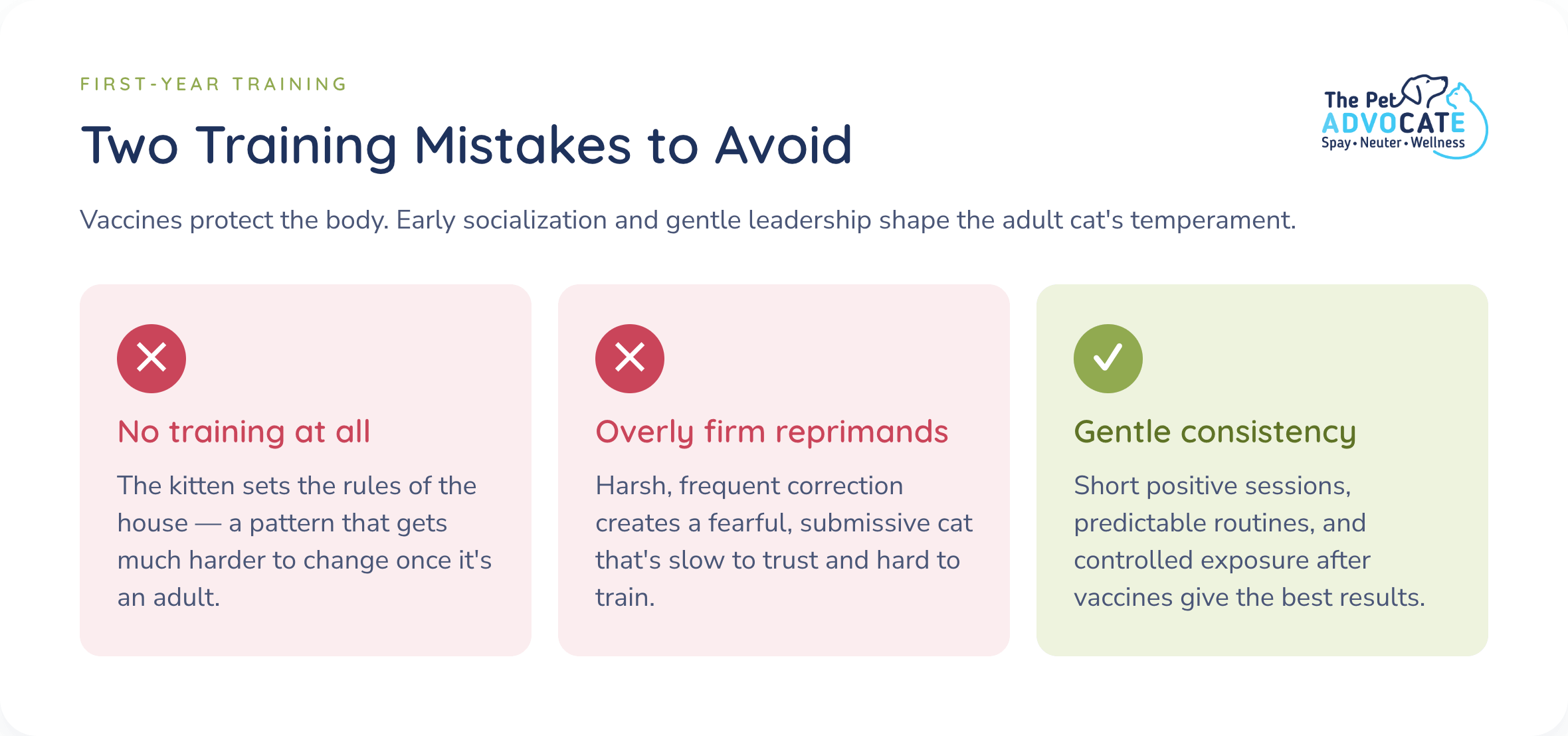
Two common mistakes show up repeatedly in the exam room and in rescue cases.
The first is no training at all. The kitten is allowed to set the rules of the house. That pattern becomes harder to change once the cat is an adult.
The second is the opposite extreme: overly firm or frequent reprimands early on. That approach can create a fearful, submissive cat that is difficult to train and slow to trust people. We see this pattern often in rescue cats with unknown or abusive histories. Those cats take longer to come out of their shell.
Gentle consistency beats both extremes. Short positive sessions, predictable routines, and controlled exposure after vaccines give the best long-term results.
A microchip is permanent identification. The implant itself is simple. The step most owners miss is registering and updating the contact information.
Without current phone numbers and an email address in the registry, the chip cannot reunite a lost cat with its family. That registration failure is the number-one issue we see.
Have the chip placed and registered at the same visit when possible. Keep the registry login information so you can update it if you move or change numbers.
Our microchip process is the same for cats and dogs and includes registration.
Use this as a running checklist through the first 12 months.

A low-entry litter box with unscented litter, the food the kitten is already eating, stainless steel or ceramic bowls, a secure carrier, a quiet starter room, and a sturdy scratching post. Everything else can wait until the kitten is settled.
Within the first week. The visit includes a physical exam, parasite screening, and the start of the vaccine and deworming series if the kitten is old enough.
Deworm with pyrantel at every vaccine visit in the kitten series and at annual visits. Assume parasites are possible because they are commonly passed through the mother’s milk. Tapeworms require a separate product (praziquantel) given by injection at least once during the series or when rice-grain segments are seen.
Between 4 and 6 months of age, before the first heat cycle. Cats can become pregnant as early as 4 months. Indoor versus outdoor lifestyle does not change the recommended window.
Yes. Core vaccines including FeLV are recommended for all cats. Indoor cats can still be exposed through open windows, insects, or items brought into the home. Deworming follows the same schedule because parasites can be present even without outdoor access.
Until it is eating, drinking, and using the litter box reliably. For most kittens that is 24–48 hours. Shy or overwhelmed kittens may need longer. Expand access one room at a time once those basics are consistent.
A complete first-year plan is more than a shopping list. The medical series and early training decide how healthy and easy the adult cat will be to live with.
If you need affordable vaccines, deworming, microchipping, or a kitten spay or neuter, we see patients five days a week in Tracy. Many owners drive from the Bay Area and Central Valley because the pricing is transparent and the process is straightforward. You can view current prices and rates and book online, or call with questions before you come in.