

Or call us at 209-879-9367 — we'll answer Mon–Fri, 8 AM to 4:30 PM.📍 1973 N. Tracy Blvd., Tracy, CA 95376
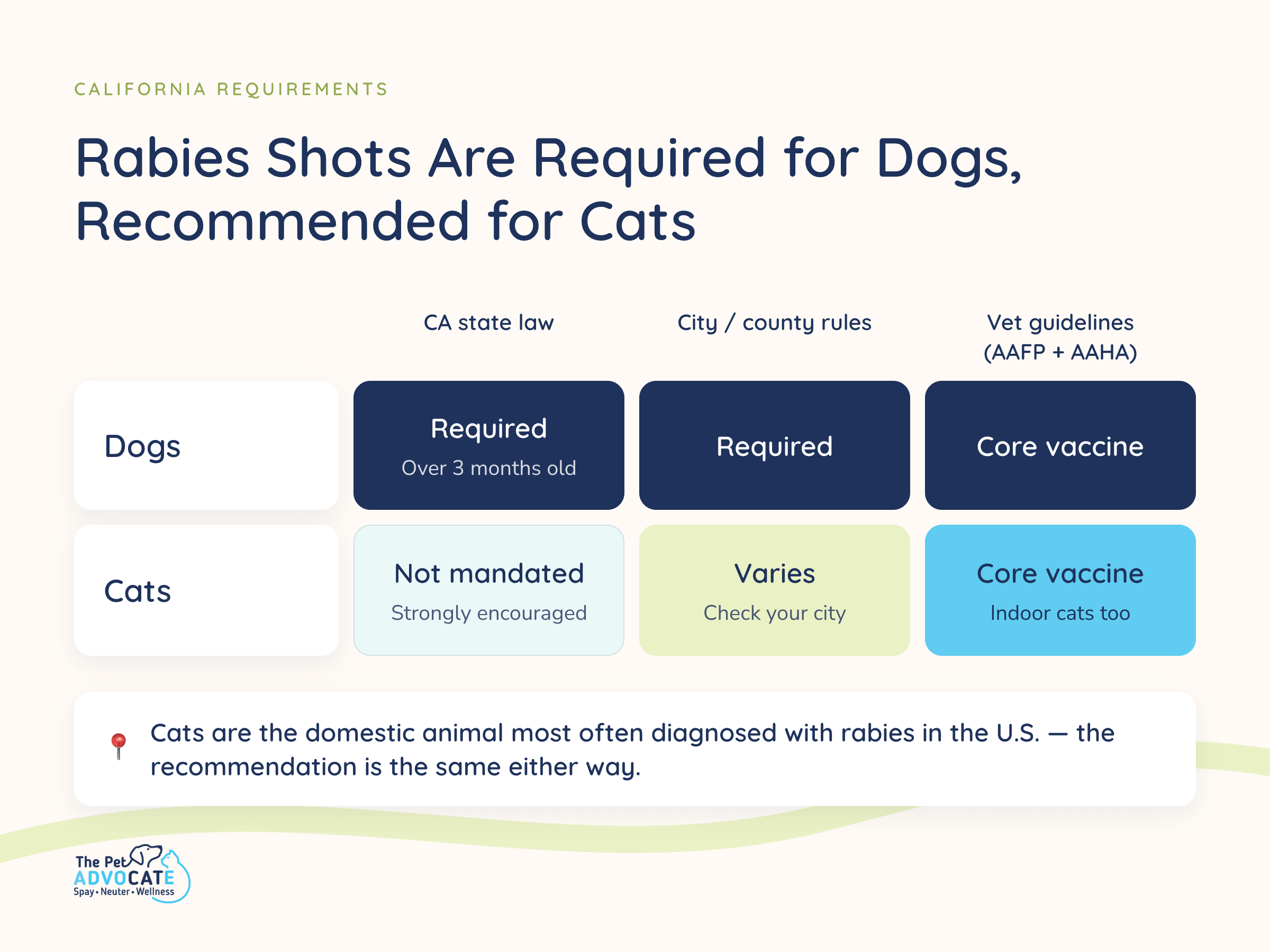
Schedule OnlineMost national pages tell California cat owners that rabies vaccination is required by law. That is true for dogs. It is not true statewide for cats.
The California Department of Public Health requires rabies vaccination for dogs over three months of age. For cats the state strongly encourages it, especially for outdoor cats or those with wildlife contact. Some cities and counties add their own ordinances.
Veterinary guidelines from the American Association of Feline Practitioners still list rabies as a core vaccine for every cat, indoor or outdoor. Bats can enter homes, and an unvaccinated cat that bites someone can trigger strict quarantine or euthanasia rules.
At The Pet Advocate the cat rabies vaccine is $25 on a walk-in basis Monday through Friday, 12–3 PM, with no exam fee. This guide covers the schedule, the 1-year versus 3-year options, side effects, and exactly what the law and the science say for California owners.
Rabies is almost always fatal once clinical signs appear. The virus travels through nerves to the brain. Transmission occurs through saliva, almost always via a bite.
Cats are the domestic animal most frequently diagnosed with rabies in the United States in recent years. Wildlife reservoirs (bats, skunks, foxes) remain active in California.
An indoor cat can still encounter a bat that enters through a chimney, attic, or open window. Or it can slip outdoors for a few minutes. Vaccination protects the cat and removes the legal and medical risk to the human family if the cat ever bites someone or is exposed.
California Health and Safety Code requires rabies vaccination for dogs. It does not impose a statewide mandate on cats.
The California Department of Public Health states that rabies vaccination is strongly encouraged for cats that go outdoors or have potential contact with wild animals. Local ordinances vary. Some cities and counties require it for licensing or for cats over a certain age; others do not. Always check your specific city or county animal-control rules.
Regardless of local law, the American Association of Feline Practitioners and the American Animal Hospital Association classify rabies as a core vaccine recommended for every cat. Boarding facilities, groomers, and many rescue organizations also require current proof of vaccination.
In our clinic we regularly meet owners who are surprised that California treats dogs and cats differently under state law. The recommendation for cats remains the same either way.
Kittens receive their first rabies vaccine at 12 weeks of age or older. In our high-volume clinic we often give the dose at the final kitten-series visit, around 16 weeks or four months of age, after the last FVRCP and FeLV doses. This timing leaves the kitten fully protected before the spay or neuter appointment.
Adult cats with no prior vaccination history receive a single dose and then follow the same booster schedule.
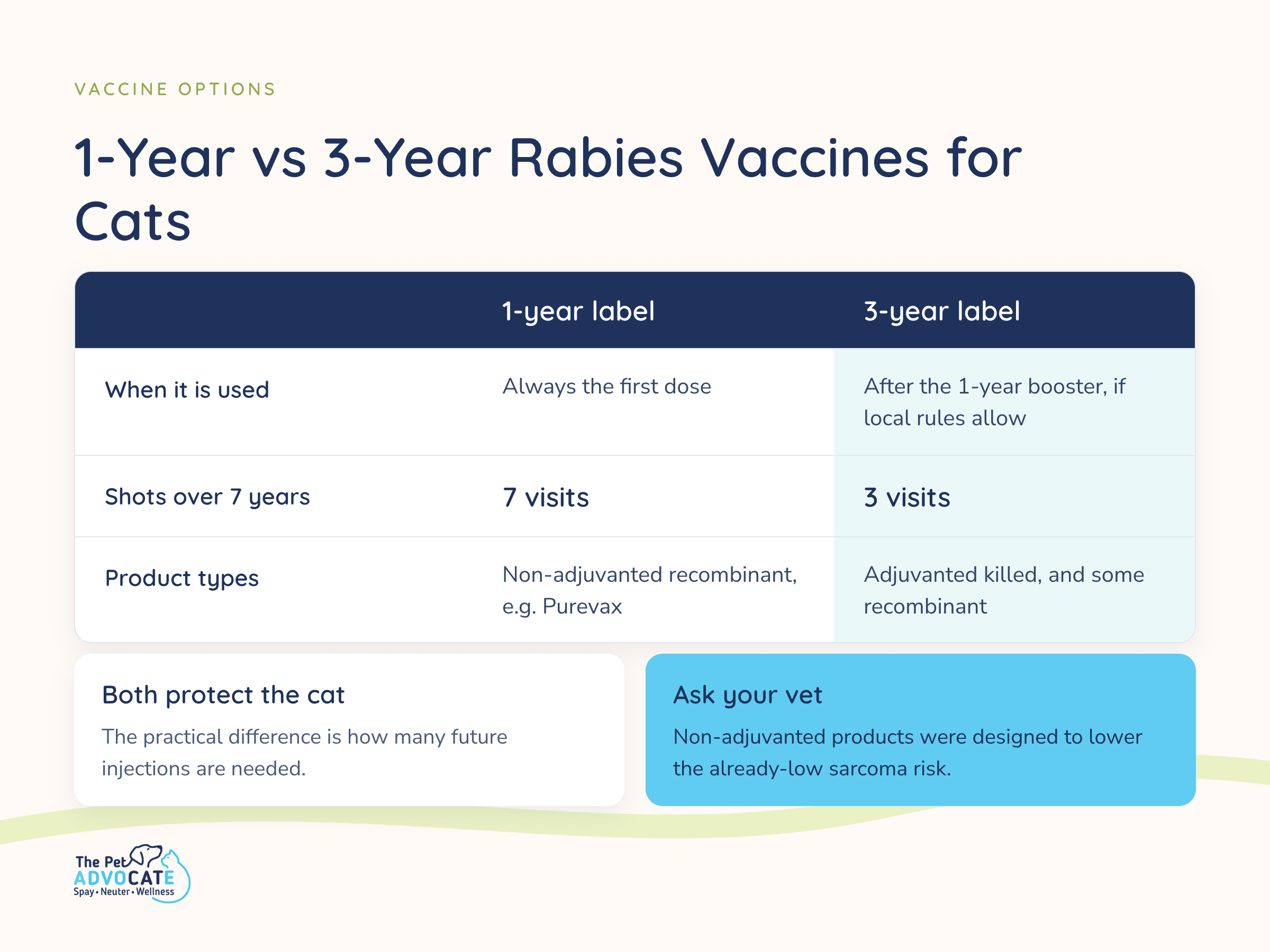
The first rabies vaccine always carries a one-year duration. Subsequent doses may be labeled for three years provided the prior vaccination is still current. Local ordinances or the specific product used can shorten the interval.
Both one-year and three-year products are available. After the mandatory first-year booster, most clinics prefer a three-year labeled vaccine when local rules allow it.
Non-adjuvanted recombinant vaccines (such as Purevax) were developed to reduce the already-low risk of injection-site sarcomas in cats. Adjuvanted killed vaccines remain effective and widely used. Discuss the options with the veterinarian. The practical difference for most owners is the number of future injections required.
At The Pet Advocate the cat rabies vaccine is $25. It is available on a walk-in basis Monday through Friday from 12 to 3 PM. No examination fee is charged for walk-in vaccinations.
Typical full-service clinics in the region charge $15–$40 for the vaccine itself plus a $60–$130 examination fee. That brings the total well above $100 in many cases. Community clinics sometimes offer lower cash prices but may still require an appointment or a brief exam.
Prices listed on the clinic site are cash-discount rates. Card payments add a 3 percent processing fee. Always confirm the current price on the prices and rates page before your visit.
.webp)
Most cats experience no side effects. When reactions occur they are usually mild and short-lived:
These signs typically resolve within 24–48 hours. Severe allergic reactions (facial swelling, hives, vomiting, collapse) are rare. Injection-site sarcomas are also rare (estimates range from 1 in 10,000 to 1 in 30,000 vaccinations). That is one reason many veterinarians prefer non-adjuvanted products for cats when available.
Contact the clinic if swelling continues to enlarge after three days, if the cat stops eating for more than 24 hours, or if any signs of a severe reaction appear.

Yes. Veterinary guidelines treat rabies as a core vaccine for every cat regardless of lifestyle. Indoor cats still face two realistic risks: accidental escape and wildlife that enters the home (especially bats).
An unvaccinated cat that bites a person or is exposed to a potentially rabid animal can trigger mandatory quarantine or euthanasia under state and local public-health rules. A currently vaccinated cat usually requires only a booster and a short home observation period.
If a cat with no current rabies vaccination is bitten by or has contact with a rabid or suspect animal, public-health authorities decide the course. Options can include a long quarantine (often six months) at the owner’s expense or euthanasia and testing.
A currently vaccinated cat that is exposed typically receives a booster vaccine and a shorter observation period at home. Keep vaccination records accessible. Proof of current status changes the outcome for both the cat and the household.
Walk-in vaccinations are available Monday through Friday, 12–3 PM. No appointment is required. Bring any previous vaccine records if you have them. The cat rabies vaccine is $25 with no exam fee.
The same visit can include FVRCP ($30) and FeLV ($35) if the cat is due. We also offer microchipping and deworming during walk-in hours. See the full pet vaccinations menu for current options. You can also schedule your appointment if walk-in hours do not work for you.
For kittens, we usually time the rabies dose with the final series visit around four months of age. That way the animal leaves fully protected before the spay or neuter appointment. Pair it with the rest of the new kitten checklist so nothing is missed. Timing the dose before surgery also keeps the cat spay recovery process simpler.
Yes. Even indoor cats can encounter bats that enter the home or can escape outdoors. Veterinary guidelines classify rabies as a core vaccine for every cat, and many boarding and grooming facilities require proof of vaccination.
Kittens receive the first dose at 12 weeks of age or older. Many clinics give it at the last kitten-series visit, around 16 weeks or four months of age.
The first vaccine lasts one year. The booster given one year later and all subsequent doses are typically labeled for three years, provided the prior vaccination is current and local rules allow the longer interval.
At The Pet Advocate the price is $25 on a walk-in basis with no exam fee. Full-service clinics commonly charge the vaccine plus a $60–$130 examination fee.
California state law requires rabies vaccination for dogs only. Some cities and counties require it for cats. The California Department of Public Health and major veterinary associations still recommend it for all cats because of public-health risk.
No. Licensed rabies vaccines cannot cause rabies.
Confirm your city or county rules. Keep the vaccination certificate with your records. Schedule the first dose by four months of age for kittens.
The $25 walk-in option at The Pet Advocate removes the exam-fee barrier that keeps many cats unvaccinated. If your kitten is still in its vaccine series, combine the rabies dose with the final FVRCP and FeLV visit. Then move on to the spay or neuter appointment while the protection is current.