Or call us at 209-879-9367 — we'll answer Mon–Fri, 8 AM to 4:30 PM.📍 1973 N. Tracy Blvd., Tracy, CA 95376
Schedule OnlineUpdated August 2026 | Pricing and protocols from The Pet Advocate Vet clinic in Tracy, California
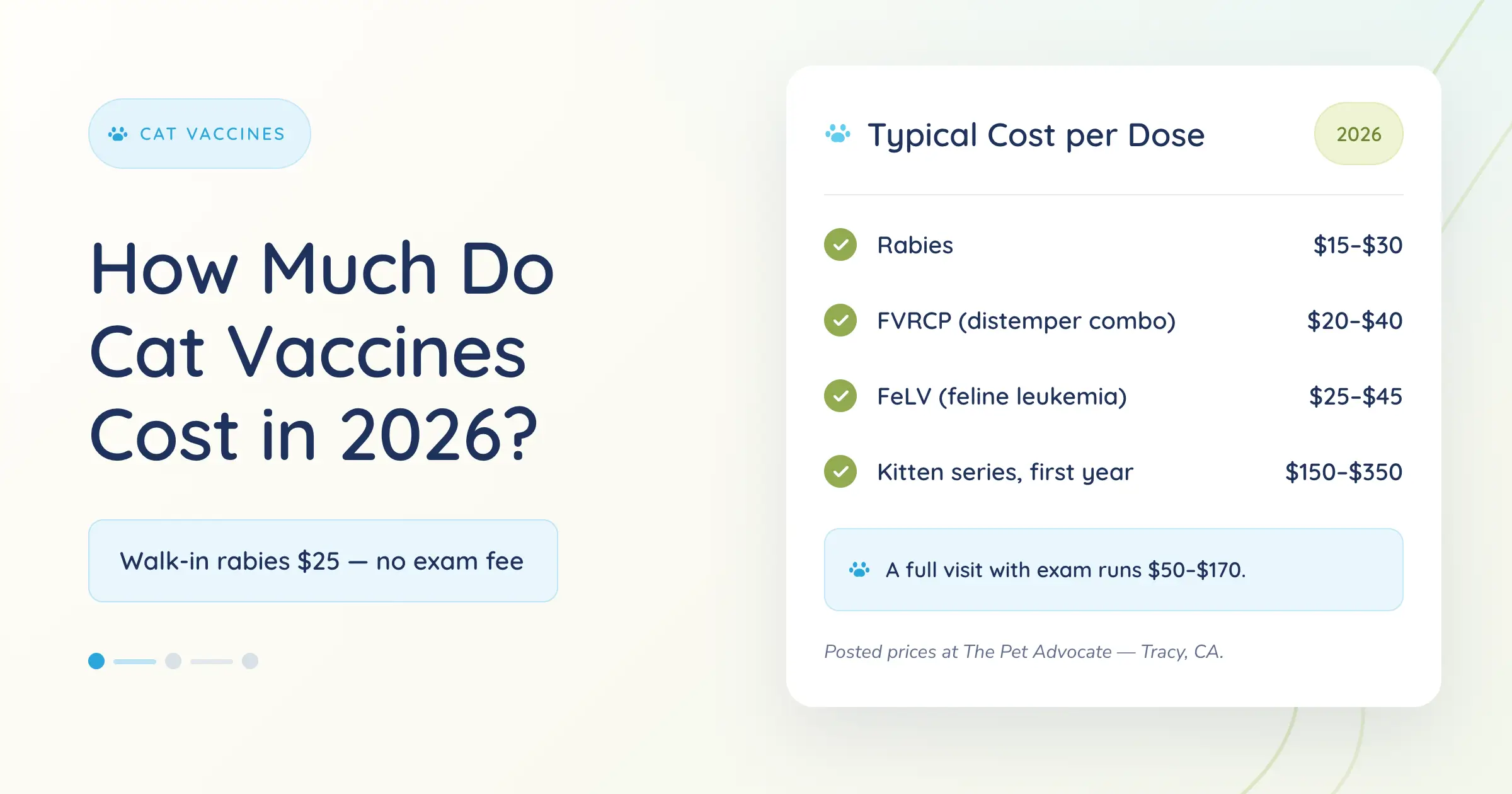
Cat vaccines typically cost $15 to $45 per dose in 2026. A full veterinary visit that includes the exam and vaccines usually runs $50 to $170, with a median near $110 based on recent real invoices. Kittens need a series of visits that total $150 to $350 for core protection. Adult boosters cost less once the initial series is complete.
This guide breaks down every major cost, shows exact ranges for each vaccine, compares private clinics to retail and shelter options, and explains how lifestyle and location change the final bill. You will also find the current AAHA/AAFP schedule tied directly to those prices so you can plan accurately.
At The Pet Advocate we keep core cat vaccines low and transparent so owners can stay current without sticker shock. Our walk-in rabies is $25 with no exam fee. FVRCP is $30 and FeLV is $35. In our high-volume Tracy clinic we see many owners choose the walk-in option specifically to avoid the $40–$70 exam fee that full-service hospitals add. The ranges below give the national picture so you know what to expect anywhere in the country.
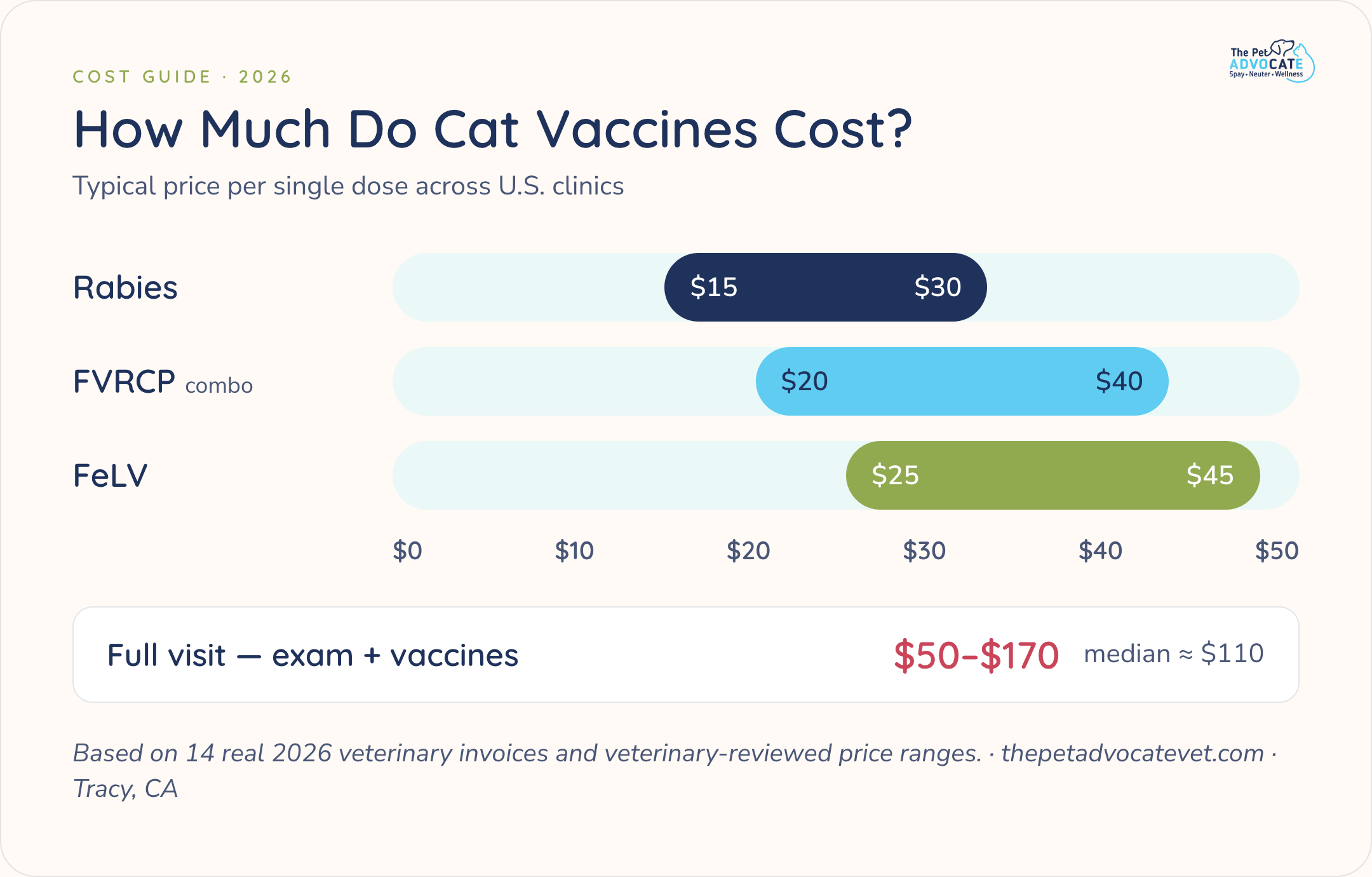
Individual core vaccines fall in these ranges across the United States:
A standard adult booster visit that includes the exam fee ($40–$70) plus one or two vaccines totals $50–$170. Low-cost retail clinics and community events often charge $15–$30 per vaccine with little or no exam fee.
These figures come from 14 real 2026 veterinary invoices (median visit $110) and consistent ranges published across multiple veterinary-reviewed sources updated in 2026.
Rabies is the only vaccine required by law in most U.S. states. The 1-year version costs $15–$25 at many clinics; the 3-year product sits at the higher end of the $15–$30 range. Choosing the 3-year option lowers long-term spending for eligible cats. See our full rabies vaccine for cats guide for California-specific rules and schedule details. The CDC recommends vaccinating cats according to local laws and notes that most should not receive their first rabies vaccine before 12 weeks of age.
FVRCP is the core combination vaccine. It protects against three highly contagious viruses. Expect $20–$40 per dose. Kittens receive it three times in the first months of life.
FeLV protects against feline leukemia virus. The 2020 AAHA/AAFP Feline Vaccination Guidelines list it as core for all kittens under one year of age. Adult cats receive it only when outdoor access or multi-cat exposure creates risk. Cost runs $25–$45 per dose, usually given as a two-dose series for kittens.
Non-core options such as Bordetella or Chlamydia felis cost $10–$40 when a veterinarian recommends them based on lifestyle. These are never given to every cat.
Kittens start vaccines as early as 6–8 weeks and finish the core series by 16–18 weeks. A typical schedule follows the 2020 AAHA/AAFP Feline Vaccination Guidelines:
Each visit usually includes an exam. Package pricing or individual dosing produces a total of $150–$350 for the complete first-year core series. Adding fecal testing, deworming, or FeLV/FIV blood tests can push the upper end higher.
After the final kitten visit, a booster set occurs at one year of age. From that point the schedule lengthens.
Our new kitten checklist walks through the exact timing we use in clinic so the series lines up with the spay or neuter appointment.
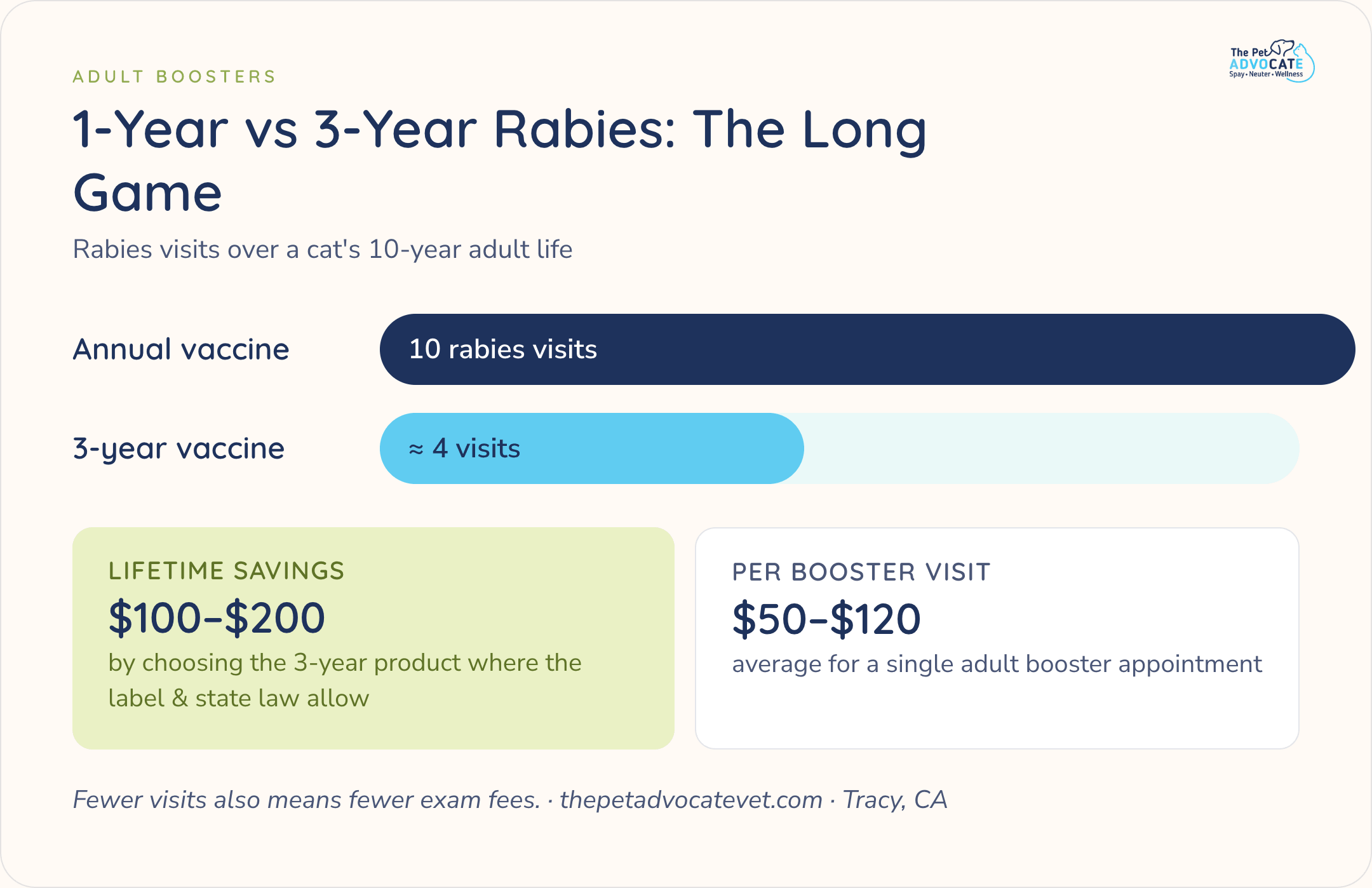
Adult cats need boosters at lower frequency. FVRCP is typically given every three years after the one-year booster. Rabies follows the product label and local law, either annually or every three years. FeLV continues only for high-risk cats and is usually annual.
A single adult booster visit averages $50–$120. Selecting a 3-year rabies vaccine when available cuts the number of visits and the long-term cost. Over a 10-year adult life, the difference between annual and triennial rabies can exceed $100–$200 depending on clinic fees.
The 3-year option is not available for every product or every jurisdiction, so the veterinarian confirms eligibility based on the vaccine label and local rules. At our clinic the 3-year rabies option is available when the cat’s history and the product label support it. That choice keeps future visits simpler and less expensive.
Four factors create most of the price variation.
Provider type produces the largest swing. Full-service private clinics charge exam fees plus vaccine mark-ups. Retail clinics such as Vetco (inside Petco) and ShotVet (inside PetSmart) sell packages with little or no exam fee. Shelters and community events offer the lowest per-dose prices but limited examination.
Location matters. Urban coastal clinics often run 15–25 percent higher than Midwest or Southern practices for the same products.
Lifestyle decides whether FeLV and other non-core vaccines appear on the bill. Indoor-only cats usually need only FVRCP and rabies. Outdoor or multi-cat households add FeLV. In our Tracy clinic we regularly advise outdoor cats to stay current on FeLV because the virus is still circulating in the Central Valley.
Exam and testing fees sit on top of vaccine prices at most private practices. A wellness exam alone can add $40–$70.
Retail and shelter options save money when the cat is healthy and only needs core boosters. Private clinics remain the better choice when the animal needs a thorough exam or has health concerns.
Our walk-in vaccine hours keep the exam fee at zero for simple boosters. That is one reason many owners use us for rabies and core vaccines between full wellness visits. Check the current prices and rates for exact numbers or explore our pet vaccinations services.
Many communities run free or low-cost vaccination events through animal shelters, humane societies, county animal services, and veterinary schools. These clinics focus on core vaccines and keep prices between $10 and $25 per dose.
Retail chains post current package prices online. Booking in advance often secures the listed rate and reduces wait times. Some nonprofit programs also cover vaccines for income-qualified owners.
Always confirm that the clinic uses USDA-licensed vaccines and follows proper storage. Most low-cost sites meet the same manufacturing standards as full-service hospitals.
For Tracy and the surrounding area, our current rates are posted on the prices and rates page. Walk-in rabies, FVRCP, and FeLV are available during set hours so you can keep the cost predictable. You can also schedule your appointment online if you prefer a set time. Find our Tracy and Central Valley locations for the nearest clinic.
Standard accident-and-illness pet insurance policies exclude routine preventive care such as vaccines. Optional wellness add-ons reimburse a portion of the cost. Coverage limits typically range from $10–$55 per vaccine or an annual preventive maximum of $100–$700 depending on the plan and provider.
Wellness plans offered directly by clinics (monthly membership) often include vaccines, exams, and preventives for a fixed monthly fee. These plans can lower the effective cost of annual care when used fully.
The 2020 AAHA/AAFP Feline Vaccination Guidelines remain the primary North American reference. Core vaccines for every cat are FVRCP and rabies. FeLV is core for kittens younger than one year and non-core (risk-based) for adult cats.
Kittens receive FVRCP every 2–4 weeks until at least 16 weeks of age, then a booster at one year, then every three years. Rabies starts at 12–16 weeks, boosts at one year, then follows label and local law. FeLV for kittens is two doses 3–4 weeks apart starting as early as 8 weeks, with boosters based on risk.
These intervals protect against the diseases that cause the highest rates of illness and death in unvaccinated cats.
You can see the exact timing we follow for kittens in our kitten vaccine schedule and how it coordinates with the low-cost spay and neuter appointment. For a complete first-year plan, start with the new kitten checklist.
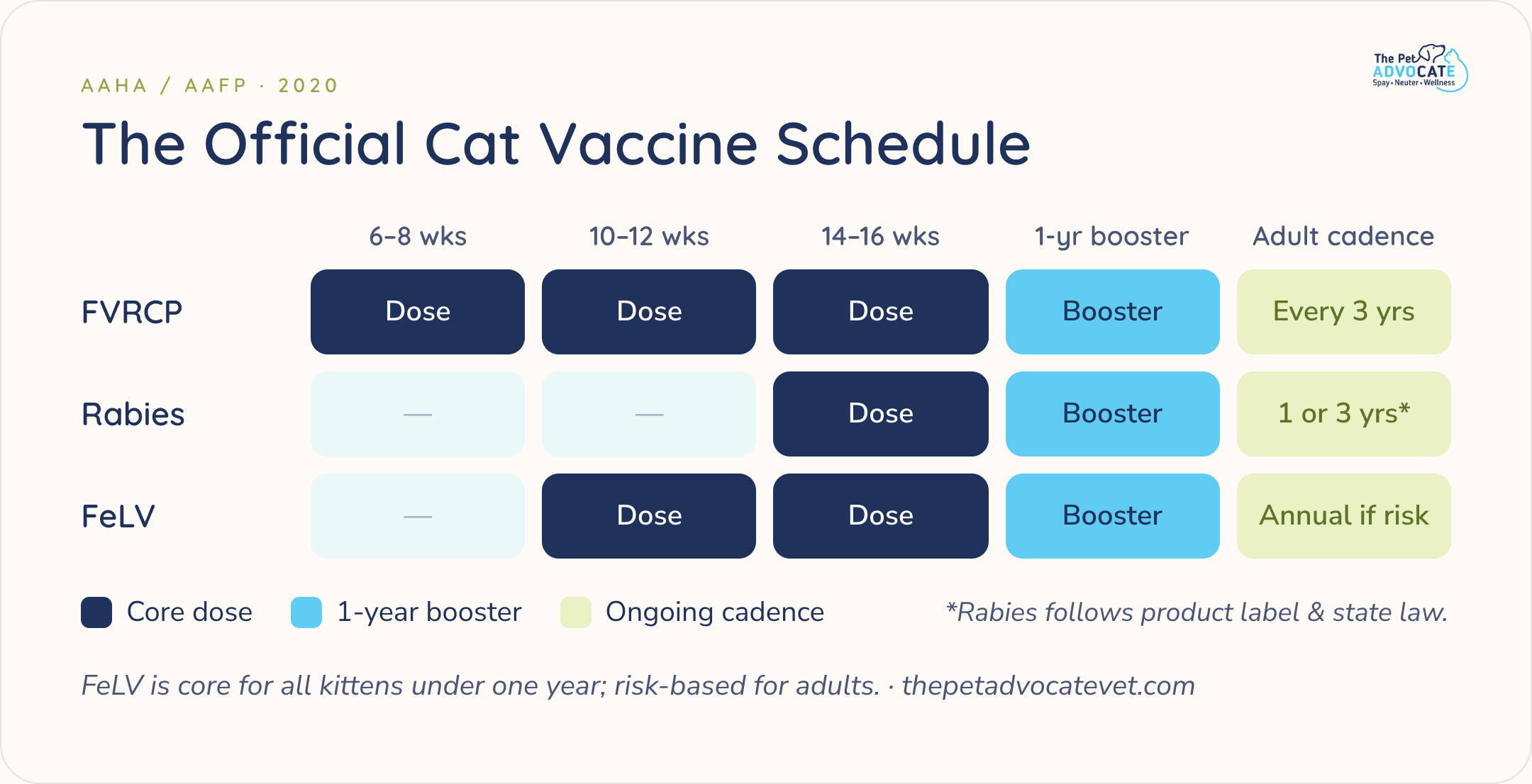
Indoor-only cats usually need only FVRCP and rabies. Their annual or triennial booster visits stay at the lower end of the $50–$120 range.
Outdoor cats or those that live with outdoor cats typically add FeLV. That single addition raises both the initial kitten series and every subsequent high-risk booster. Over a lifetime the difference can reach several hundred dollars, but the protection against a serious virus justifies the cost for at-risk animals.
Discuss lifestyle details with your veterinarian so the protocol matches actual exposure risk.
Never skip core vaccines to save money. The diseases they prevent remain common and expensive to treat. At our clinic the walk-in options for pet vaccinations keep the per-dose cost low without an exam fee for routine boosters.
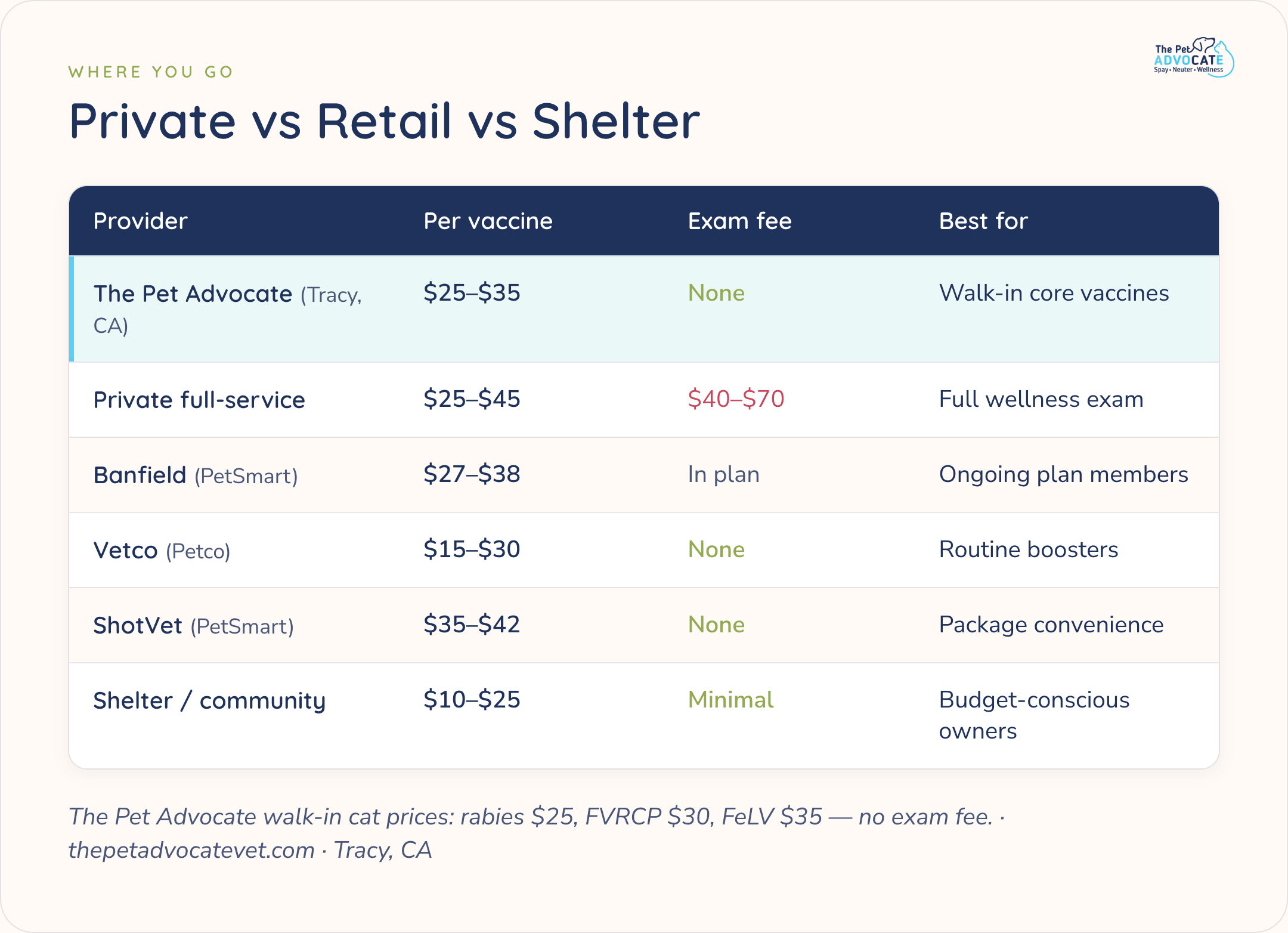
Rabies costs $15–$30, FVRCP $20–$40, and FeLV $25–$45 per dose in 2026. Exam fees at private clinics add $40–$70 on top of the vaccine prices. At our clinic the walk-in prices are $25 for rabies, $30 for FVRCP, and $35 for FeLV with no exam fee. See the full prices and rates page for the latest numbers.
The complete core series across two to three visits totals $150–$350. Packages that include exams, tests, and deworming sit at the higher end of that range.
Yes. Reputable low-cost clinics use the same USDA-licensed vaccines as full-service hospitals. The main difference is the depth of the physical exam, which is often brief or absent.
Standard policies do not. Optional wellness riders or clinic membership plans reimburse or include the cost within set annual limits.
Yes. Core vaccines (FVRCP and rabies) are recommended for every cat. Viruses can enter the home on shoes, clothing, or through screened windows. FeLV is usually unnecessary for strictly indoor cats with no exposure risk.
After the one-year booster, FVRCP is typically given every three years. Rabies follows the vaccine label and state law (1 or 3 years). FeLV continues annually only for high-risk cats.
ShotVet packages at PetSmart run approximately $99 for indoor adult cats and $139 for outdoor. Vetco packages at Petco are similar, around $115–$125. Individual doses cost more than package pricing.
Clinic overhead, regional labor costs, and local competition drive the differences. Coastal metro areas commonly charge 15–25 percent more than many Midwest or Southern clinics for the same products.
Core vaccines remain one of the highest-value investments in a cat’s long-term health. Use the ranges and provider comparisons above to set a realistic budget, then confirm exact pricing with clinics in your area. Start with the AAHA/AAFP schedule, match it to your cat’s lifestyle, and choose the delivery method that balances thoroughness with cost.
Keep records of every vaccine date and product. That simple step prevents both under- and over-vaccination and makes future visits faster and cheaper.
If you are local to Tracy or the Central Valley, check our current prices and rates or schedule your appointment for walk-in vaccine hours. Visit our locations page to find the nearest clinic. We keep the process straightforward so your cat stays protected without the high mark-ups.