
Or call us at 209-879-9367 — we'll answer Mon–Fri, 8 AM to 4:30 PM.📍 1973 N. Tracy Blvd., Tracy, CA 95376
Schedule OnlineUpdated August 2026 by Mike Wesselink, DVM
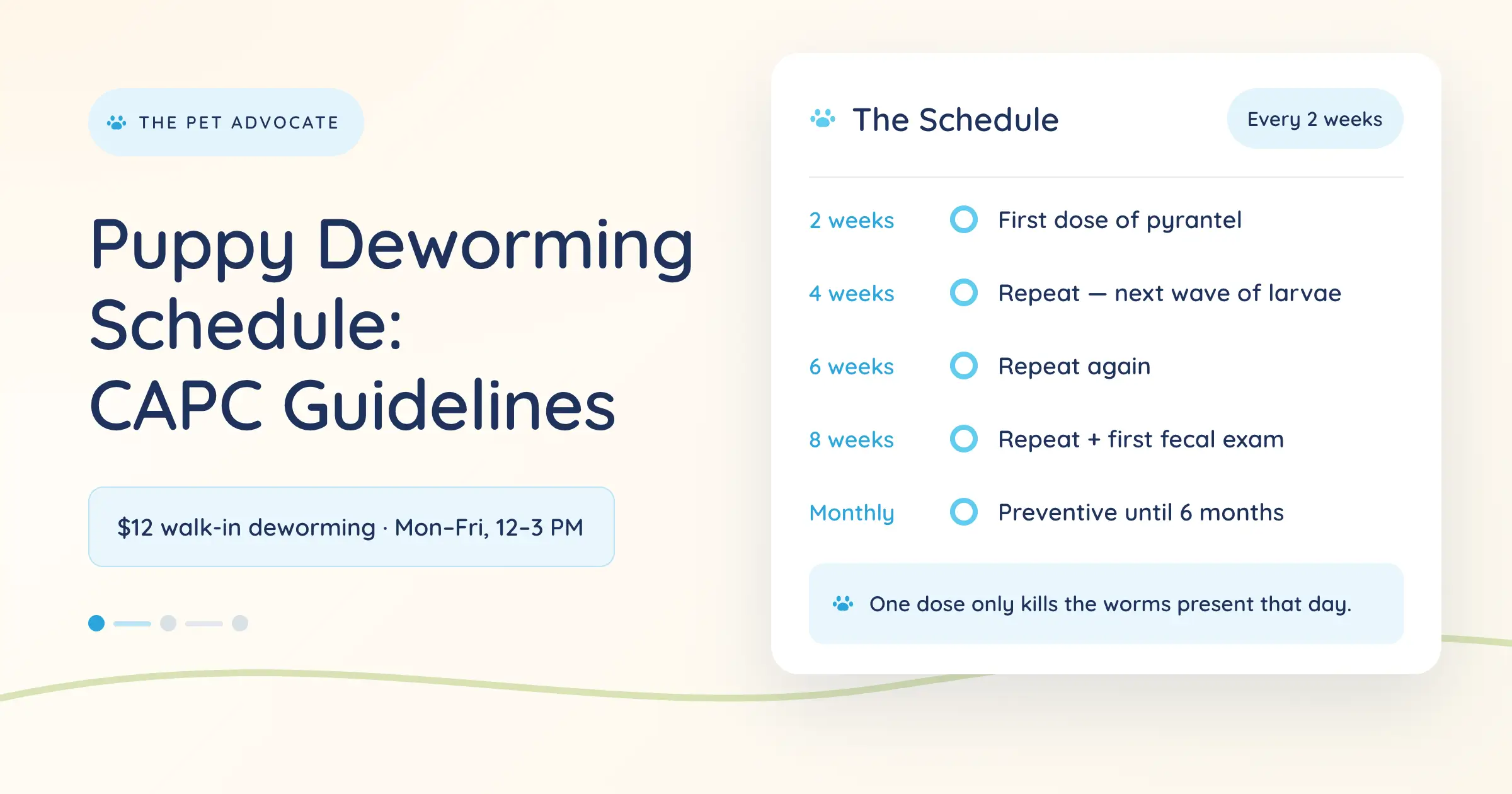
Puppies need deworming every 2 weeks starting at 2 weeks of age until about 8 weeks, then monthly until 6 months or until a year-round preventive begins. This follows CAPC guidelines.
At The Pet Advocate Vet in Tracy we follow the same schedule and deworm with pyrantel at every vaccine visit. Walk-in deworming is available for $12 Monday through Friday from 12 to 3 p.m. See current prices and rates.
Here is the full timeline, why the repeats matter, the signs to watch for, and exactly how we handle it at the clinic.
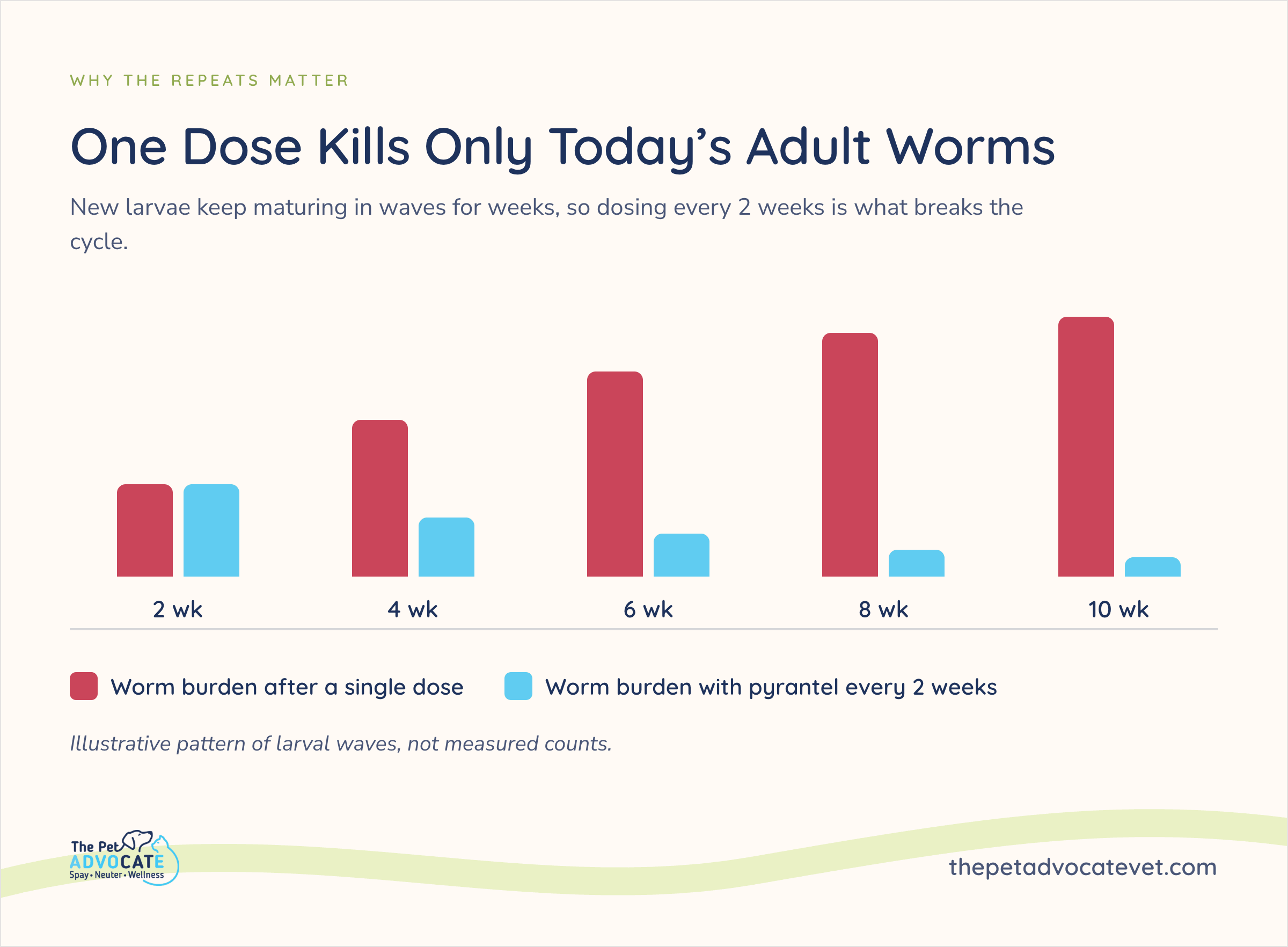
Most puppies acquire roundworms before birth or through the mother’s milk. Hookworms travel the same route. A single dose of dewormer kills only the adult worms present at that moment. New larvae continue to mature in waves over the following weeks, so treatment must be repeated every two weeks to break the cycle.
Without that early, repeated treatment the parasite load can grow large enough to cause diarrhea, poor growth, anemia, or even death in severe cases. Roundworms and hookworms are also zoonotic and can infect children who play in contaminated soil or sand.
At The Pet Advocate Vet in Tracy we treat every new puppy as if it already carries GI parasites. The life cycle of the common worms passes through the mother’s milk, so we give pyrantel at every vaccine visit starting around 8 weeks and offer $12 walk-in deworming Monday through Friday from 12 to 3 p.m. This keeps us from waiting for symptoms that may never appear until the burden is already high. The same approach appears in our full new puppy checklist.
The Companion Animal Parasite Council and AAHA Canine Life Stage Guidelines align on the same core rhythm. At The Pet Advocate Vet we follow this schedule closely.
CAPC also recommends fecal examinations at least four times during the first year of life. A negative fecal does not mean the schedule can stop. Many puppies still carry migrating larvae that are not yet shedding eggs.
If your puppy is already 8 weeks or older when you bring it home, start the schedule immediately and work with your veterinarian to catch up. Breeders and rescues often begin the early doses. Ask for the records so the remaining doses can be timed correctly.
Many owners first meet their puppy at 8 to 12 weeks. At The Pet Advocate Vet we begin pyrantel at the first vaccine visit and then move into the monthly phase. The earlier every-two-weeks doses cannot be recovered, but starting now still interrupts the cycle and reduces environmental contamination. You can schedule your appointment online or use our walk-in window.
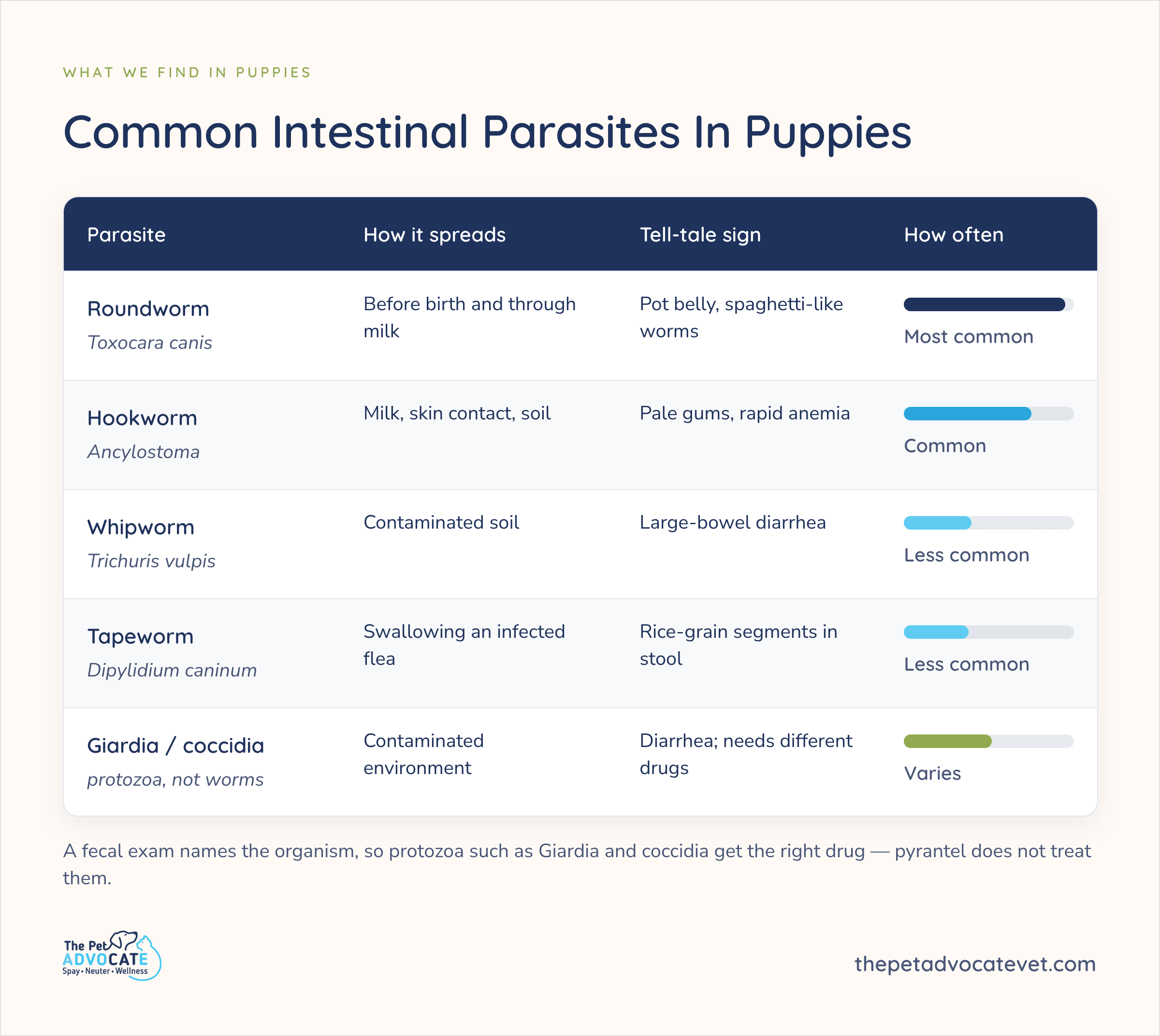
Roundworms (Toxocara canis) are the most frequent. They can be transmitted before birth and through milk. Heavy loads produce the classic pot-bellied appearance.
Hookworms (Ancylostoma) are next. They attach to the intestinal wall and feed on blood. Puppies can become anemic quickly if the burden is high.
Other parasites appear less often but still matter. Whipworms live in the large intestine. Tapeworms are often linked to fleas. Protozoa such as Giardia or coccidia can cause diarrhea and require different treatment. A fecal exam identifies which organisms are present so treatment can be targeted when needed.
In our Tracy clinic the highest rates of roundworms and hookworms show up in the youngest puppies. That is why we start pyrantel early and repeat it rather than waiting for a positive fecal.
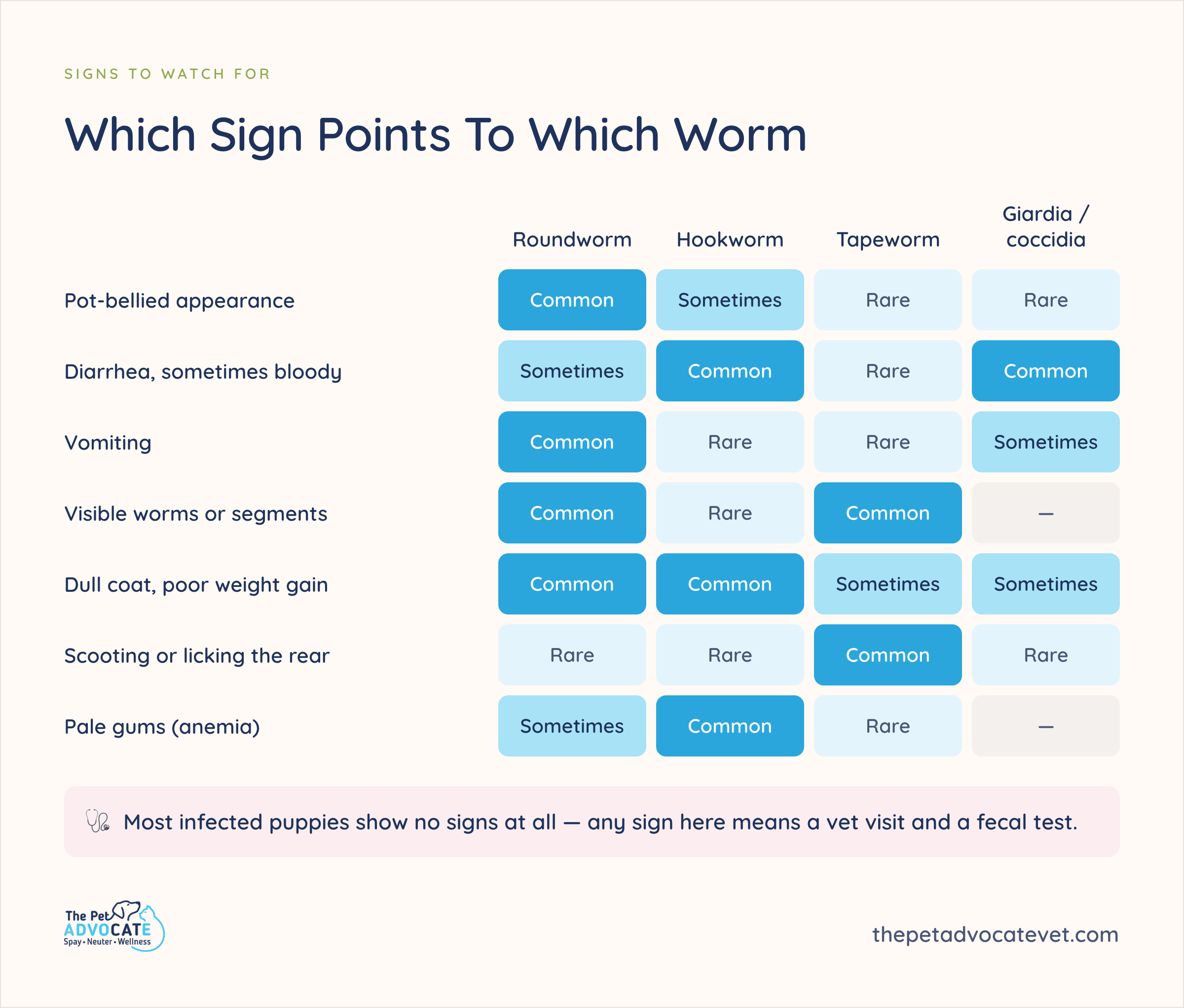
Many infected puppies show no obvious signs until the load is high. Watch for these common indicators:
Any of these signs warrants a veterinary visit and fecal testing rather than guessing at home. At The Pet Advocate Vet we often see puppies pass worms after the first dose of pyrantel. That is expected and means the product is working.
In our Tracy clinic we treat every new puppy as if it already carries intestinal parasites. That assumption comes from the high rate of maternal transmission we see in practice.
We administer pyrantel at every vaccine appointment, which usually begins around 8 weeks of age. The first-visit combination of DHPP vaccine plus pyrantel typically costs $65–$70 with no exam fee on walk-ins. If the puppy is already on a heartworm preventive that includes an intestinal dewormer such as ProHeart 6, the separate pyrantel dose can often be dropped.
Owners who need additional doses or who missed the early schedule can walk in Monday through Friday from 12 to 3 p.m. for deworming alone. The price is $12. No appointment is required. See our current prices and rates for the full list. You can also schedule your appointment for a combined vaccine and deworming visit if you prefer.
Fecal exams are available when indicated. CAPC recommends four in the first year. We discuss the timing at the first visit and continue as needed, especially if the puppy scavenges or has diarrhea.
This approach keeps the schedule practical for busy families while staying aligned with national guidelines. The same visit often covers the next vaccine booster, so owners do not have to make extra trips.
Families from Lathrop, Manteca, Stockton, Antioch, and Brentwood regularly use our Tracy walk-in hours.
Once the intensive every-two-weeks phase ends, most puppies move onto a monthly heartworm preventive that also controls intestinal worms. Many products can start as early as 6–8 weeks of age once the puppy reaches the label weight.
Year-round monthly prevention is the preferred path in California because mosquito activity and environmental parasite pressure never fully disappear. Dogs that cannot stay on a monthly product should receive a broad-spectrum dewormer at least four times a year plus regular fecal exams.
At The Pet Advocate Vet we use the first-year window—the same period that includes the vaccine series and early pyrantel doses—to also schedule the remaining boosters, rabies, microchip, and spay or neuter between 4 and 6 months for most breeds.
The full timeline is laid out in our new puppy checklist. You can book a visit to start the series.
Heartworm, flea, and tick prevention starts as early as eight weeks and continues year-round. Keeping the puppy on a consistent monthly product after the early deworming phase is the simplest way to protect against both heartworm and ongoing intestinal parasites.
Current pricing for vaccines and wellness is always posted.
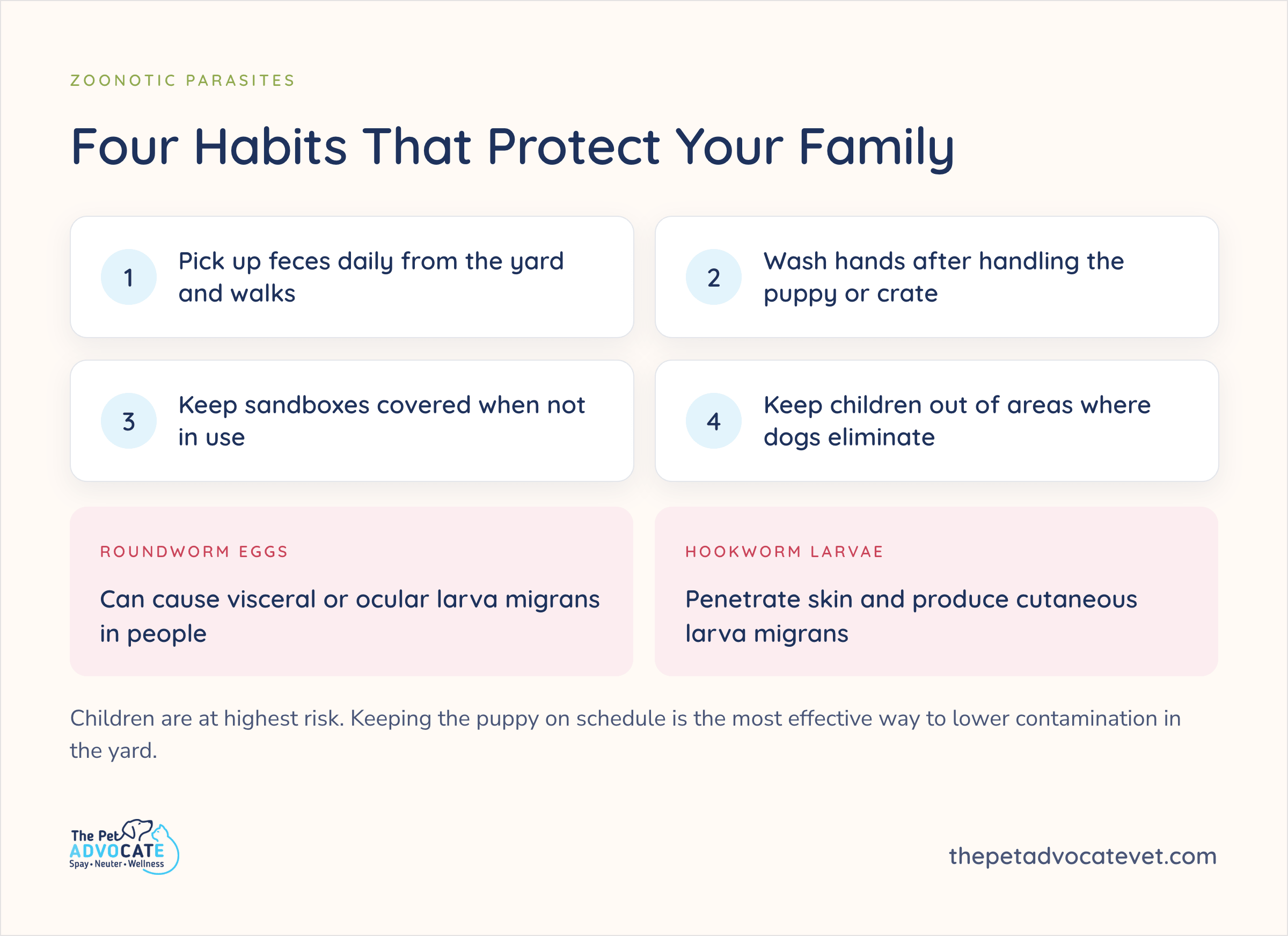
Roundworms and hookworms can infect people, especially children. Roundworm eggs can cause visceral or ocular larva migrans. Hookworm larvae can penetrate skin and produce cutaneous larva migrans. The CDC notes that puppies are a major source of environmental contamination with these eggs.
Simple habits reduce the risk:
At The Pet Advocate Vet we emphasize consistent deworming of the puppy as the most effective way to lower environmental contamination. The CAPC emphasizes control of parasites with zoonotic potential for exactly this reason. You can read the full CAPC general guidelines for the latest recommendations.
CAPC recommends starting at 2 weeks of age and repeating every 2 weeks until a monthly broad-spectrum preventive begins. If your puppy is already older when it comes home, start the schedule at the first veterinary visit and catch up from there. At The Pet Advocate Vet we begin pyrantel at the first vaccine visit for most new owners.
Every 2 weeks from 2 weeks of age until roughly 8 weeks, then monthly until 6 months of age or until a year-round preventive is in place. After that, monthly prevention is preferred; otherwise treat at least four times a year.
Yes. Pyrantel and similar products paralyze the worms so they are passed in the stool. Seeing dead or dying worms for a day or two after treatment is expected and does not mean the product failed.
Yes. Most exposure occurs before the puppy ever leaves the breeder or rescue, through the mother. Indoor living does not eliminate the need for the early schedule or ongoing prevention.
Walk-in deworming is $12. When combined with a vaccine visit the pyrantel is included in the typical $65–$70 first-visit total. There is no exam fee for walk-in wellness services. Current prices are listed on our prices and rates page.
Yes. Roundworms and hookworms are zoonotic. Children are at highest risk. Daily feces pickup, hand washing, and keeping the puppy on schedule are the practical protections.
Begin deworming at the first visit, perform a fecal exam if possible, and then move onto the monthly schedule. Ask the breeder or rescue for any prior deworming records so doses are not duplicated unnecessarily. At The Pet Advocate Vet you can schedule a visit or walk in during our wellness hours.
If your puppy still needs early doses or you want to start the vaccine-plus-deworming series, walk-in hours at The Pet Advocate Vet run Monday through Friday from 12 to 3 p.m. No appointment is required. You can also review current prices and book a full first visit through our pet vaccinations page.
Fully protected puppies recover more smoothly from later spay or neuter, so many owners complete the early schedule first. The complete first-year timeline, including vaccines, deworming, socialization, and spay timing, is in our new puppy checklist.
We serve Tracy and the surrounding Central Valley and East Bay communities including Lathrop, Manteca, Stockton, Antioch, and Brentwood. Directions and local pages are available under areas we serve.