Or call us at 209-879-9367 — we'll answer Mon–Fri, 8 AM to 4:30 PM.📍 1973 N. Tracy Blvd., Tracy, CA 95376
Schedule OnlineLast reviewed: September 2026. Written by Mike Wesselink, DVM, from surgical work at The Pet Advocate in Tracy, California.
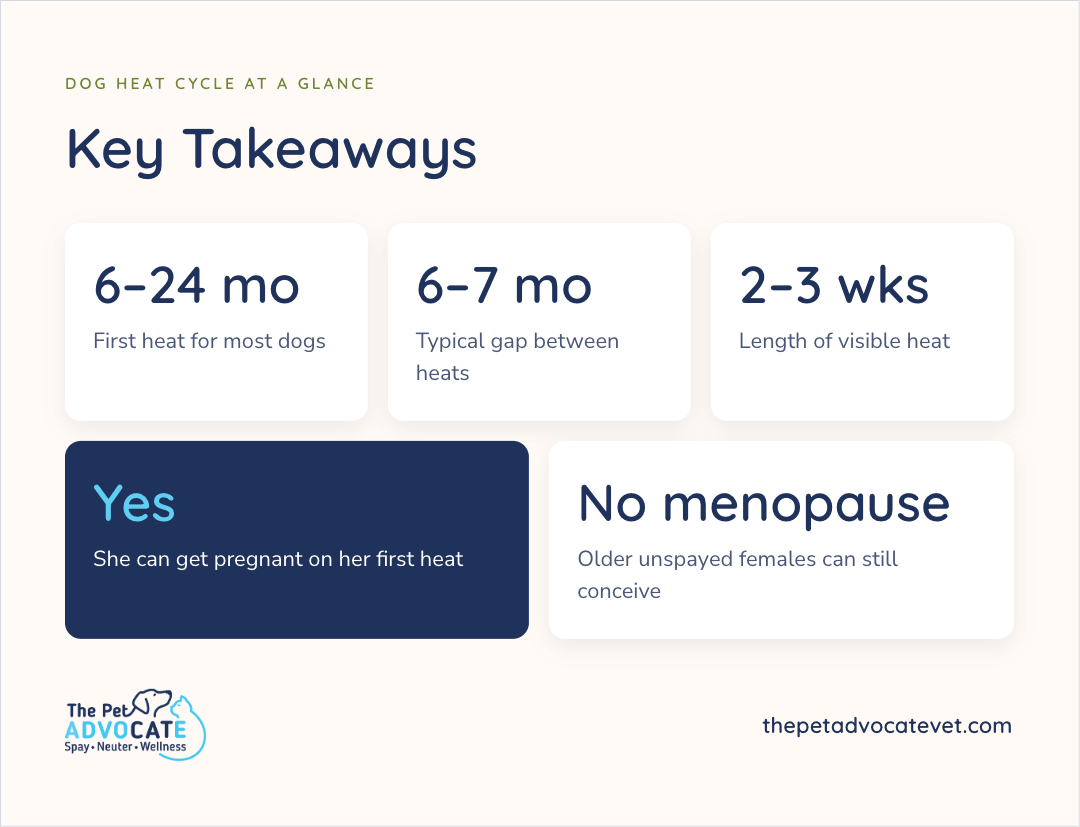
Most female dogs have a first heat between 6 and 24 months. After that, most cycle about every 6 to 7 months. The stretch owners call “in heat” lasts about 2 to 3 weeks.
At The Pet Advocate in Tracy, first heats in small-breed puppies often start while we still schedule most females for a spay at 4 to 6 months. Waiting for obvious bleeding is how a first cycle gets missed.
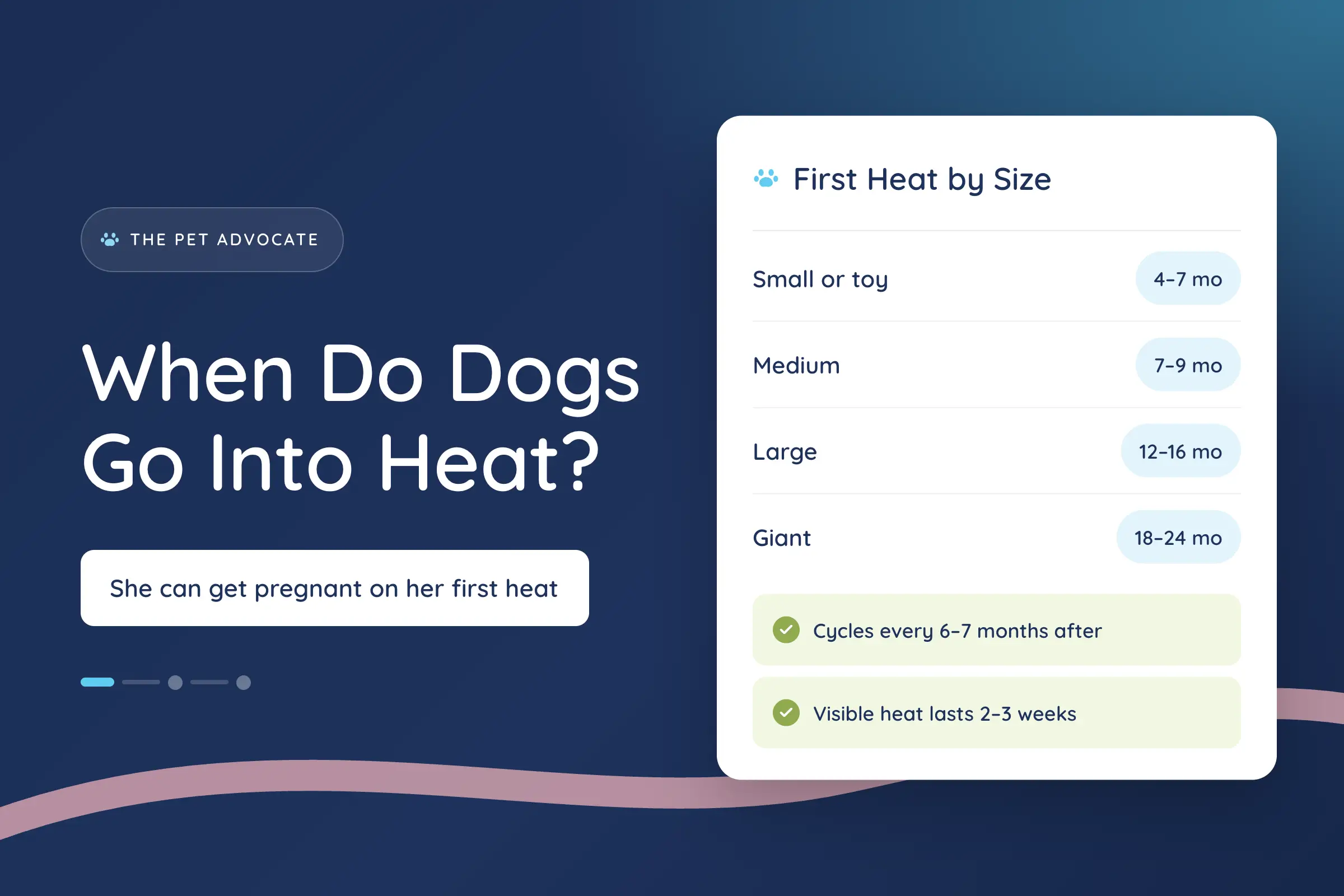
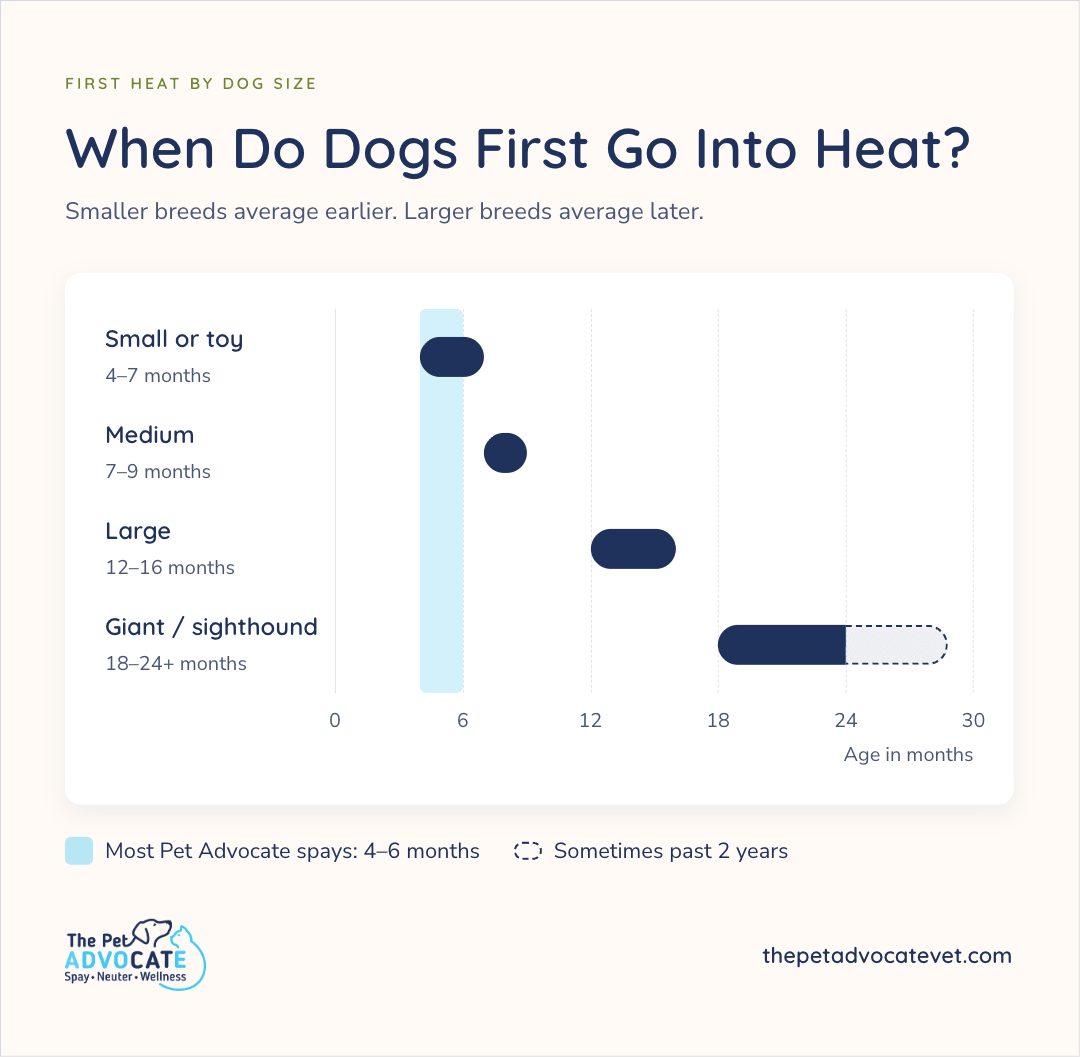
Most dogs have a first heat between 6 and 24 months. Cornell’s Riney Canine Health Center uses that range. Smaller breeds average earlier. Larger breeds average later.
| Size | Typical first heat |
|---|---|
| Small or toy | 4–7 months |
| Medium | 7–9 months |
| Large | 12–16 months |
| Giant or many sighthounds | 18–24 months, sometimes past 2 years |
VCA puts average puberty near 6 months and notes that large and giant breeds may not cycle until 18 months to 2 years. Some toy dogs start as early as 4 or 5 months.
The first cycle can be irregular or quiet. For many dogs it shows few of the usual signs. Cycles may not settle into a steady interval until about 2 years of age.
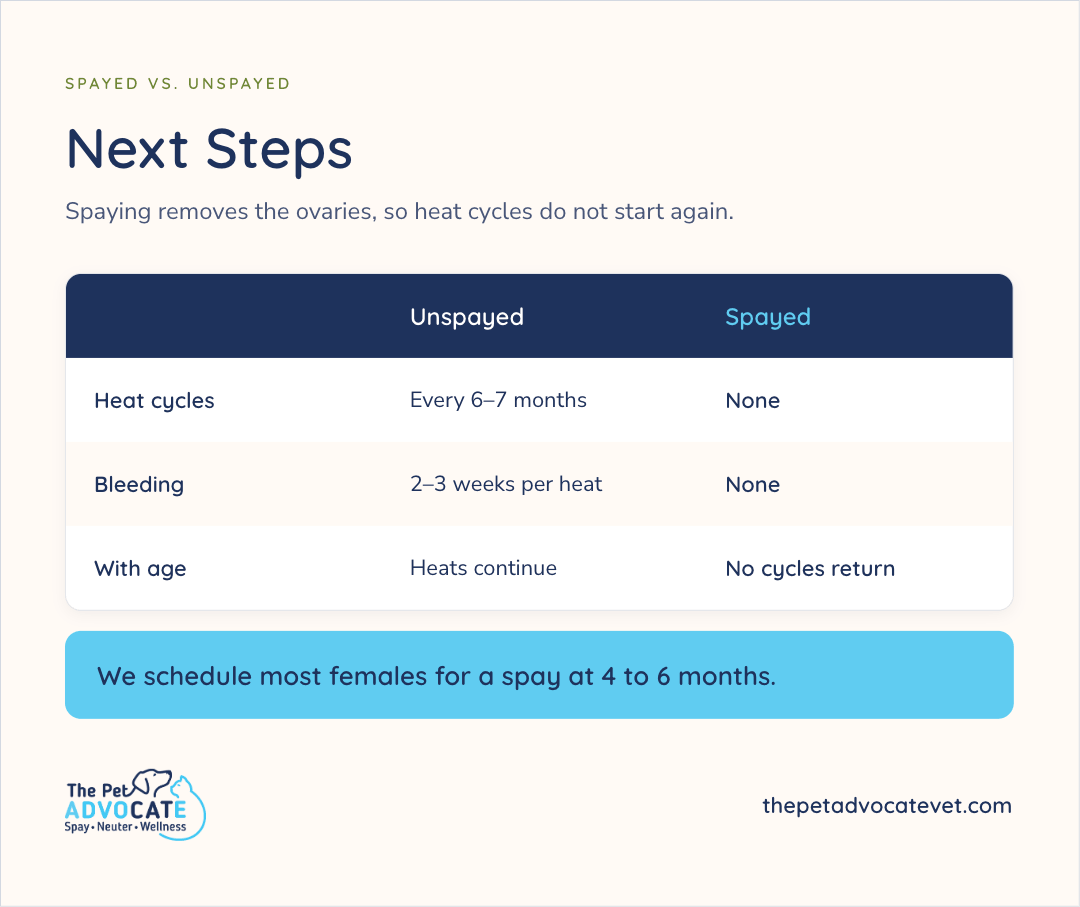
Because that first cycle can be quiet, we schedule most females for a spay at 4 to 6 months, before an owner is sure a heat has started.
Size and breed timing for a spay is on When to Spay or Neuter Your Dog. A giant-breed owner who wants to wait on growth should set that plan with their primary veterinarian.
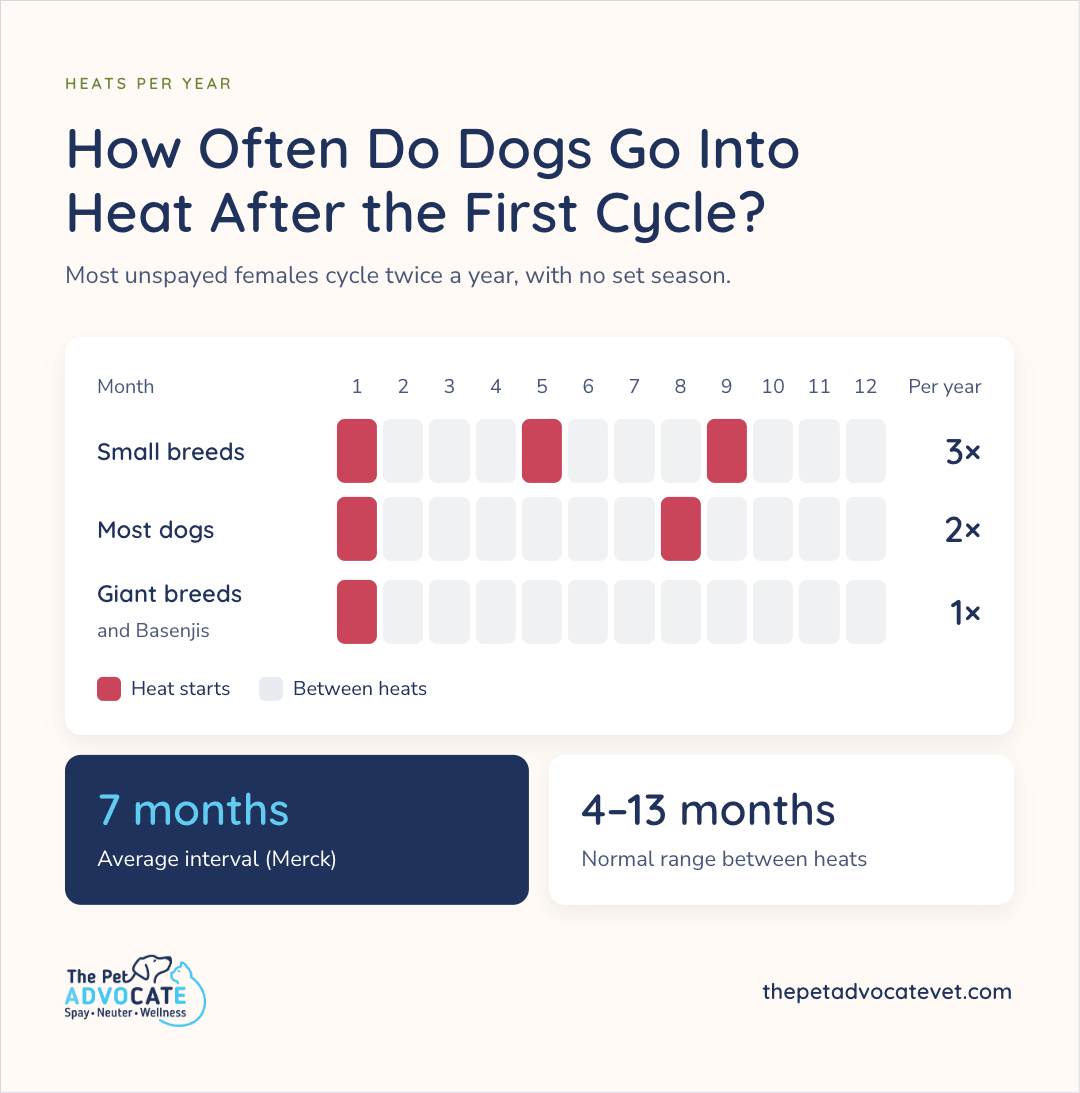
Most unspayed females cycle twice a year. The Merck Veterinary Manual puts the average interval at 7 months, with a range of 4 to 13 months. Cornell puts the typical gap at 5 to 11 months.
Small breeds may cycle three times a year. Giant breeds often cycle once. Merck uses Great Danes as an example of a 9 to 12 month interval. Basenjis, Tibetan Mastiffs, and dingoes typically cycle once a year.
Most pet dogs do not have a calendar season. Basenjis and some sled breeds are the exception and tend to cycle in spring.
After the first one or two cycles, the interval usually settles. Until then, write down the start date instead of assuming she will repeat every six months.
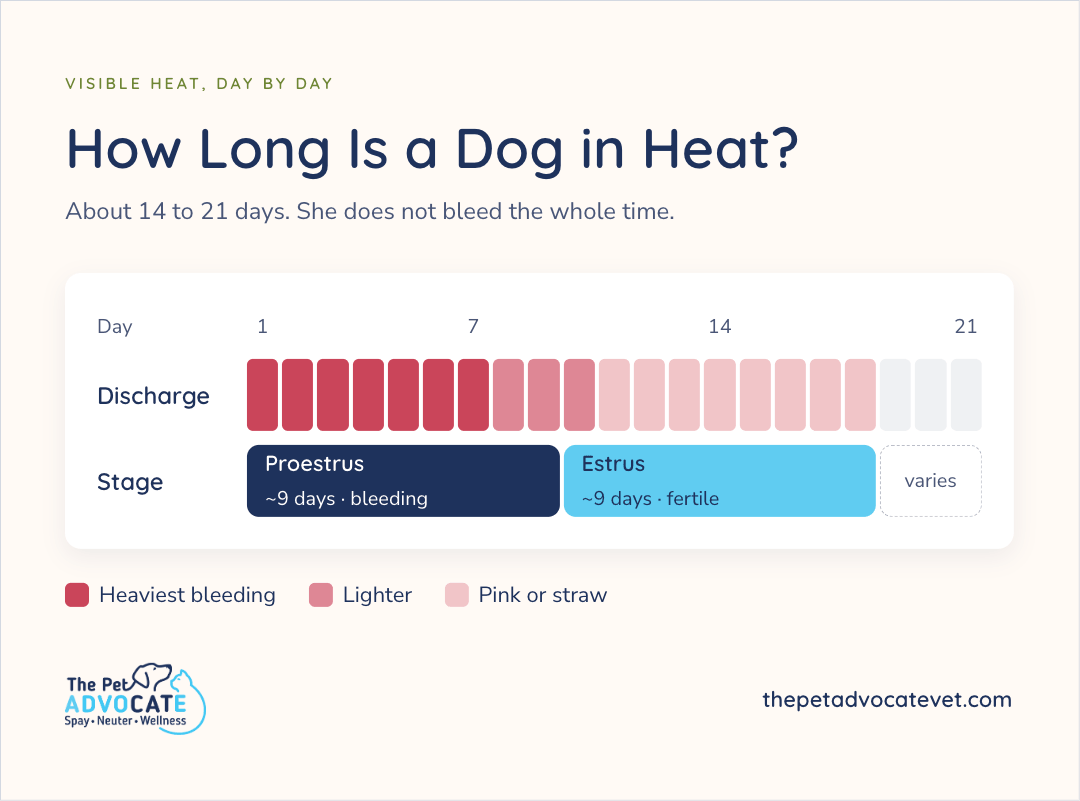
Visible heat lasts about 14 to 21 days. Those two stages are called proestrus, the bleeding stage, and estrus, the fertile stage.
She does not bleed the whole time. Bleeding is usually heaviest in proestrus, often about a week to 10 days. Discharge often lightens to pink or straw once she enters estrus.
Merck lists proestrus at about 9 days on average, with a range from 2 days to 3 weeks, and estrus at about 9 days on average, with a range from 3 days to 3 weeks. VCA’s 9-day average, with a range of 2 to 24 days, is estrus, the days she will stand for a male.
The amount of blood varies. Some dogs bleed a lot. Some bleed so little it is easy to miss.
If she is bleeding today and you are asking about a spay, start on Can You Spay a Dog in Heat.
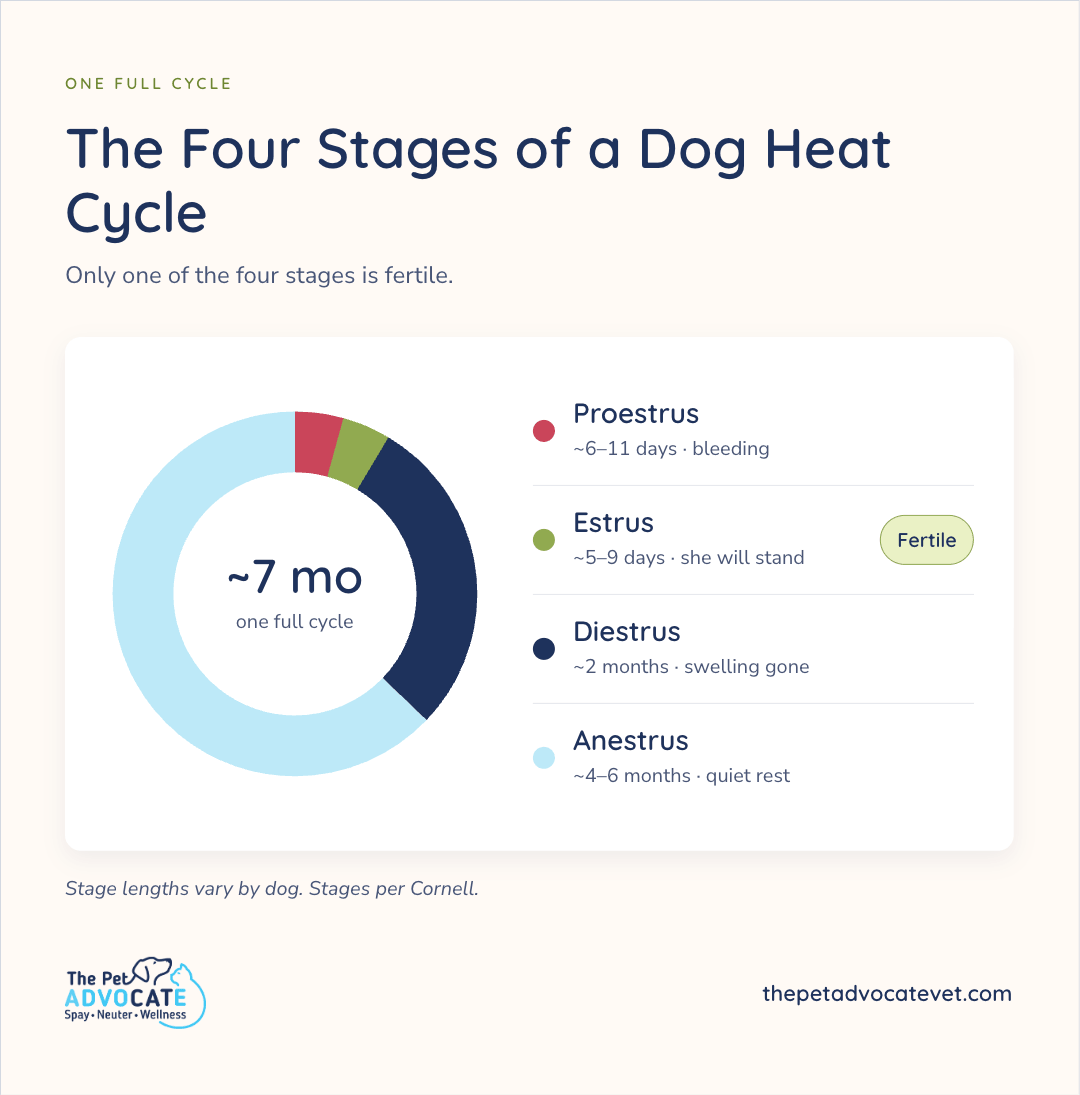
A dog’s heat cycle has four stages. Only one of them is fertile. Cornell lists the same four stages below.
| Stage | Typical length | What you see | Fertile? |
|---|---|---|---|
| Proestrus | About 6–11 days (average near 9; range 2 days to 3 weeks) | Swollen vulva, bloody discharge, males interested, she will not stand | No |
| Estrus | About 5–9 days typical (average near 9; range can run 1–21 days or more) | Discharge lighter or straw-colored; tail held to the side; she will stand | Yes |
| Diestrus | About 2 months | Swelling gone; males lose interest | No |
| Anestrus | About 4–6 months (Merck range 1–6) | Quiet rest until the next proestrus | No |
Ovulation happens during estrus, about 2 to 3 days after a hormone surge. Sperm can live for days, so she can get pregnant through the whole estrus stage.
The hormone that supports pregnancy stays high in diestrus even if she is not pregnant. That is why a false pregnancy can follow a heat that did not produce a litter.
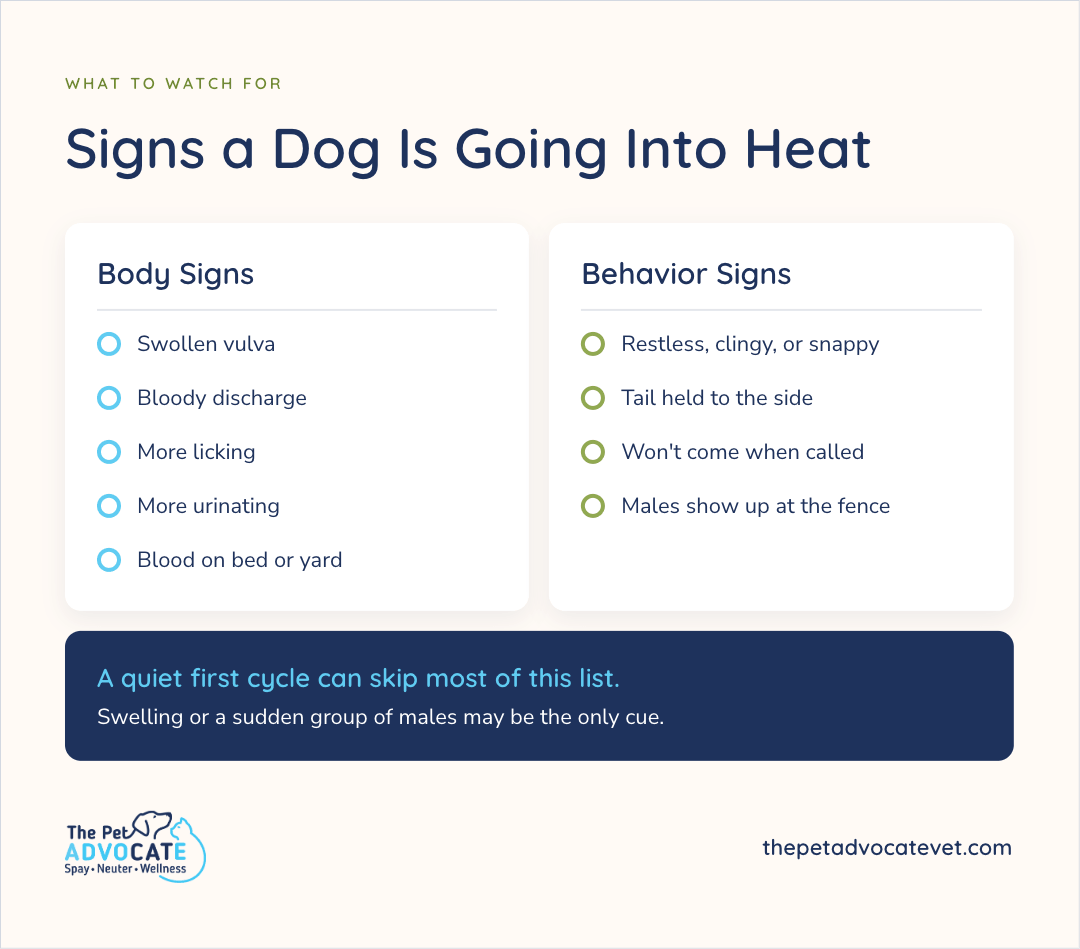
Heat has started when the vulva swells and a bloody discharge appears. Swelling often shows first and is not always obvious. Discharge is usually darkest at the start and later turns pink or straw-colored. Many dogs lick more, urinate more, and leave blood on a bed, a diaper, or the yard.
Behavior shifts with the same hormones. She may be restless, clingy, or snappy. In estrus she may hold her tail to the side and refuse to come when called, even if she usually does. Unneutered males show up at the fence.
A quiet first cycle can skip most of that list. Swelling or a sudden group of males may be the only cue.
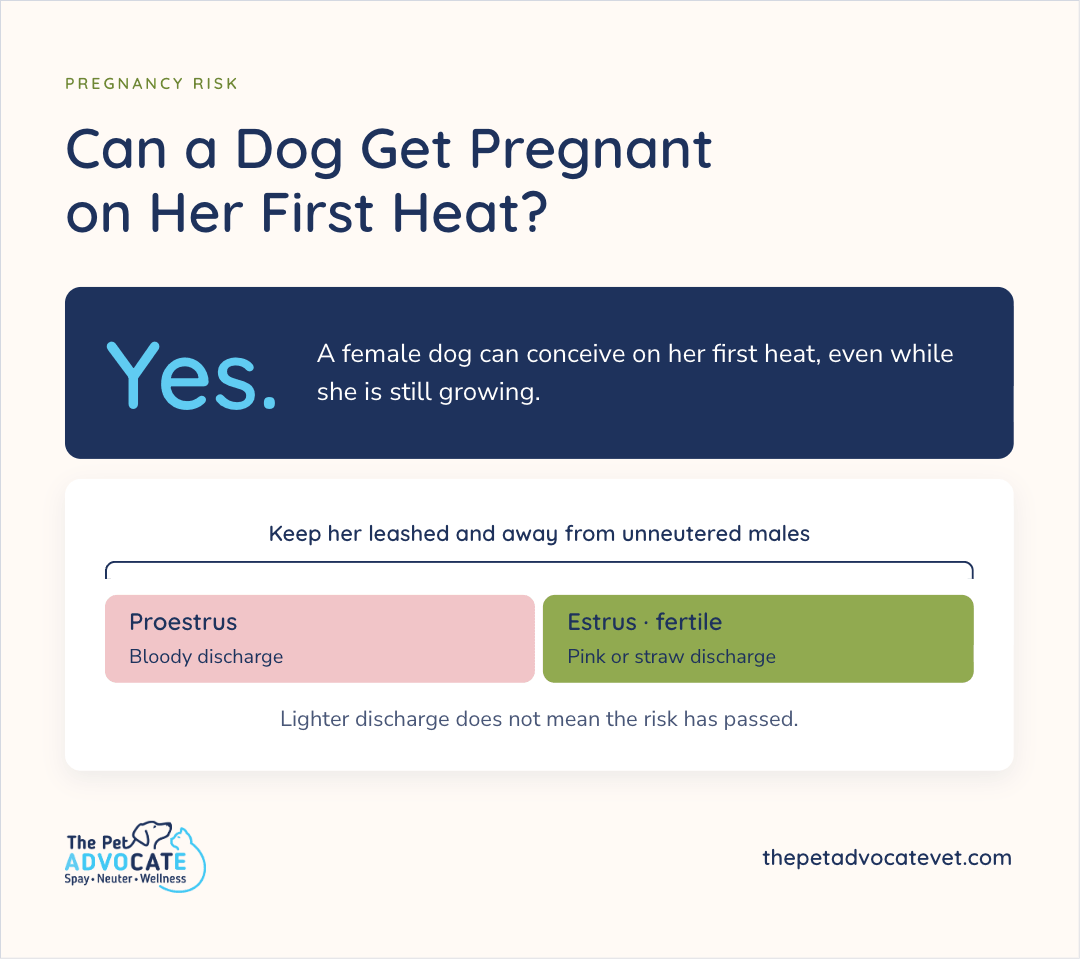
Yes. A female dog can conceive on her first heat, even while she is still growing. VCA notes that a dog can become pregnant on her first cycle.
Keep her leashed and away from unneutered males for the whole visible heat, not for one afternoon. Pink or straw discharge still means she can conceive.
If a mating already happened, start on Can You Spay a Pregnant Dog or Cat.
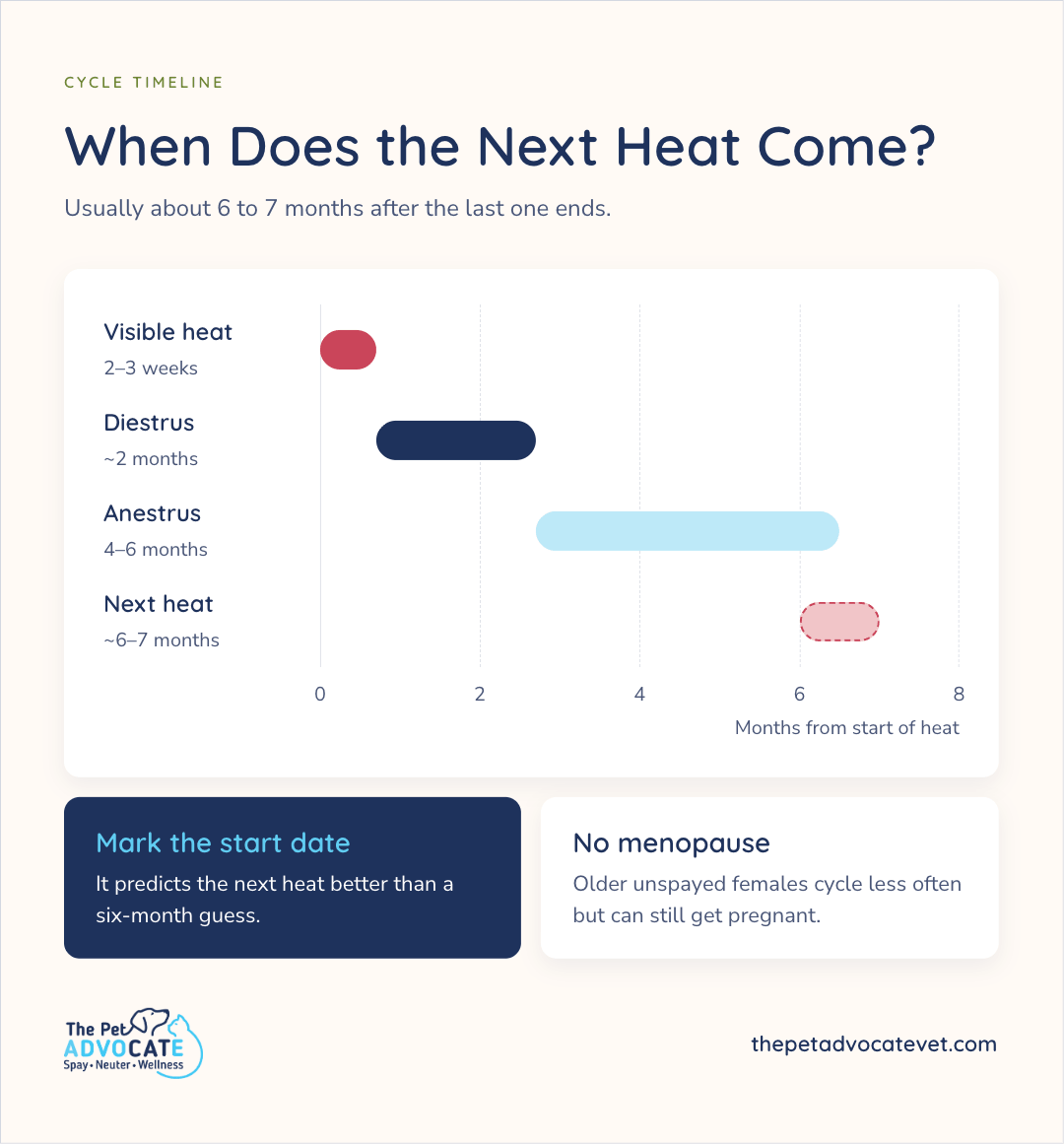
After a female dog’s visible heat ends, the next one usually comes in about 6 to 7 months. Diestrus lasts about 2 months. Anestrus lasts about 4 to 6 months. Mark the start date of the heat that just finished. That date predicts the next cycle better than a generic six-month guess.
Dogs do not go through menopause. Older unspayed females may cycle less often. They can still get pregnant.
If she already finished a heat and the question is whether surgery is still worth doing, use I Missed the First Heat — Is Spaying Still Worth It.
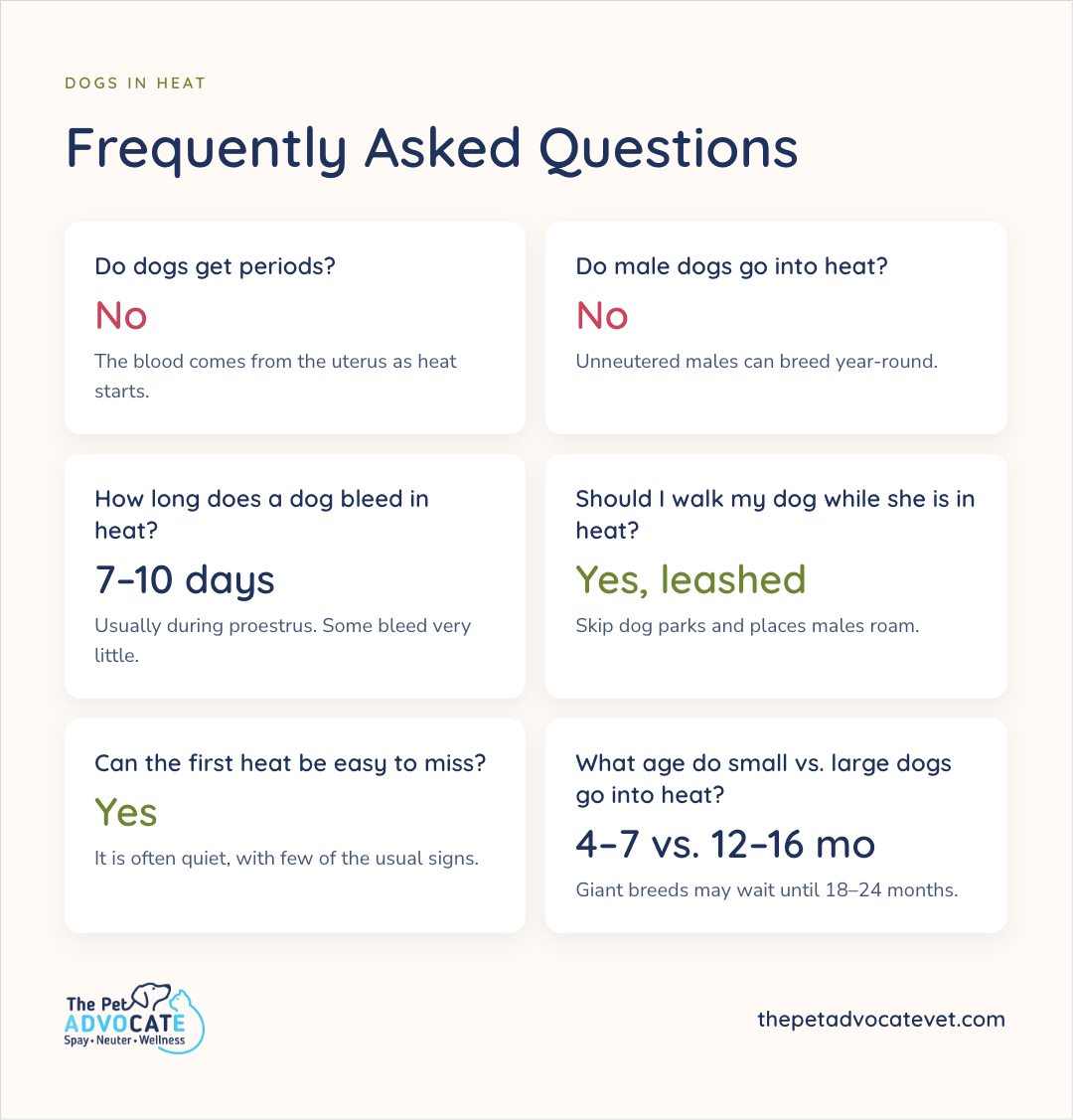
No. Dogs do not have a menstrual period. The blood you see comes from the uterus as heat starts.
No. Male dogs do not have heat cycles. An unneutered male can breed year-round if he finds a female in heat.
Many dogs bleed for about a week to 10 days, usually in proestrus. Some bleed through more of the visible heat. Some bleed so little the cycle is easy to miss.
Yes, on a leash, and not at a dog park or anywhere unneutered males roam. She can get pregnant for as long as she is in estrus.
Yes. For many dogs the first heat is quiet, with few of the usual signs. Swelling or a sudden group of male dogs may be the only cue.
Small and toy dogs often start at 4 to 7 months. Large dogs often start at 12 to 16 months. Giant breeds and some sighthounds may wait until 18 to 24 months.
Spaying removes the ovaries, so heat cycles do not start again. The difference between a spay and a neuter is on Spay vs Neuter.
Current fees are on prices and rates. Booking is on schedule your appointment. The first-year timeline is on the new puppy checklist.
The size clock for first heat and the four-stage cycle chart are below for a visual summary of the tables above.
Only estrus is fertile. The other three stages fill the rest of a typical heat cycle.