
Or call us at 209-879-9367 — we'll answer Mon–Fri, 8 AM to 4:30 PM.📍 1973 N. Tracy Blvd., Tracy, CA 95376
Schedule OnlineMost adult dogs need a professional teeth cleaning under anesthesia about once a year. Small breeds and dogs that already show brown tartar often need one sooner, every 6 to 12 months.
The right interval comes from what your veterinarian sees in your dog's mouth. A dog with clean teeth and daily brushing can sometimes go longer. A dog that already has tartar and has never had a cleaning is usually overdue.
At The Pet Advocate in Tracy, a dental cleaning is $700 and includes pre-anesthetic bloodwork, full-mouth X-rays, scaling, polishing, fluoride, and charting.
Most healthy adult dogs need a professional cleaning every 12 months. The schedule shifts with size, age, and how much tartar builds between visits.
| Your dog | Typical cleaning interval |
|---|---|
| Healthy adult, medium or large breed, with home brushing | About every 12 months, sometimes longer if the exam stays clean |
| Small or toy breed (under about 20 lb) | Every 6 to 12 months |
| Flat-faced breed with crowded teeth | Every 6 to 12 months |
| Senior dog | Every 6 to 12 months, based on the exam |
| Dog with brown tartar or red gums today | Now, then on the schedule your vet sets |
| Dog that has had extractions or gum disease | Every 6 months is common |
AAHA recommends a dental evaluation at least once a year as part of every preventive exam. That yearly look is what sets your dog's real interval.
Your dog may not need the same schedule as a neighbor's dog of the same age. If you can already see brown tartar or red gums, you don't have to wait for the next calendar date.

A dental cleaning at The Pet Advocate is $700, or $650 when it's booked with a spay or neuter. Extractions are additional.
That price includes:
We keep the price down by focusing on spay, neuter, and dental work. How much a dog dental cleaning costs includes the $700 and $650 figures, plus what extractions add.
A cleaning done on schedule usually costs less than one done late. The longer tartar sits, the more likely a tooth will need to come out.

Small and toy breeds often need a cleaning every 6 to 12 months. Their full set of adult teeth is packed into a small jaw, so plaque and tartar collect in the tight spaces faster.
Flat-faced breeds also tend to have more dental issues, because their teeth are rotated and crowded and trap plaque along the gumline. Even with regular brushing, a yearly cleaning is often not frequent enough for these dogs.
The front teeth can look fine while the back teeth already have heavy tartar. Starting professional cleanings earlier, once tartar or red gums show up, keeps that first visit simpler.

AAHA's 2019 dental guidelines recommend a first full cleaning with X-rays by age 1 for small and medium dogs and by age 2 for larger dogs, even when the teeth look clean. Problems under the gumline don't show up on an awake exam. If tartar or red gums appear sooner, you don't need to wait for that birthday.
Look for these signs that a cleaning is due:
By age 3, a dog will very likely have some early gum disease, according to the American Veterinary Medical Association, and it gets worse with age without prevention. A first cleaning done early is usually the simplest one your dog will have.

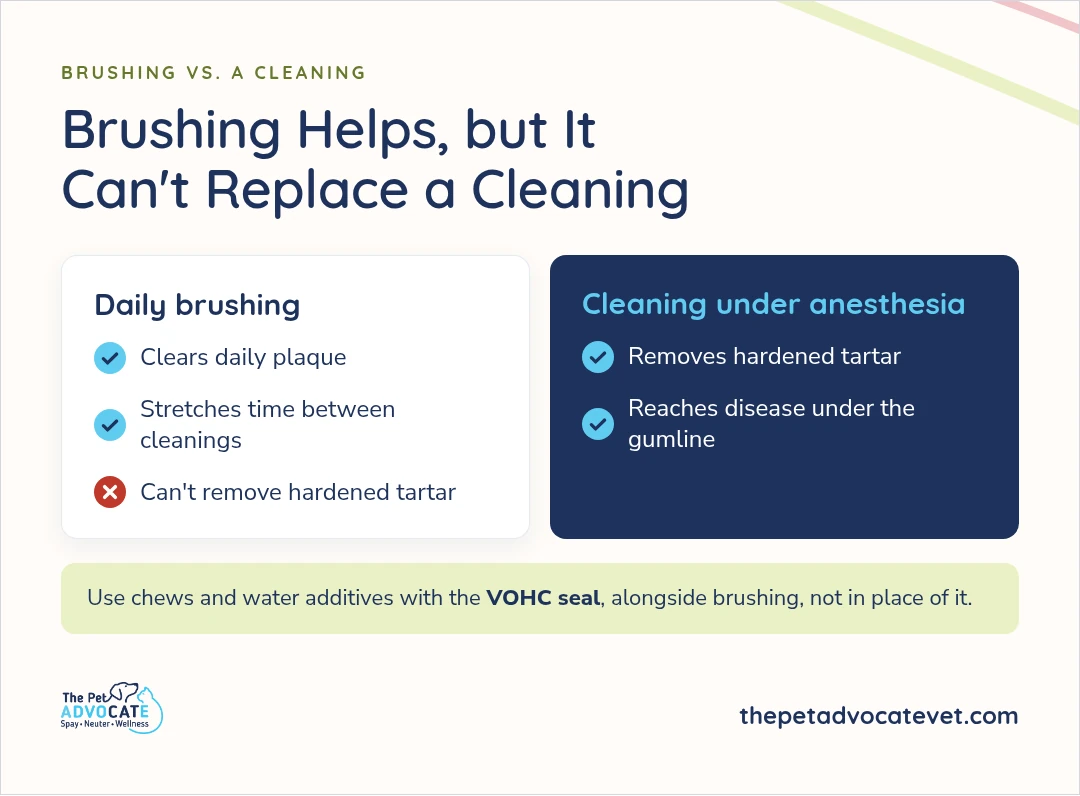
Daily brushing removes plaque and stretches the time between cleanings, but it can't remove tartar once it has hardened. Only a cleaning under anesthesia reaches tartar and disease under the gumline.
Plaque is the clear, slimy film that builds on teeth every day, like the film you feel on your own teeth in the morning. Left alone, it hardens into brown tartar.
Brushing clears plaque. Brown buildup means your dog is past the brushing stage and needs a cleaning.
To get the most from home care:
Powders and additives without the VOHC seal haven't had their plaque or tartar results reviewed by the council. If you're unsure about a product, ask us when you book.
Plaque that sits along the gumline is the start of dog gingivitis.
For a healthy dog, anesthesia for a dental cleaning is routine, and it's the only way to clean under the gumline and take X-rays. Every dental at The Pet Advocate starts with a physical assessment and pre-anesthetic bloodwork the same day, before anesthesia.
If your dog has seizures, diabetes, a heart condition, or another ongoing health issue, a full-service hospital is the right fit, because their regular veterinarian can tailor anesthesia to them.
Anesthesia-free cleanings scrape the visible tooth surface only. We regularly see dogs whose owners believed a yearly dog teeth cleaning without anesthesia was enough, and X-rays under anesthesia found teeth that needed to come out.

Tartar keeps building under the gumline, which leads to gum disease, pain, infection, and eventually lost or extracted teeth. A skipped year usually means a longer, more expensive cleaning later.
Dogs hide mouth pain well. Many keep eating while a tooth root is infected. If the breath already lingers or the gums look red, waiting another year usually makes the next cleaning harder on your dog.
Advanced gum disease doesn't stay in the mouth, either. It has been linked with changes in the kidneys, liver, and heart.

A dental cleaning at The Pet Advocate follows the same steps every time:
The assessment and bloodwork happen the same day, before anesthesia. Those steps are how a dog dental cleaning is done at our Tracy clinic.

Booking starts with a short online history form and 3 photos or a short video of your dog's teeth. Our team reviews them and reaches out to schedule.
The photos help us plan the right amount of time for your dog, so the day runs smoothly.
Dogs who are under 14 years old, weigh 3 to 100 lb, and are free of ongoing health conditions are a great fit. Dental requirements include the age, weight, health, and breed limits. We aren't able to take French Bulldogs, English Bulldogs, or Rottweilers for dentals, though Pugs, Boston Terriers, and Boxers are usually accepted.
A $50 deposit holds the appointment and comes off the total on the day of the procedure. Prices and rates list the $700 cleaning, the $650 bundle, and every other service.
We're at 1973 N. Tracy Blvd. in Tracy and see dogs from Stockton, Manteca, Lathrop, and the East Bay.

Daily brushing is the home care that helps the most. It keeps plaque from hardening into tartar, which is what stretches the time between professional cleanings.
A yearly cleaning under anesthesia with X-rays is enough for most dogs. If that yearly cleaning was done while your dog was awake, it likely missed disease under the gumline, and a full cleaning with X-rays is the next step.
You can book a dental cleaning with your dog's spay or neuter at The Pet Advocate for $650. Extractions, if they're needed, are additional.
Senior dogs often need a cleaning every 6 to 12 months, based on what the yearly exam shows. We see dogs for dentals until they turn 14.
Small and toy breeds tend to have more dental problems than larger dogs, because a full set of adult teeth sits in a much smaller jaw. Flat-faced breeds also tend to have more dental issues, because their teeth are rotated and crowded.
The products you can count on carry the Veterinary Oral Health Council seal. They help alongside daily brushing but can't remove tartar that has already hardened.
A yearly cleaning is the simplest way to keep your dog comfortable and avoid bigger dental bills later. If it's been more than a year, or you can see brown tartar today, we'd be glad to take a look.
Send us a few photos of your dog's teeth when you book a dog dental cleaning, and we'll help you find a day that works. We look forward to meeting you and your dog in Tracy.