Or call us at 209-879-9367 — we'll answer Mon–Fri, 8 AM to 4:30 PM.📍 1973 N. Tracy Blvd., Tracy, CA 95376
Schedule OnlineThe feline leukemia vaccine protects cats against a contagious and incurable virus spread through everyday contact. Guidelines from major veterinary organizations classify it as core for every cat under one year of age. For adult cats the decision depends on lifestyle and exposure risk.
I am Dr. Mike Wesselink, a UC Davis-trained veterinarian who runs The Pet Advocate, a high-volume spay, neuter, and wellness clinic in Tracy, California. In our practice we see cats from every background and have found that clear recommendations combined with testing and transparent pricing help owners make the best choice for their pet.
This page explains what the vaccine does, which cats benefit most, the schedule we follow, why testing comes first, safety considerations, and what it costs at our clinic.
The feline leukemia vaccine protects cats against feline leukemia virus (FeLV), a contagious and incurable infection spread through saliva and close contact. Veterinary guidelines classify it as core for every kitten and cat under one year of age. For adult cats, the need depends on lifestyle and exposure risk.
Feline leukemia virus weakens a cat's immune system over time. It can lead to anemia and certain cancers, and there is no cure once a cat is infected.
The virus spreads through saliva, shared food bowls and litter boxes, mutual grooming, bites during fights, and from an infected mother to her kittens. It does not spread to people or dogs.
.webp)
The American Animal Hospital Association and the Feline Veterinary Medical Association classify the feline leukemia vaccine as core for every cat under one year of age. For adult cats the guidelines shift to a risk-based approach.
They recommend it for cats that go outdoors or live with other cats of unknown status. It becomes optional for strictly indoor adult cats with no new additions to the home.
In our practice we recommend the feline leukemia vaccine for every cat, whether they stay inside or go out. We explain the reasoning so each owner can decide.
Indoor cats slip outside more often than owners expect. Households add new cats. The virus spreads through everyday contact like shared water bowls or grooming each other. We respect owners who choose to opt out for their low-risk adult cat after we have talked through the risks.
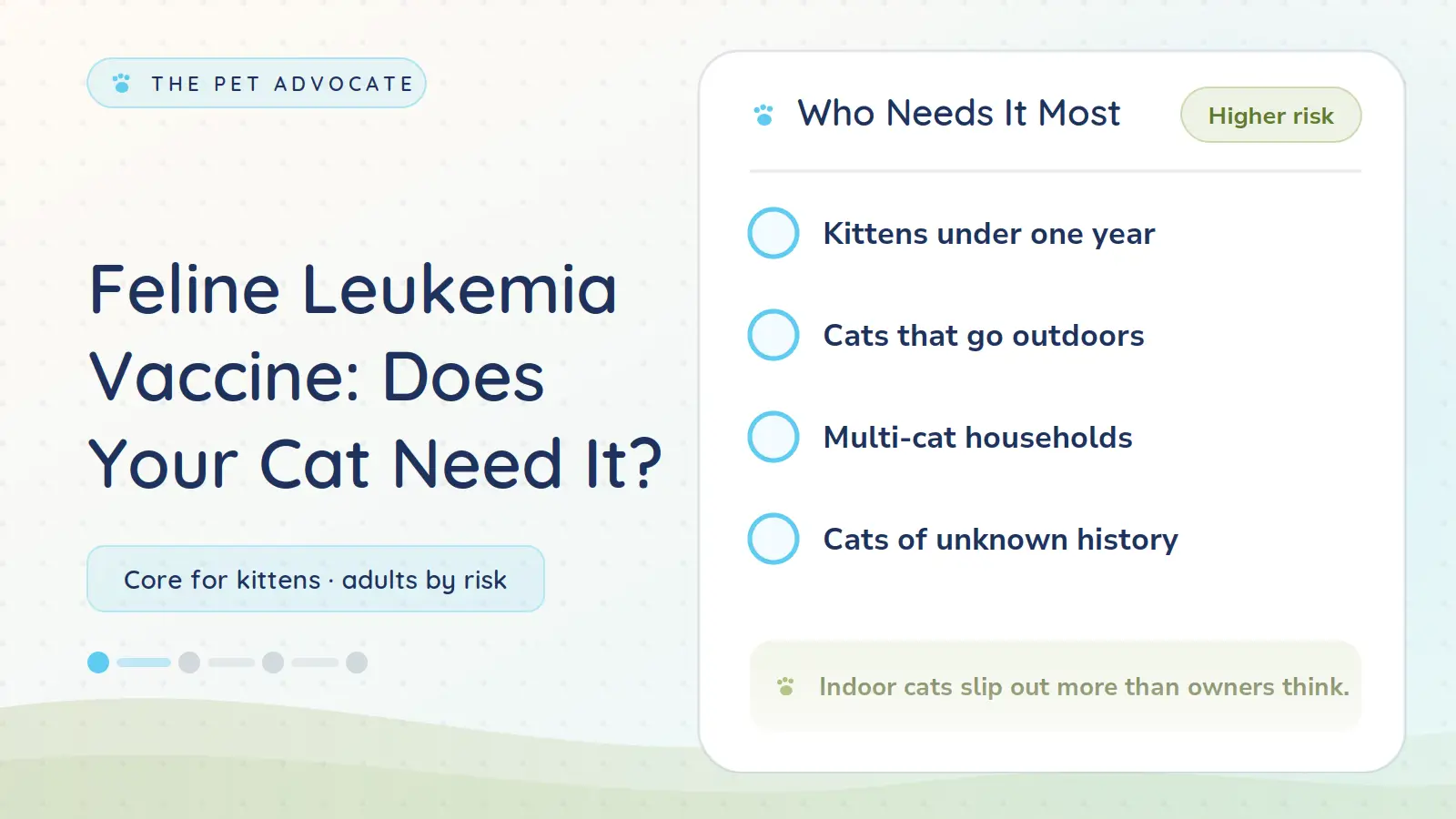
Higher-risk cats include outdoor and indoor-outdoor cats, kittens under one year, cats in multi-cat homes, cats living with an FeLV-positive cat, and cats of unknown history.
.webp)
Here is a simple way we think about risk in practice: outdoor or indoor-outdoor cats and those in multi-cat homes or living with a known positive cat sit at the highest risk. Indoor cats with new additions or unknown history fall into moderate risk. Strictly indoor adult cats in stable single-cat homes with no new exposures carry the lowest risk.
You can review our full vaccination guidelines and the current American Animal Hospital Association feline vaccination guidelines for the complete classification framework.
We give the vaccine as a two-dose initial series about three to four weeks apart, followed by a booster one year later. After that the interval depends on the cat's exposure risk and gets set during the annual wellness visit.
Kittens usually receive the first FeLV dose at 12 weeks and the second at 16 weeks as part of their core series. We time the doses this way because maternal antibodies from the mother's milk can interfere with the vaccine's ability to build immunity early on.
By the later doses those antibodies have typically faded, allowing the kitten's own immune system to respond strongly. The final dose after four months of age is the one that usually creates the most robust protection.
If you are bringing in a kitten for vaccines, the full series includes several other core shots. You can find the complete kitten vaccine schedule on our site.
Before we start the feline leukemia vaccine series, we run a quick blood test for FeLV. The vaccine offers no benefit to a cat that already carries the virus, so testing first prevents giving owners false confidence.
The same test also screens for feline immunodeficiency virus. We combine both into one test at our clinic because it is efficient and gives us the full picture before any injection.
In our practice we have seen cats whose owners assumed they were protected only to discover later the cat was already positive. Testing removes that uncertainty and lets us focus on proper management for any cat that tests positive.
When a cat tests positive we discuss management options and monitoring rather than proceeding with vaccination that cannot help. This step fits into our broader approach to feline wellness. We test before the first FeLV vaccine because it is the responsible way to start any new cat on a vaccination plan, whether the cat is a kitten or an adult of unknown history.
Most cats show no reaction at all or only mild, short-lived signs such as lower energy or a smaller appetite for a day or two. The main concern owners ask about is injection-site sarcoma, a rare tumor that can develop at the site of any injection in cats.
The reported rate remains very low. We monitor the injection site after vaccination and advise owners to watch for any lump that persists or grows and to call us if they notice one.
.webp)
Over the years we have vaccinated thousands of cats with the FeLV vaccine and the vast majority tolerate it without issue. We still discuss the small risk openly with every owner because informed decisions lead to better long-term care. We have found that transparency builds trust.
We keep vaccine pricing transparent and low because we run a walk-in model with no exam fee for these services.
Vaccines and wellness services are available as walk-ins Monday through Friday from 12 to 3 PM. Current rates and any updates appear on our pricing page.
The Pet Advocate offers low-cost feline vaccines, including the FeLV vaccine, to Tracy and the surrounding communities. We provide them as walk-ins with no exam fee.
Our clinic is located in Tracy, California. Walk-in hours run Monday through Friday from 12 to 3 PM. For the exact address, phone number, and directions, visit our pet vaccinations page.
Indoor cats are lower risk, which is why national guidelines make the vaccine optional for strictly indoor adult cats with no exposure. In our practice we still recommend it for every cat.
Indoor cats get outside more often than owners expect and the virus spreads through everyday contact. Kittens under one year should get it regardless of lifestyle.
Cats receive a two-dose initial series, then a booster one year later. After that the interval depends on the cat's exposure risk and is set at the annual visit.
Outdoor and at-risk cats are usually boosted yearly. Low-risk cats may go longer between boosters.
Yes. Most cats have no reaction or a mild, short-lived one such as low energy or reduced appetite. A rare injection-site tumor can form after any injection, and the reported rate is very low.
The protection against an incurable virus outweighs that small risk for cats at risk of exposure.
No. The feline leukemia vaccine cannot give a cat FeLV and does not cause a false positive on the FeLV test. It trains the immune system to recognize the virus without causing infection.
No. FeLV infects only cats. It does not spread to people, dogs, or other non-feline animals. An FeLV-positive cat poses no infection risk to the rest of the household outside of other cats.
At our clinic the FeLV vaccine is a low-cost walk-in service with no exam fee. We test for FeLV and FIV before the first dose.
See our pricing page for current rates on the test and the vaccine.
Feline leukemia has no cure and spreads through ordinary contact. The vaccine is one of the few tools that reliably lowers a cat's risk. Every kitten should receive it.
For adult cats the choice comes down to exposure, which owners often underestimate. In our practice we recommend the vaccine for every cat and explain the reasoning so you can decide what fits your situation.
Stop by The Pet Advocate in Tracy for a walk-in vaccine appointment or check current pricing and availability on our pet vaccinations page. We are here to make the process simple, transparent, and based on what actually works in a busy feline practice.