

Or call us at 209-879-9367 — we'll answer Mon–Fri, 8 AM to 4:30 PM.📍 1973 N. Tracy Blvd., Tracy, CA 95376
Schedule OnlineBy Mike Wesselink, DVM. Doctor of Veterinary Medicine, UC Davis, 2015. Owner of The Pet Advocate, a low-cost clinic in Tracy, CA.
Last updated June 2026.
Your puppy needs core vaccines starting at 6 to 8 weeks old. After that, they get a booster every three to four weeks until the final dose at 16 weeks or older. That last dose builds the protection that lasts.
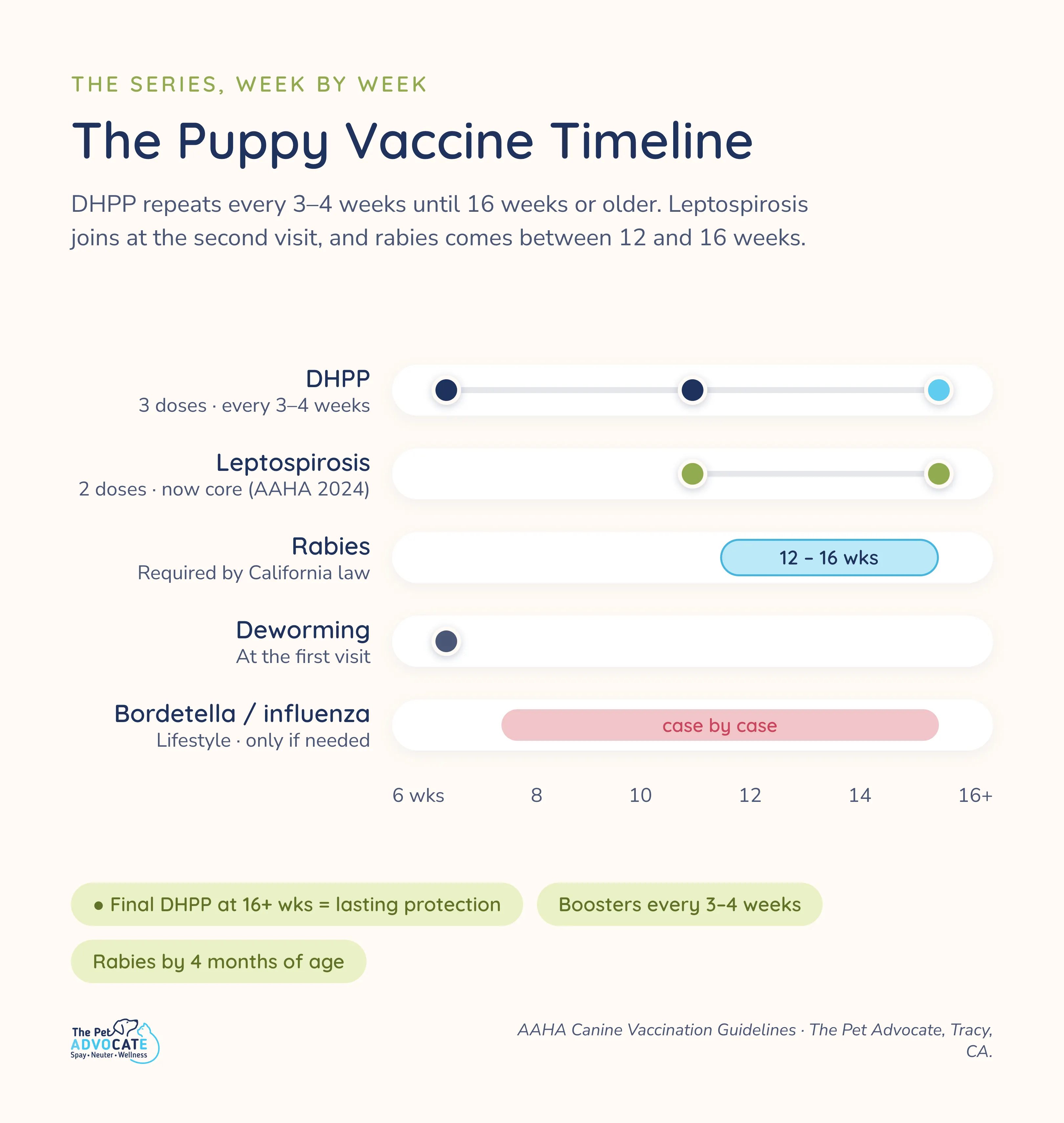
I run a low-cost clinic in Tracy, and I see new puppies for their shots every week. The schedule below shows each vaccine, the right age for it, and what it costs at our clinic.
Puppies start core vaccines at 6 to 8 weeks old. They get a DHPP booster every three to four weeks until the final dose at 16 weeks or older. Rabies comes between 12 and 16 weeks. The dose given at 16 weeks or later builds the strongest, longest-lasting protection.
Your vet adjusts this for your puppy. A dog with a known history or a specific risk may need a different plan.
Most clinics follow the AAHA canine vaccination guidelines. The core list for dogs covers DHPP, rabies, and now leptospirosis.
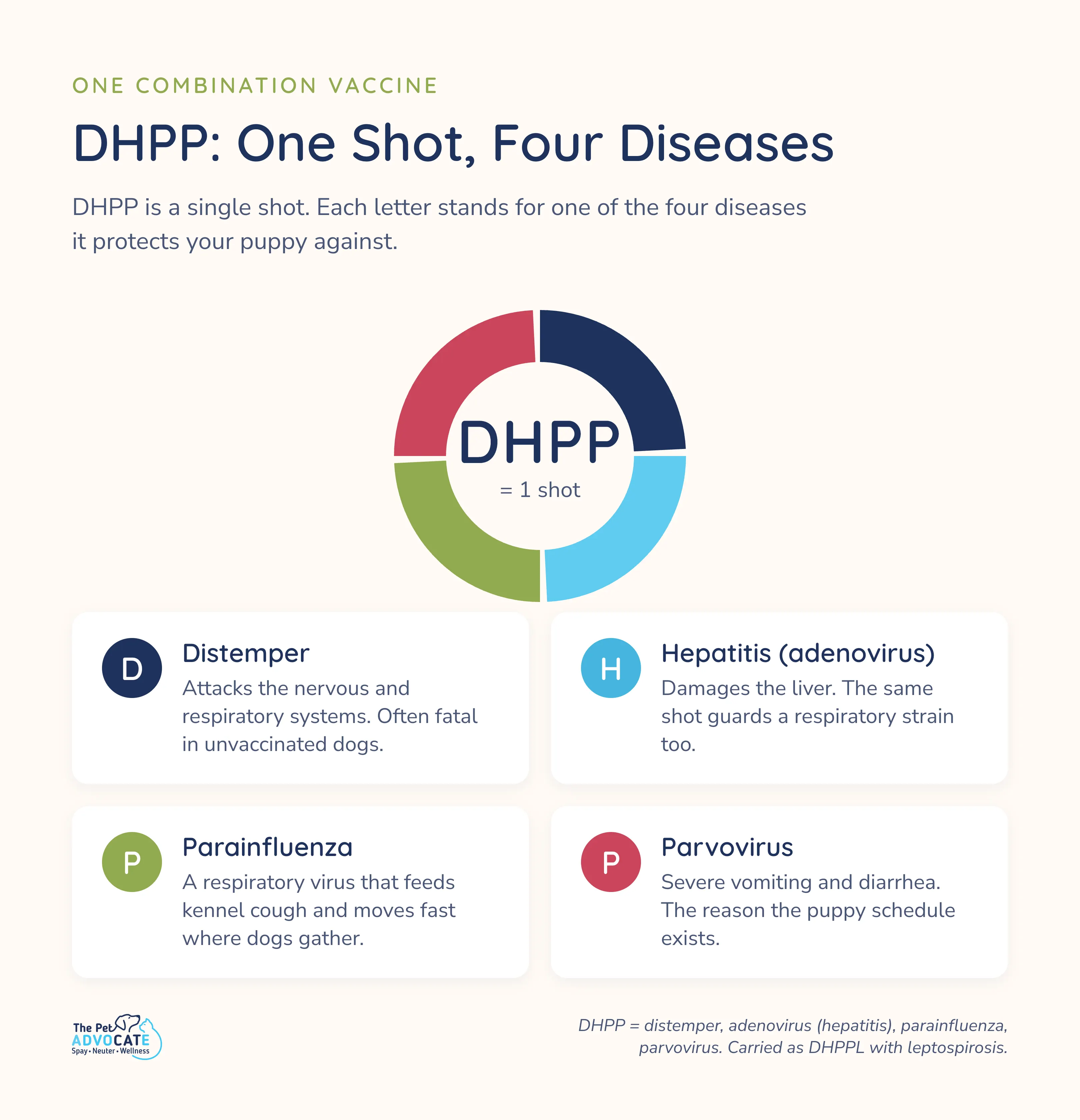
DHPP is one shot that covers four diseases. The letters stand for distemper, adenovirus (hepatitis), parainfluenza, and parvovirus.
Distemper attacks the nervous and respiratory systems. It spreads between dogs and often kills unvaccinated ones.
Adenovirus causes infectious hepatitis, which damages the liver. The same vaccine guards against a respiratory strain too.
Parainfluenza is a respiratory virus that feeds into kennel cough. It moves fast where dogs gather.
Parvovirus is the reason the puppy schedule exists. It causes severe vomiting and diarrhea, and it kills young puppies who have no protection.
Rabies is fatal once symptoms start. It attacks the nervous system and can pass to people.
Leptospirosis moved onto the core list in AAHA's 2024 update. It is a bacterial infection found in standing water and wildlife urine, and it can spread to people. AAHA now recommends it for any dog that spends time outdoors. We carry it in a combined shot with DHPP, listed as DHPPL. You can see the full list of dog and puppy vaccines we carry on our site.
Lifestyle vaccines depend on where your puppy lives and what they do. I recommend these case by case.
Bordetella guards against kennel cough. I suggest it for puppies who board, visit grooming, or join daycare.
Canine influenza fits social dogs who spend time around other dogs in close quarters.
Two vaccines I do not stock. I leave off the rattlesnake vaccine, because the evidence on how well it works has not held up. I skip the Lyme vaccine too, since Lyme disease is uncommon here in the Central Valley. Your own vet may weigh these for your area.
A newborn puppy gets its first protection from its mother. In the first day of life, a nursing puppy absorbs antibodies from her colostrum, the rich first milk. Those antibodies guard the puppy through its early weeks.
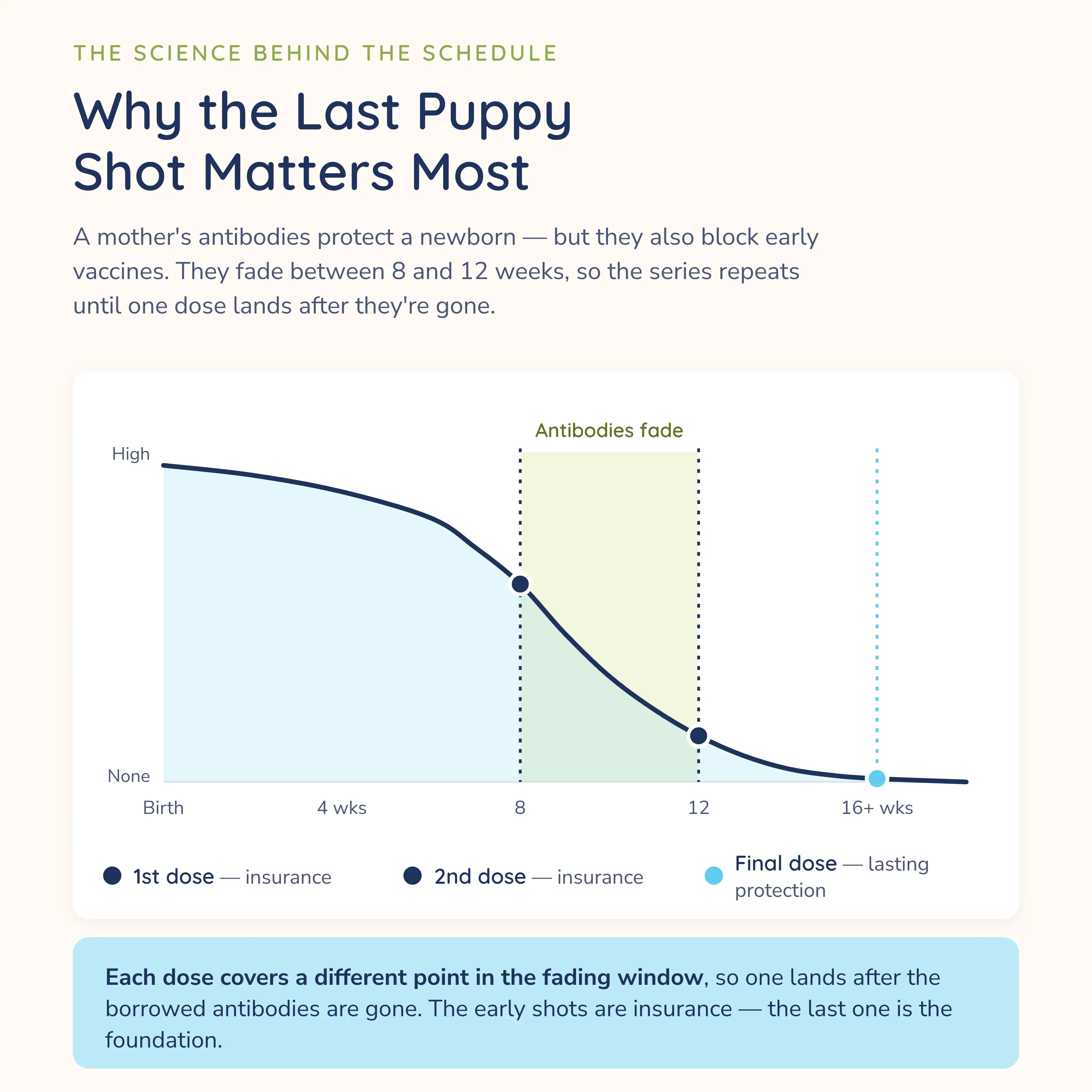
The same antibodies block vaccines. A mother's antibodies can neutralize an early shot before the puppy's own immune system responds. The vaccine does little in that moment.
These borrowed antibodies fade between 8 and 12 weeks in most puppies. The timing differs from one puppy to the next. It depends on how much colostrum the puppy took in during that first day.
In some puppies the antibodies last longer, and they can block a shot given as late as 16 weeks. I cannot predict the exact day they clear for any single puppy.
That uncertainty is why we repeat the series. Each dose covers a different point in the fading window, so one lands after the antibodies are gone. The dose at 16 weeks or older builds the lasting protection in most puppies. I treat the early shots as insurance and the last one as the foundation.
Most puppies handle their shots with no trouble. When a reaction happens, it tends to be mild and short. You might see soreness at the injection site or a mild fever. Some puppies eat less for a day.
Smaller and younger puppies react a bit more often than larger ones. For a small-breed puppy, I may space the shots out across visits rather than give several at once.
Serious reactions are rare. Call a vet right away if your puppy has facial swelling, hives, repeated vomiting, or trouble breathing after a shot. Go back to whoever gave the vaccine, or to an emergency clinic if it is after hours.
Your puppy is not protected until about one to two weeks after the final dose. Until then, parvovirus is the main concern. It survives in the environment and hits unprotected puppies hard.
You can still get your puppy out in the world. Clean sidewalks and your own yard are fine. Carry your puppy through busy areas if you want the exposure without the ground contact.
Hold off on dog parks and pet store floors until the series is done. Set up playdates with healthy, vaccinated dogs you know. Early socialization shapes a puppy's behavior for life, so I do not want owners keeping them shut inside.
A missed shot does not mean starting over in most cases. If the gap is short, we pick up where the series left off. Bring your puppy in and we adjust the plan.
A long lapse can change things. Leptospirosis and rabies follow their own timing rules, and a big delay can mean repeating part of the series. Reschedule a missed dose soon rather than wait.
California law requires rabies vaccination for dogs. Your puppy needs the first rabies shot by 4 months of age, and the minimum age is 12 weeks. I give most puppies theirs at 16 weeks, at the same visit as the final core dose.
The first rabies vaccine is good for one year. Every shot after that lasts three years, as long as the previous one was current when I gave it. If it lapses, the clock resets to one year and the cycle starts again.
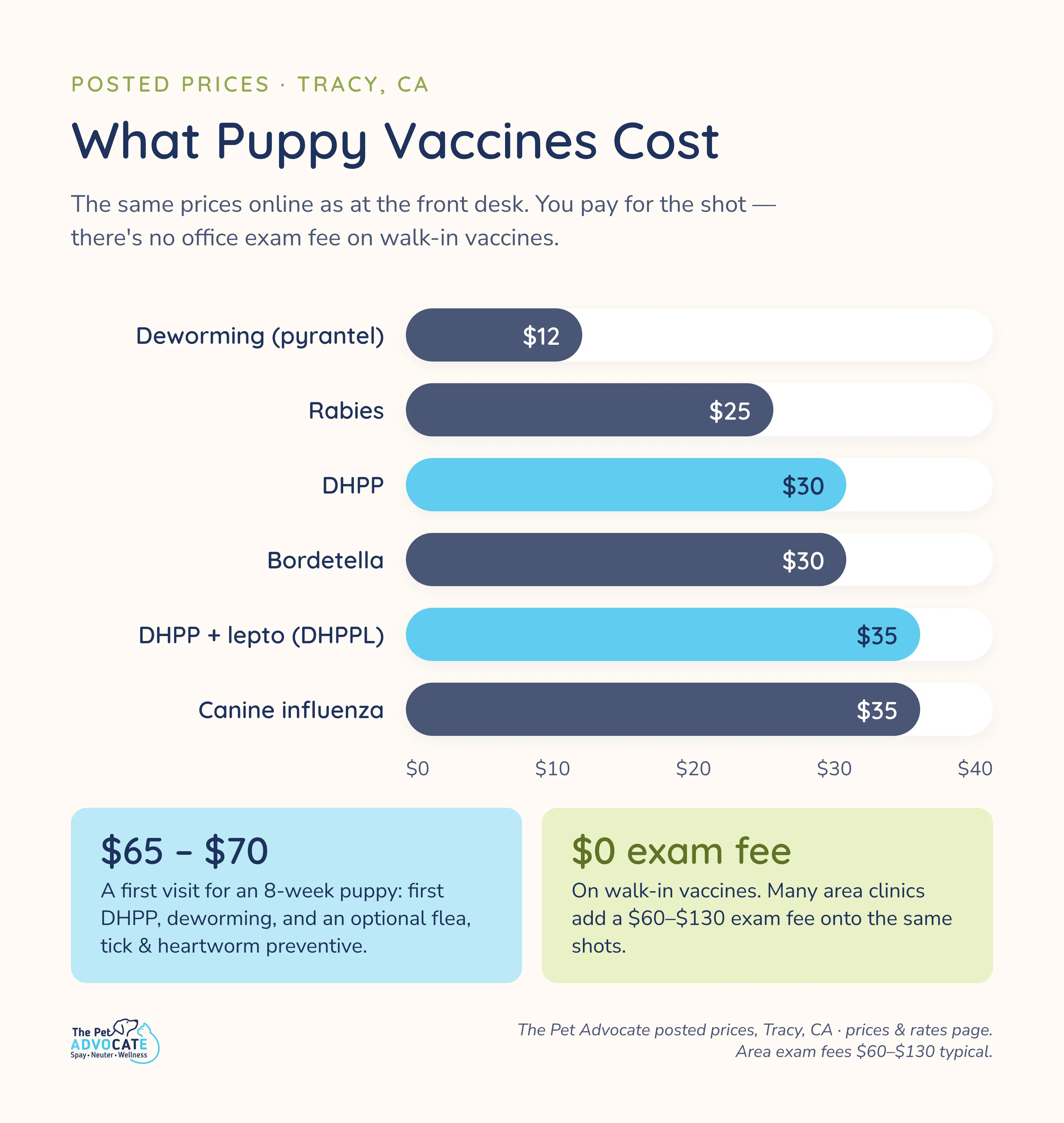
Here is what core puppy vaccines cost at our clinic in Tracy:
A first visit for an 8-week puppy runs about $65 to $70. That covers the first DHPP, deworming, and an optional flea, tick, and heartworm preventive. You can see full pricing for every service on our rates page.
We keep the cost down with one choice: no office exam fee on walk-in vaccines. You pay for the vaccine, not for a visit charge on top of it. Many clinics in our area add a $60 to $130 exam fee onto the same shots each year.
You do not need an appointment for puppy shots with us. We run walk-in vaccine and wellness hours Monday through Friday, from 12 to 3 PM.
You can combine the visit with flea, tick, and heartworm prevention and get it done at once. We see puppies from Tracy, Manteca, Lathrop, and Stockton.
Find us at 1973 N. Tracy Blvd., Tracy, CA 95376. Call 209-879-9367 with any questions before you come in.
Puppies get their first core shot at 6 to 8 weeks old. The first DHPP dose starts the series, and a booster follows every three to four weeks until the final dose at 16 weeks or older.
Puppies need the first rabies shot by 4 months of age, with a minimum age of 12 weeks. California law requires rabies vaccination for dogs.
Puppies need three core vaccines: DHPP, leptospirosis, and rabies. DHPP covers distemper, adenovirus, parainfluenza, and parvovirus. Some puppies also need lifestyle vaccines like Bordetella, based on where they live.
Puppies can visit clean, low-traffic spots before the series is done. Avoid dog parks and pet store floors until then. Protection arrives about one to two weeks after the final dose near 16 weeks.
Core puppy vaccines at our clinic run $25 to $35 each. A first walk-in visit for an 8-week puppy lands around $65 to $70 with deworming. There is no exam fee on walk-in vaccines.
DHPP includes the parvovirus vaccine along with distemper, adenovirus, and parainfluenza. A puppy that gets DHPP is protected against parvo, so a separate parvo shot is not needed.
A titer test measures the antibodies already in a dog's blood. Vets use it in adult dogs to check existing immunity, not as a shortcut around the puppy series. Puppies still need the full set of shots through 16 weeks.
Keep your puppy on the schedule through 16 weeks, and make the final dose count. The early shots cover the gaps while maternal antibodies fade. The last one builds the protection your dog carries forward.
If you are near Tracy and want core puppy vaccines without an exam fee, come see us. Our walk-in hours run weekday afternoons. Many families come in for spay or neuter next, and you can read about our low-cost spay and neuter when you are ready.
This guide reflects the AAHA Canine Vaccination Guidelines (2022, with the 2024 leptospirosis update), the UC Davis vaccination guidelines, and California rabies law.
Mike Wesselink, DVM, earned his Doctor of Veterinary Medicine from UC Davis in 2015. He owns The Pet Advocate, a low-cost clinic in Tracy, CA, and sees new puppies for vaccines each week.