
Or call us at 209-879-9367 — we'll answer Mon–Fri, 8 AM to 4:30 PM.📍 1973 N. Tracy Blvd., Tracy, CA 95376
Schedule OnlineLast reviewed: September 2026. Written by Mike Wesselink, DVM, from surgical work at The Pet Advocate in Tracy, California.
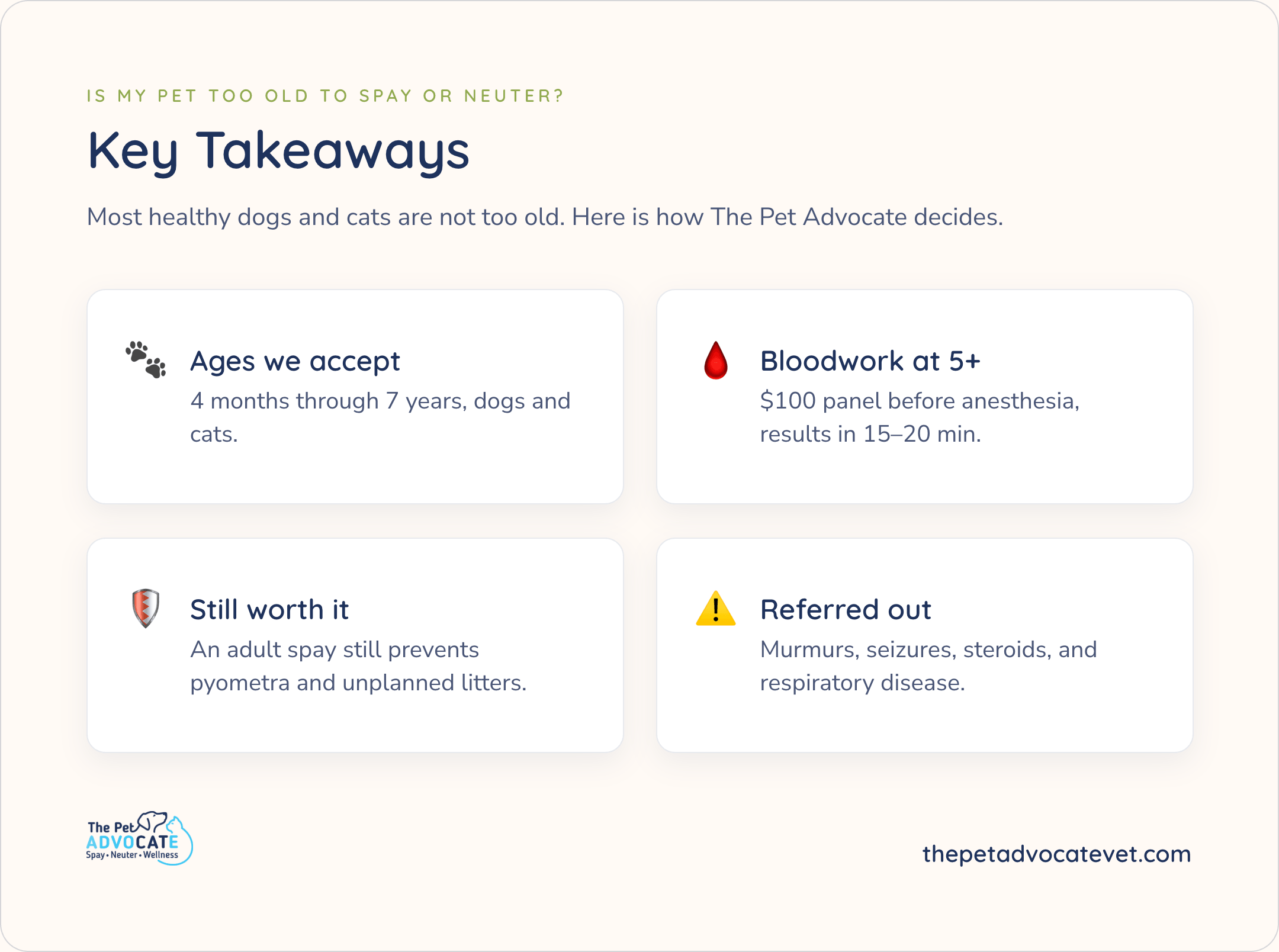
Most healthy dogs and cats are not too old to be spayed or neutered.
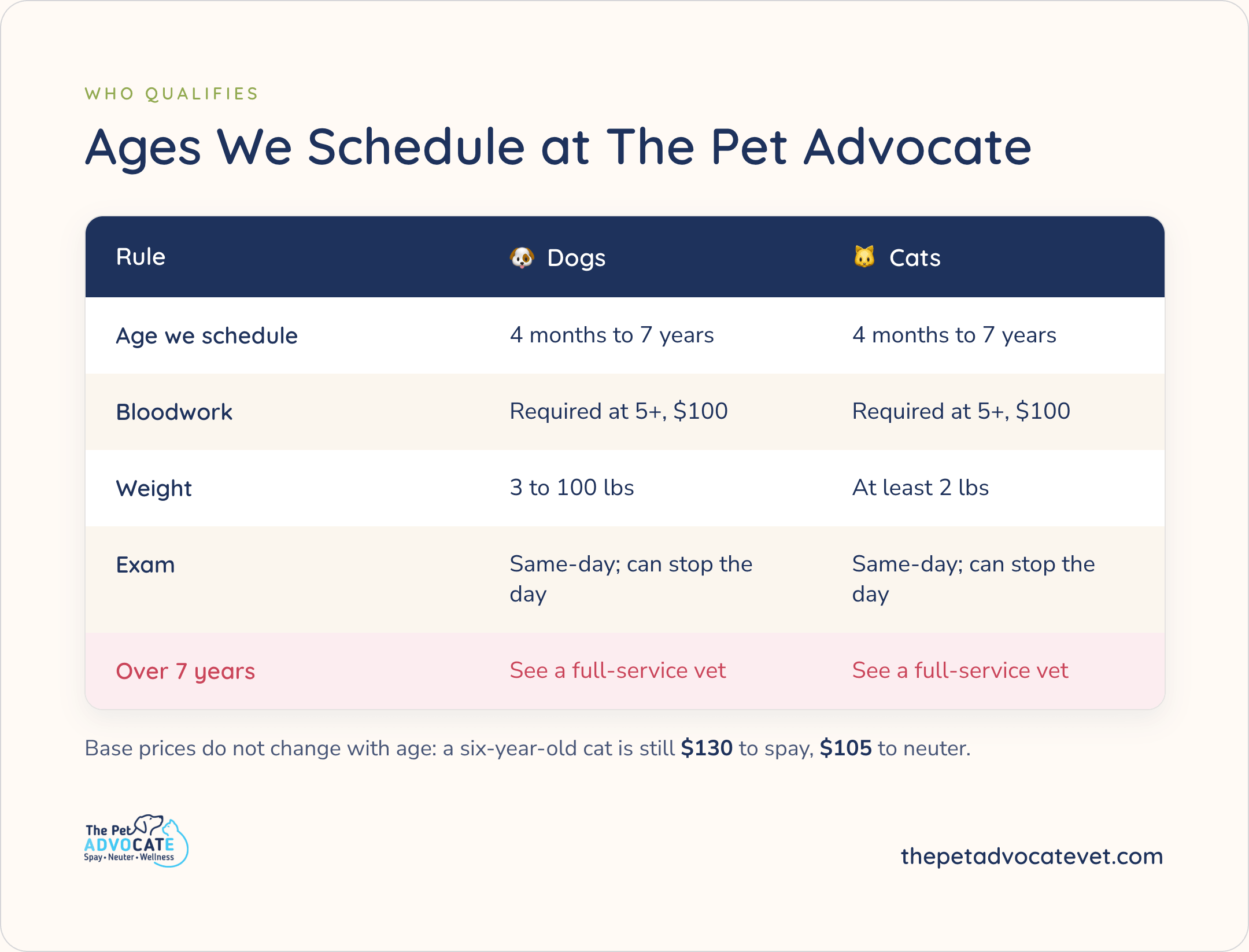
The Pet Advocate will schedule a dog or cat from 4 months through 7 years when the morning exam is clean and, from age 5, bloodwork before anesthesia ($100) looks safe. Full-service hospitals evaluate older pets one at a time.
The Oregon Veterinary Medical Association says that if the pet is healthy enough for anesthesia, there is generally no automatic upper age cap.
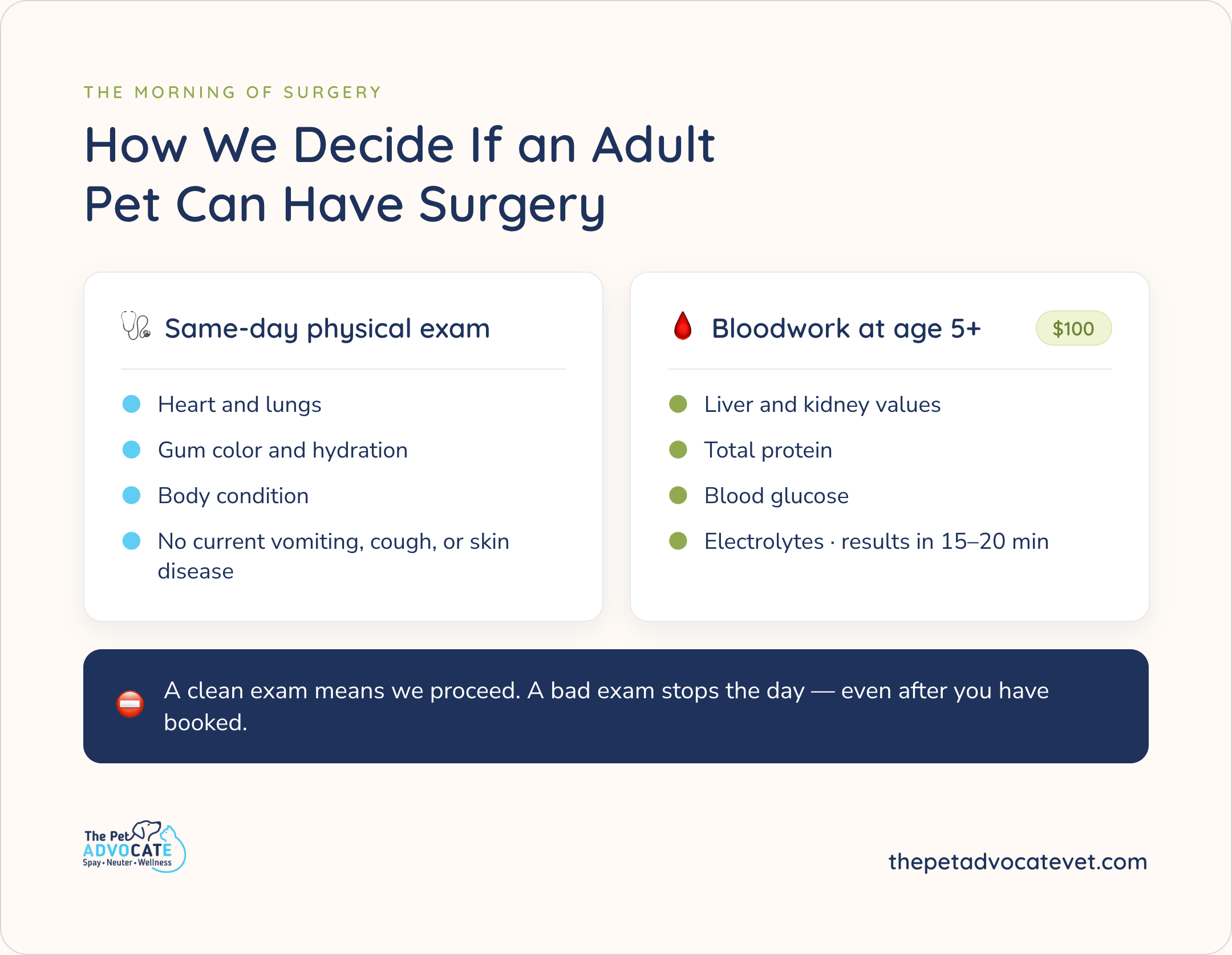
At The Pet Advocate I decide from the morning exam whether an adult dog or cat can have a spay or neuter. Disease risk rises with years. That does not make every six-year-old a poor candidate. We have declined younger pets whose exam looked worse than a healthy adult.
Heart and lungs, gum color, hydration, body condition, and any current vomiting, diarrhea, cough, or skin disease decide whether we proceed. Bloodwork that looks normal does not override a bad exam.
From five years old we add a $100 blood test we run here the same morning. It checks liver values, kidney values, total protein, blood glucose, and electrolytes. Results take 15 to 20 minutes. The panel looks for hidden problems that would make our usual anesthesia unsafe.
Surgery requirements list the same age, weight, and health screens we use on the day.
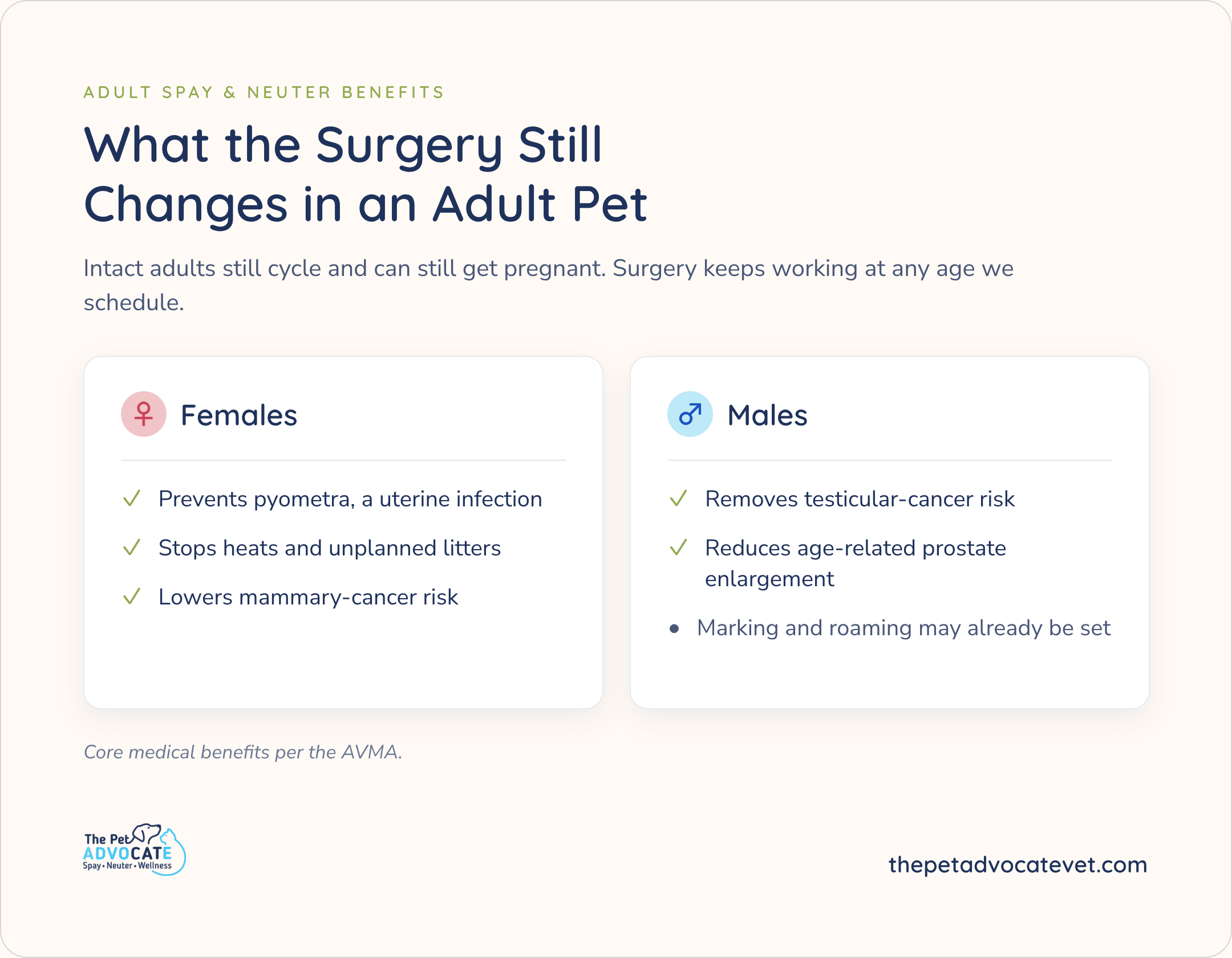
Intact adult dogs and cats still cycle and still get pregnant. They can still get pyometra.
Pyometra is a uterine infection that follows a heat cycle. I would rather do an elective spay on a healthy six-year-old than meet that same dog as an emergency. The Merck Veterinary Manual recommends removing the ovaries and uterus once pyometra is present. Cornell describes the same emergency. Doing the spay while the pet is stable is a smaller surgery than treating pyometra later.
Males keep testicular cancer risk and, in dogs, the prostate enlargement that comes with years of testosterone. Neutering removes the testes. Neutering does not reliably erase marking or roaming that already set in after puberty.
The AVMA lists the same core medical benefits: uterine infection and mammary-cancer risk in females; testicular cancer and an enlarged prostate in males.
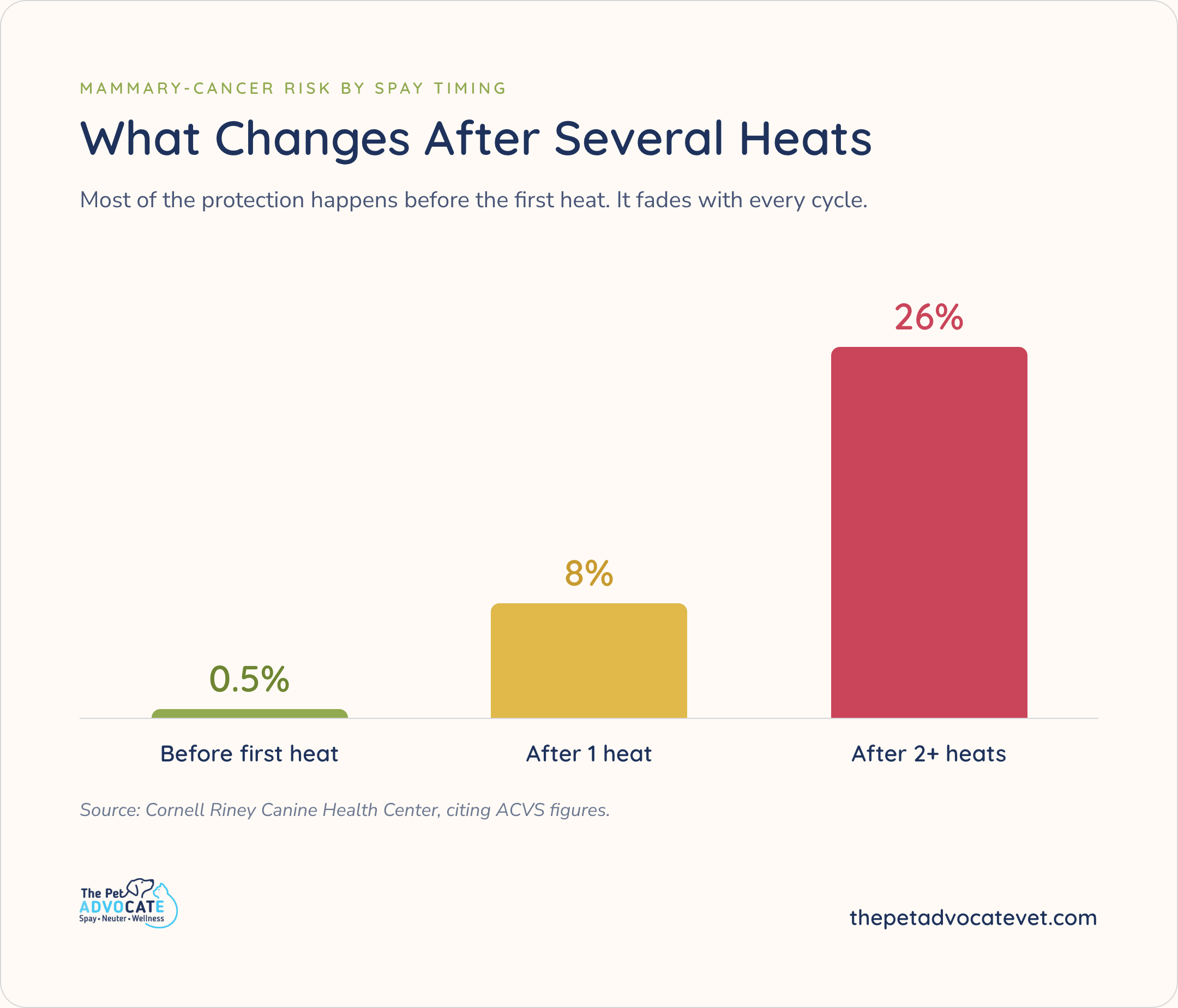
Most of the drop in mammary-cancer happens if a female is spayed before her first heat. Cornell cites American College of Veterinary Surgeons figures of about 0.5% risk before the first heat, 8% after one heat, and 26% after a second. A five-year-old who has cycled for years does not get those early numbers back.
A later spay still stops the next heat and the next litter. It also removes the uterus so pyometra cannot start.
| Rule | Dogs | Cats |
|---|---|---|
| Age we schedule | 4 months to 7 years | 4 months to 7 years |
| Bloodwork | Required at 5 years and older, $100 | Required at 5 years and older, $100 |
| Weight | 3 to 100 lbs | At least 2 lbs |
| Exam | Same-day physical; exam can stop the day | Same-day physical; exam can stop the day |
| Over 7 years | Not scheduled here; see a full-service veterinarian | Not scheduled here; see a full-service veterinarian |
Base surgery prices do not change with age. A six-year-old cat is still $130 to spay or $105 to neuter. Dog prices still follow weight. Current prices are on the prices and rates page.
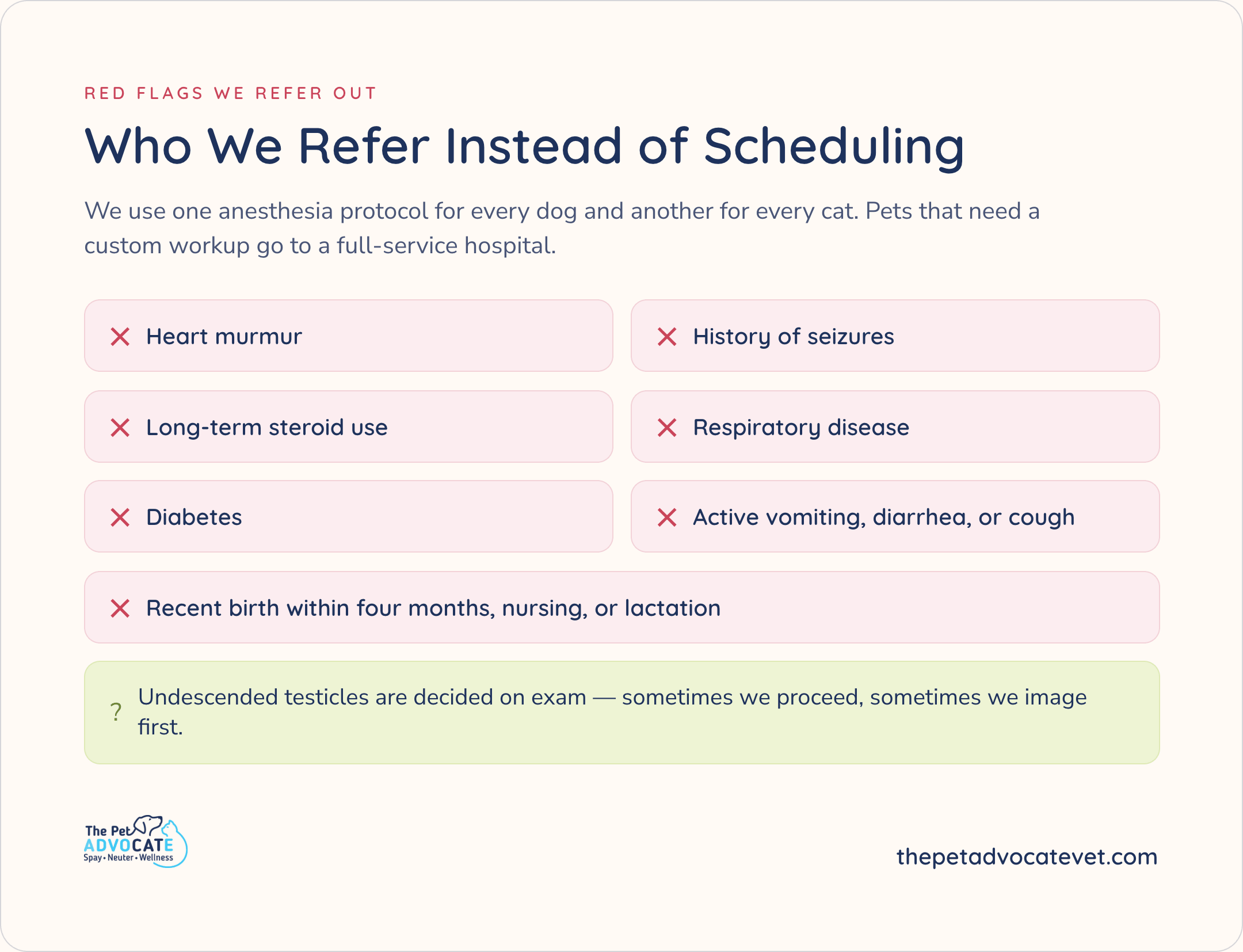
The Pet Advocate uses the same anesthesia drugs and monitoring for every dog, and a separate set for every cat. Pets that need a comprehensive workup go to a full-service hospital.
We refer, or we decline on the morning exam, when we find:
Undescended testicles are decided on exam. If we can feel the missing testicle under the skin we often proceed. If we cannot, we send the dog or cat for an ultrasound or x-ray before anyone cuts. Breed limits are on the surgery requirements page.
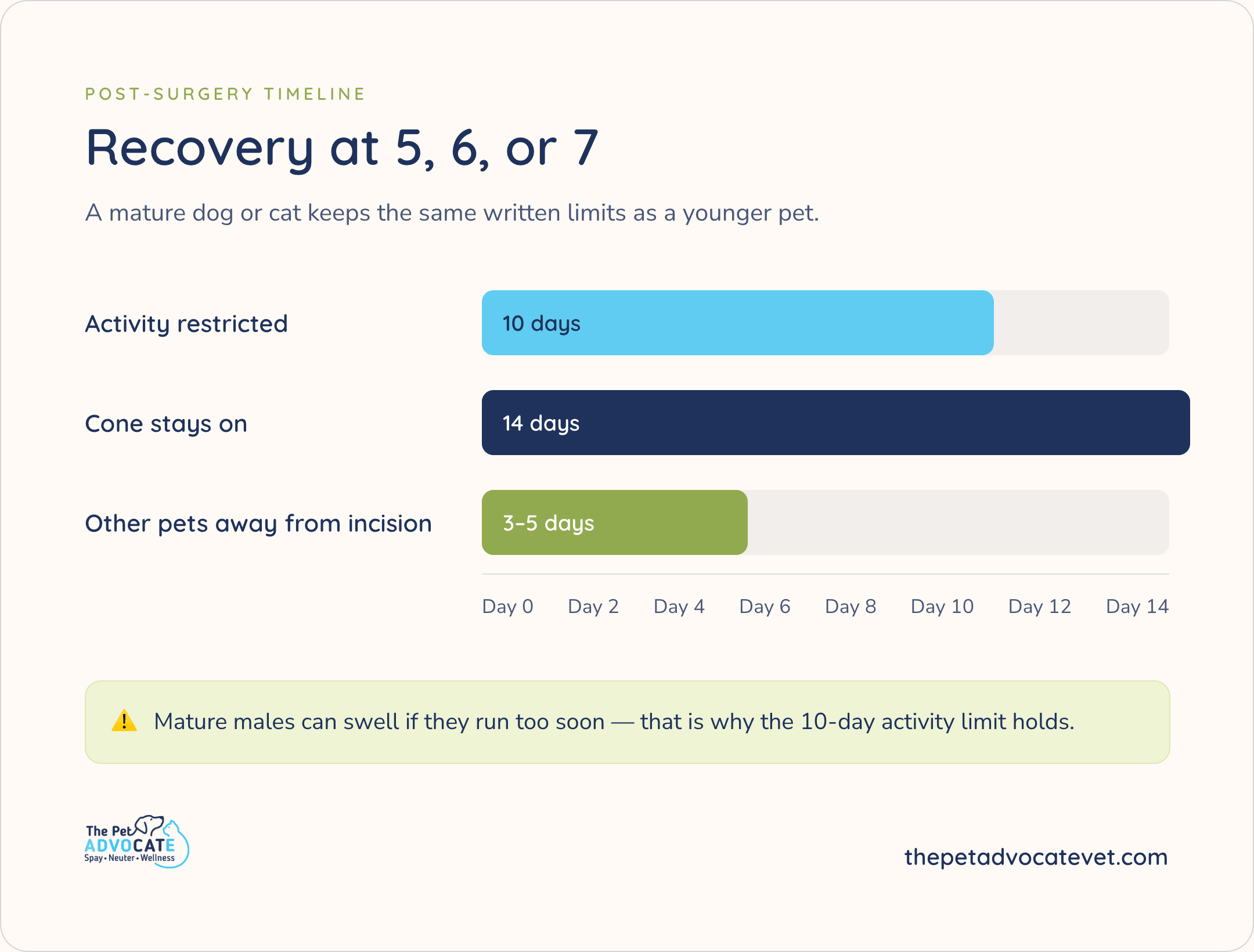
A five-, six-, or seven-year-old dog or cat going home after a spay or neuter at The Pet Advocate keeps the same written limits as a younger pet: activity restricted for 10 days, cone on for 14 days, other pets away from the incision for three to five days. Mature males can swell at the scrotum if they run too soon. That is why the 10-day activity limit stays in place.
Not if the dog is 7 or under at The Pet Advocate, clears the morning exam, and, from age 5, has bloodwork before anesthesia. A murmur, a seizure history, or a birthday past 7 belongs at a full-service hospital.
Not if the cat is 7 or under at The Pet Advocate, clears the morning exam, and, from age 5, has bloodwork before anesthesia. Indoor status does not change the age rules. Cats can still become pregnant well into adult life.
Yes. Bloodwork is required at 5 and older. A three-year-old and a six-year-old pay the same surgery fee based on her weight. Only the $100 blood test is added at five.
The strongest protection is before the first heat. After several cycles that benefit shrinks. A later spay still removes the uterus and stops future heats.
The Pet Advocate will not book that spay or neuter. An 8- or 10-year-old, or a pet people call senior, is past the ages we schedule. Ask your primary-care veterinarian to evaluate anesthesia risk. Some full-service hospitals will still operate after extra diagnostics. We do not do that work here.
Yes. A mature abdomen has more fat and a larger blood supply than a five-month-old, so the surgery itself takes longer. That is one reason I would rather see a healthy four-year-old now than a heavier adult later. It is not a reason to skip a pet who is 7 or under and clears the exam.
If a dog or cat that is not yet spayed or neutered meets The Pet Advocate age and health rules on surgery requirements, book on the schedule page or call. If the exam that morning is off, we cancel even after you booked.