
Or call us at 209-879-9367 — we'll answer Mon–Fri, 8 AM to 4:30 PM.📍 1973 N. Tracy Blvd., Tracy, CA 95376
Schedule OnlineA simple single-rooted dog tooth extraction averages about $78. Larger or multi-rooted teeth cost more. A full dental visit that includes extractions, anesthesia, and X-rays usually lands between $800 and $2,500 all-in. The price changes with the teeth themselves and everything required to remove them safely, not with the size of your dog or cat.
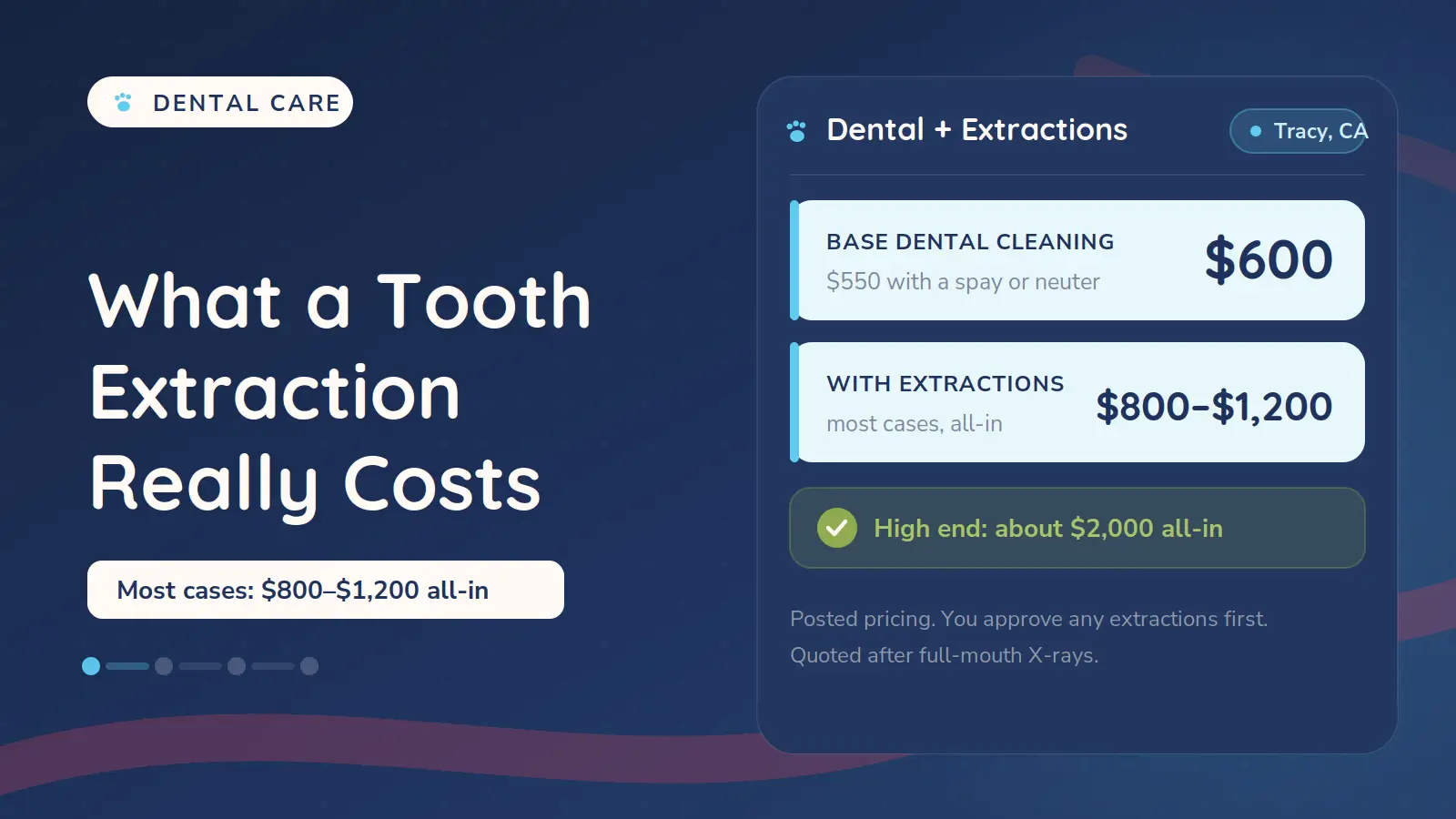
Quick answer for most cases at our clinic: Simple extractions start around the national average, but the majority of full dental visits with extractions at The Pet Advocate land between $800 and $1,200 all-in.
I’m Dr. Mike Wesselink. My team and I run a high-volume dental and spay/neuter clinic in Tracy, California. We see these cases every day, and we built our pricing to make necessary extractions accessible without sacrificing the care your pet receives on the table.
National averages give you a starting point, but they vary widely by region and by what a clinic includes. Here’s how typical costs compare to what we charge in Tracy.
Our base dental cleaning fee covers pre-anesthetic bloodwork, full-mouth digital X-rays, ultrasonic scaling, polishing, and fluoride. Extractions are added on top once we see exactly what needs to come out. You can see the full breakdown of what’s included on our dog dental cleaning and cat dental cleaning pages.
National averages above are drawn from CareCredit/Synchrony research, PetMD, and GoodRx data.
The extraction itself is a small piece of the total. Before we begin, we run pre-anesthetic bloodwork to confirm your pet can safely handle anesthesia. We place an IV catheter for fluids and quick access, keep a close eye on heart rate, blood pressure, and oxygen levels the entire time, and take full-mouth digital X-rays before and after the work.
We numb the area with local nerve blocks so your pet feels nothing while we’re working. Once the teeth are out, we suture the sites closed to help them heal cleanly. Because we created a surgical site, extractions always come with take-home pain medication and antibiotics. A cleaning without extractions doesn’t require those.
Tooth anatomy explains most of the price spread. A small single-rooted tooth near the front of the mouth often loosens and lifts out in one piece. A large multi-rooted tooth in the back holds on much harder.
Multi-rooted teeth frequently need sectioning. We cut the crown in half so we can remove each root individually without fracturing the jaw or leaving pieces behind. That extra step requires more time, more skill, and specialized equipment, which is why the cost per tooth goes up with difficulty.
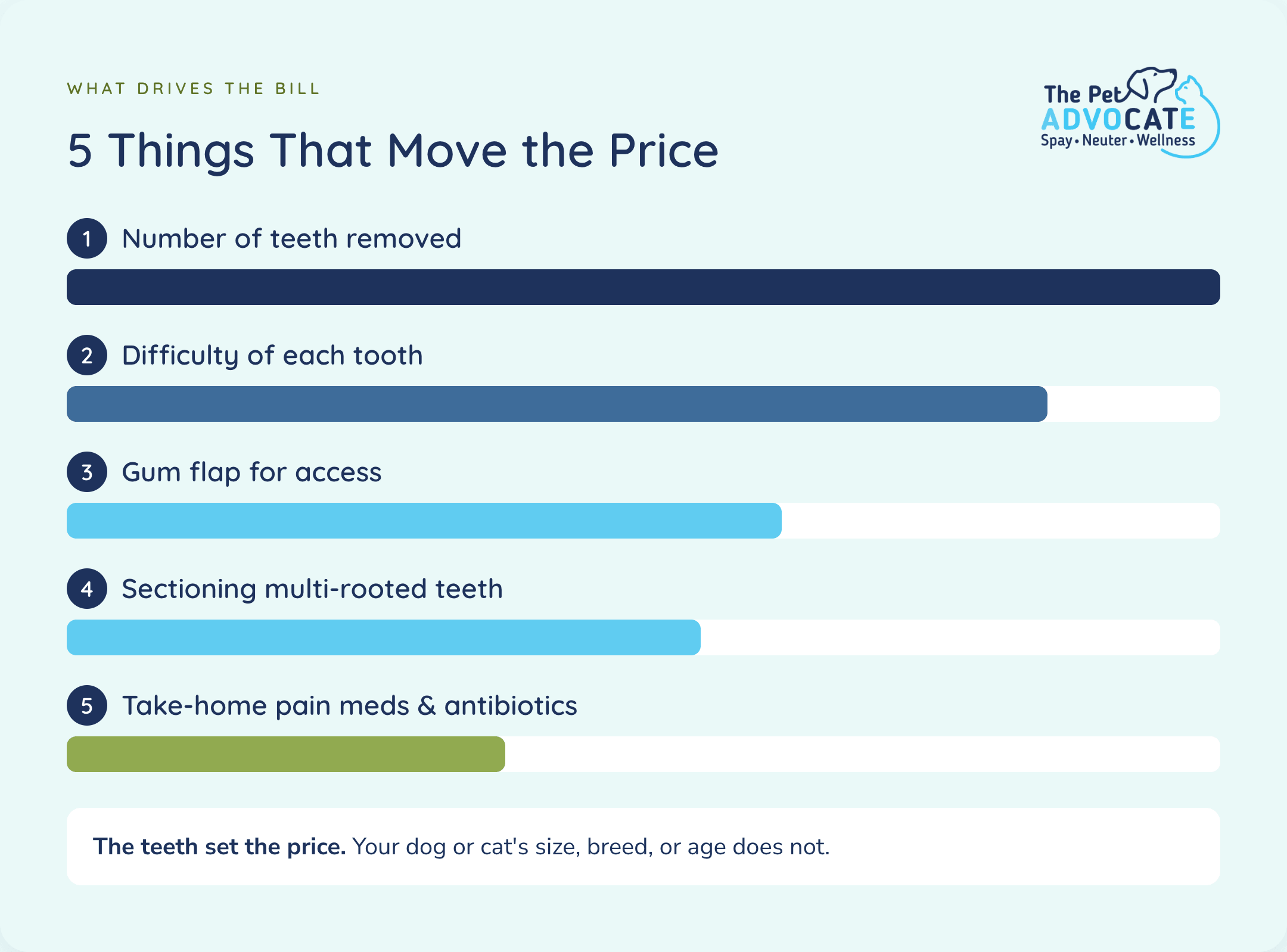
Several factors change what shows up on your final bill.
The number of teeth that need to come out makes the biggest difference.
How difficult each tooth is plays a close second. Some come out quickly. Others require sectioning or a gum flap to reach the root safely.
Whether we need to create a gum flap for better access to a large or deeply diseased tooth adds time and skill.
Sectioning a multi-rooted tooth adds another layer of work.
Finally, every extraction includes take-home pain medication and antibiotics because we left a healing surgical site. Cleanings without extractions do not.
In the end, the teeth set the price. Your dog or cat’s size or breed does not.
Cats follow the identical pricing model as dogs. The anesthesia protocol, pre-anesthetic bloodwork, and full-mouth X-rays are the same regardless of species. Our base dental cleaning fee is $600 for a cat, the same as for a dog, with the option to bundle at $550 when it happens alongside a spay or neuter. The same three-photo submission process and full day-of sequence apply to cats.
Extractions add on top using the same tooth-by-tooth calculation. The clinical steps on the table stay exactly the same. See our cat dental cleaning page for more details on the cat-specific experience.
Owners often ask what the day actually looks like. Here’s the exact sequence we follow every time.
The detail most people miss is that the extraction decision happens after the X-rays and probing. You pay the base cleaning fee up front. Any extractions are quoted and approved during the day once we have the full picture.
You’ll see a wide range of quotes for the same procedure. Some of that spread comes from the teeth themselves — how many, how difficult, and whether sectioning or flaps are required. We covered those variables earlier.
The rest comes from how each clinic is organized. We focus on a narrow set of high-volume procedures: spay/neuter and dental work. We perform about six dentals every weekday. That focus means we don’t carry the overhead of equipment, medications, and specialized staff for services we never offer. The savings show up in our pricing.
This approach has nothing to do with the level of care your pet receives. The anesthesia monitoring, the X-rays, the sterile technique, and the pain management stay consistent. It’s simply a different business model built around doing these procedures efficiently and often.
You have real options that don’t compromise safety or results.
Get written quotes from two or three clinics and compare line by line. Ask exactly what is included — bloodwork, X-rays, take-home medication, and follow-up care all move the total. Our current prices and rates are always listed transparently on the site.
University teaching hospitals such as UC Davis sometimes offer reduced rates when supervised students perform the work. It’s worth asking if travel fits your schedule.
Prevention is the cheapest long-term strategy. Consistent home brushing with veterinary toothpaste and vet-approved dental products slow the disease process that leads to extractions in the first place. This pairs well with the professional cleanings we offer.
We designed our pricing in Tracy to be the low-cost option in the Central Valley precisely so a needed extraction doesn’t have to be delayed.
A simple single-rooted tooth averages about $78 based on 2025 national data. Larger or multi-rooted teeth cost more because they require more time and technique. A complete dental visit that includes the cleaning, anesthesia, X-rays, and any extractions usually falls between $800 and $2,500 all-in at most clinics, including ours.
Cat extractions use the same pricing structure as dogs. The base dental cleaning is $600 either way because the anesthesia, bloodwork, and full-mouth X-rays are identical. What changes the final number is how many teeth need to come out and how complex each extraction is.
Feed soft food while the extraction sites heal, and skip hard kibble, bones, and hard chews until your vet clears them.
The extractions are only one part of a morning-long procedure. Drop your pet off at 8 a.m. We typically call you for pickup about two hours after we finish working.
Administer the prescribed pain medication and antibiotics exactly as directed. Keep your pet calm and restrict rough play or jumping while the sites heal. Monitor for any swelling that worsens or discharge from the mouth and contact us promptly if you notice either.
Age alone does not disqualify a pet. We perform dental procedures on dogs and cats up to 13 years old. What matters far more than the number on their birthday is the physical exam findings and the pre-anesthetic bloodwork. We evaluate each patient as an individual rather than applying a strict age cutoff.
The cost of a tooth extraction follows the teeth and the work required to remove them safely. It does not follow the size or age of your pet. The only number that truly helps you plan is a clear, itemized quote based on what we actually find once your pet is under anesthesia and we have the X-rays in hand.
If you want that transparent quote for your dog or cat, start with our online form. Send the three photos of the teeth and we’ll review them, call you with what to expect, and help you decide on next steps before you commit to an appointment. You can also explore our low-cost spay and neuter options if you’re bundling services.