Or call us at 209-879-9367 — we'll answer Mon–Fri, 8 AM to 4:30 PM.📍 1973 N. Tracy Blvd., Tracy, CA 95376
Schedule OnlineYour dog has two small scent sacs on either side of the anus. They fill with a strong-smelling fluid and empty during a bowel movement. Most dogs manage this on their own and never have a problem.
I'm Mike Wesselink, DVM, and I own The Pet Advocate, a low-cost clinic in Tracy, CA. Anal glands come up often in my exam room, and a lot of the worry I hear is misplaced. Owners tend to blame scooting on the glands when something else is going on.
Dog anal glands are two small sacs, about the size of a pea, on either side of the anus. They hold a scented fluid that dogs use to mark and identify each other. Most dogs empty them on their own and never need help.
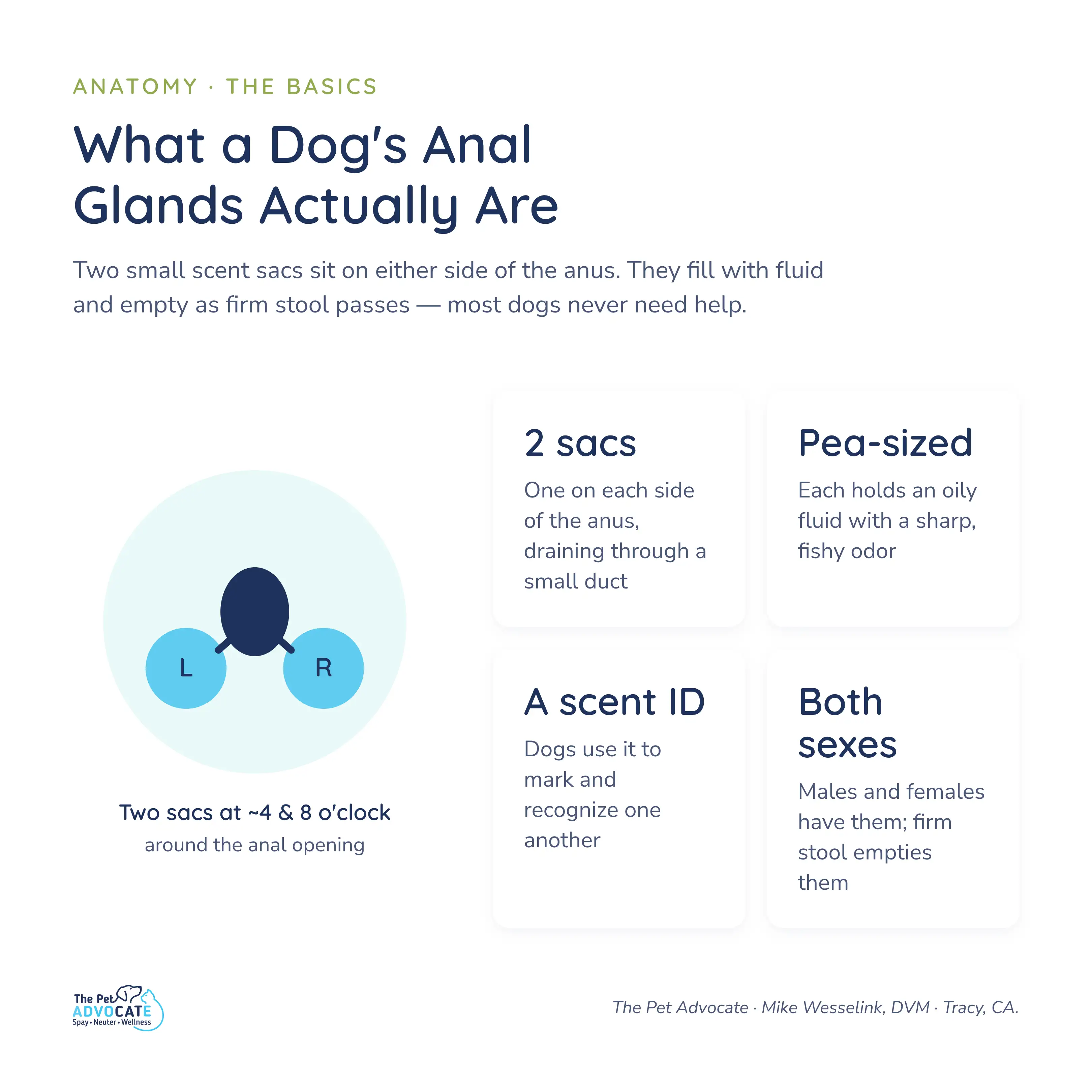
Each sac drains through a small duct beside the anal opening. As firm stool passes, it presses on the sacs and pushes the fluid out. The fluid is oily, with a sharp and fishy odor that differs from dog to dog. Both males and females have them.
Dogs read a lot from that scent. One dog sniffs another and picks up who it is. A startled or stressed dog can also release the fluid on its own, which is where that sudden smell comes from.
I tell owners this all the time. A healthy dog should not need a person expressing its glands by hand. Picture a wolf. It eats a balanced diet, passes firm stool, and the sacs empty on their own every time.
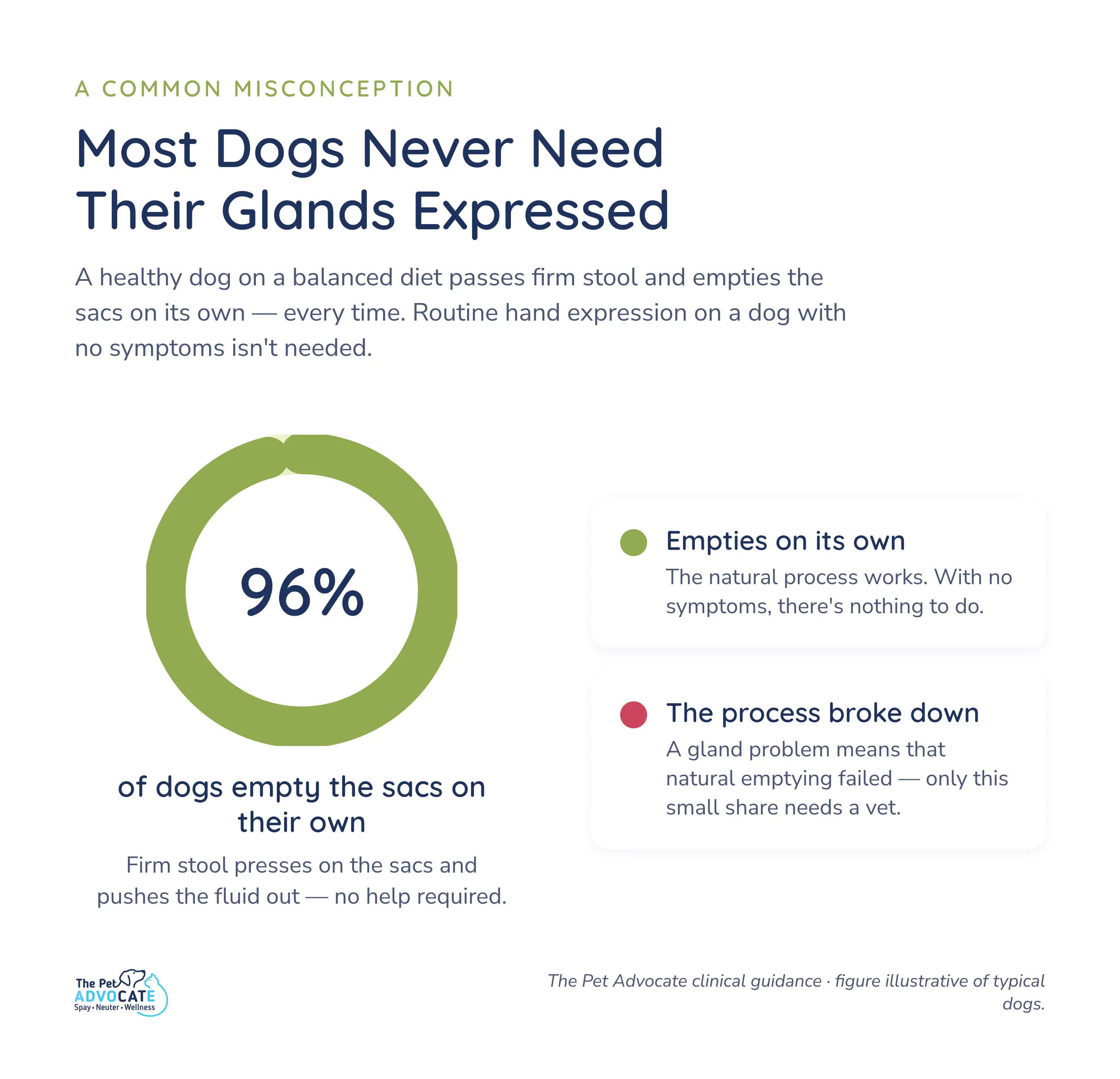
We bred dogs into a wide range of shapes and sizes. Along the way, some lost the ability to empty the sacs cleanly. A gland problem means that natural process broke down, and many dogs go their whole lives without it.
Some owners still book routine expressions their dog does not need. With no symptoms, there is little to do.
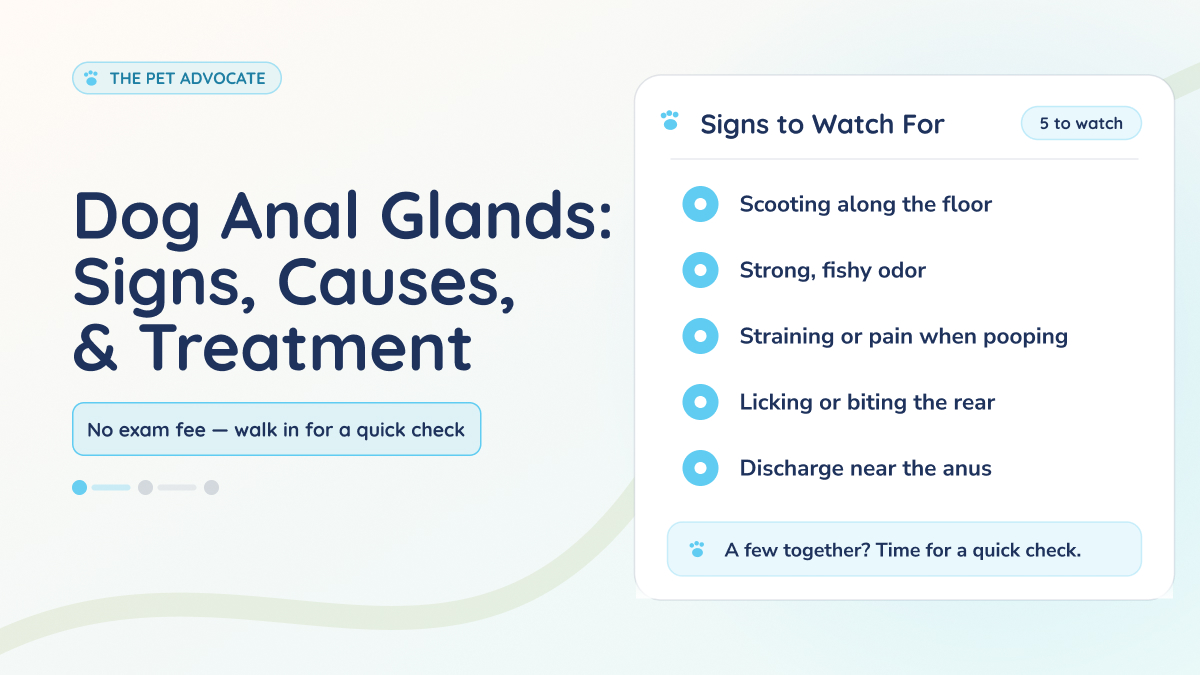
Watch for these signs:
In my exam room, the first three carry the most weight. A few signs together mean more than any one on its own.
Some signs mean you should call us the same day:
An untreated gland can go from full, to infected, to abscessed. The early stage is quick to treat. The later ones hurt your dog and cost more to fix.
Scooting on its own does not confirm a gland problem. Several other things make a dog drag its rear across the floor.
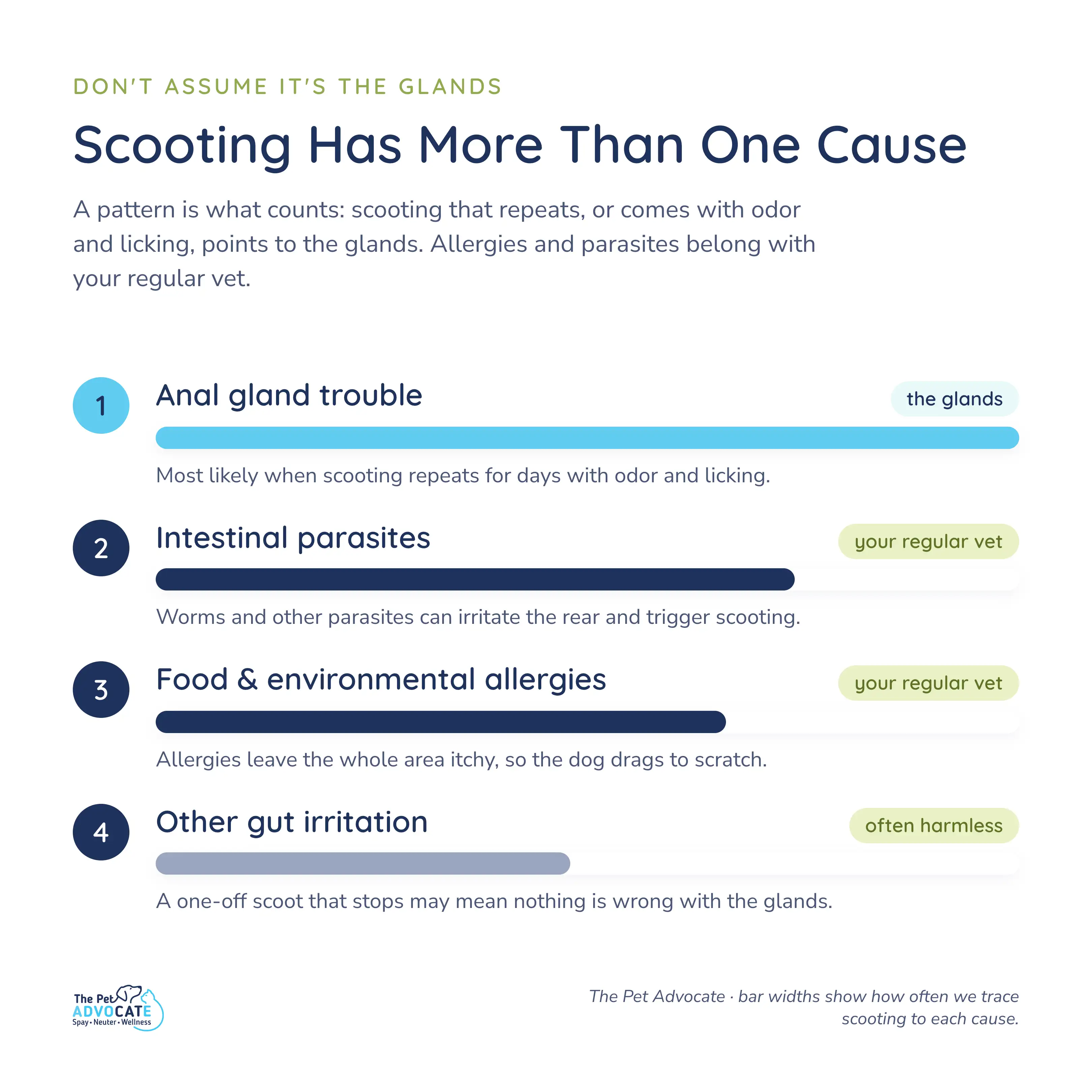
Intestinal parasites can cause it. Food and environmental allergies can leave the area itchy. Other gut irritation does the same. A dog that scoots once and stops may have nothing wrong with its glands.
I watch for a pattern. Scooting that repeats for days, or comes with odor and licking, points more toward the glands. If allergies or parasites are the cause, that workup belongs with your regular vet. We focus on wellness, so we will point you there and talk it through.
Anal gland trouble runs from mild to serious.
Most cases I see sit at the mild end, a simple impaction that an expression clears in about a minute. Infection and abscess climb fast in pain and need more than that. A ruptured abscess drains through the skin and is a same-day emergency.
Cancer of the anal sac is uncommon. It turns up more in older dogs and often gets caught during a routine exam. Cornell's canine health center covers the clinical side if you want to read further.
Smaller dogs and overweight dogs come in for this more than any other group I see. The extra weight and the smaller build seem to change how cleanly the sacs empty. I cannot point to one breed over another, but size and weight show up again and again.
Research lines up with that. A large UK study of more than 100,000 dogs found more than 4% had an anal sac problem over a year. Smaller and flat-faced breeds ran a higher risk, and larger breeds a lower one. The American Kennel Club makes the same point about smaller breeds and notes that no breed is fully in the clear. You can read the Royal Veterinary College summary for the breed detail.
Owners expect this to be a one-time fix. For a smaller or overweight dog, it can become a regular need instead.
For a simple impaction, a vet or trained groomer expresses the sacs by hand. It takes about a minute and brings fast relief. We handle it as a walk-in.
Infections and abscesses need more. We clean the area, manage your dog's pain, and in most cases send them home on antibiotics. The sooner we catch it, the less involved the treatment. After an abscess, we recheck the area to make sure it heals well.
Owners ask me about doing this at home. My honest answer is to check with your vet first and have us show you in person. An inflamed or infected sac is easy to make worse with the wrong pressure. Plenty of owners decide they would rather have us handle it, and that is a sound call.
You cannot prevent every case, but two things stack the odds in your favor: stool quality and weight.
Diet works through stool quality. Soft or loose stool does not press on the sacs the way firm stool does, so the glands do not empty well. More fiber tends to firm up and regulate the stool, which helps the sacs empty on their own. In my experience, that lowers how often a dog needs to come in.
There is some validity to the fiber link, but I do not have hard numbers, and it is not a guaranteed fix. A complete diet that meets AAFCO standards should already carry enough fiber. AAFCO is the group that audits pet food to confirm the label matches what is inside. So for most dogs, better stool quality does the work, and a shelf product is seldom needed.
Weight is the other lever, and the one most in your control. A leaner dog tends to empty the sacs better, which means fewer trips to the clinic.
Bring your dog in for swelling, a draining sore, crying, straining, or scooting that will not quit. Those point to something that will not sort itself out.
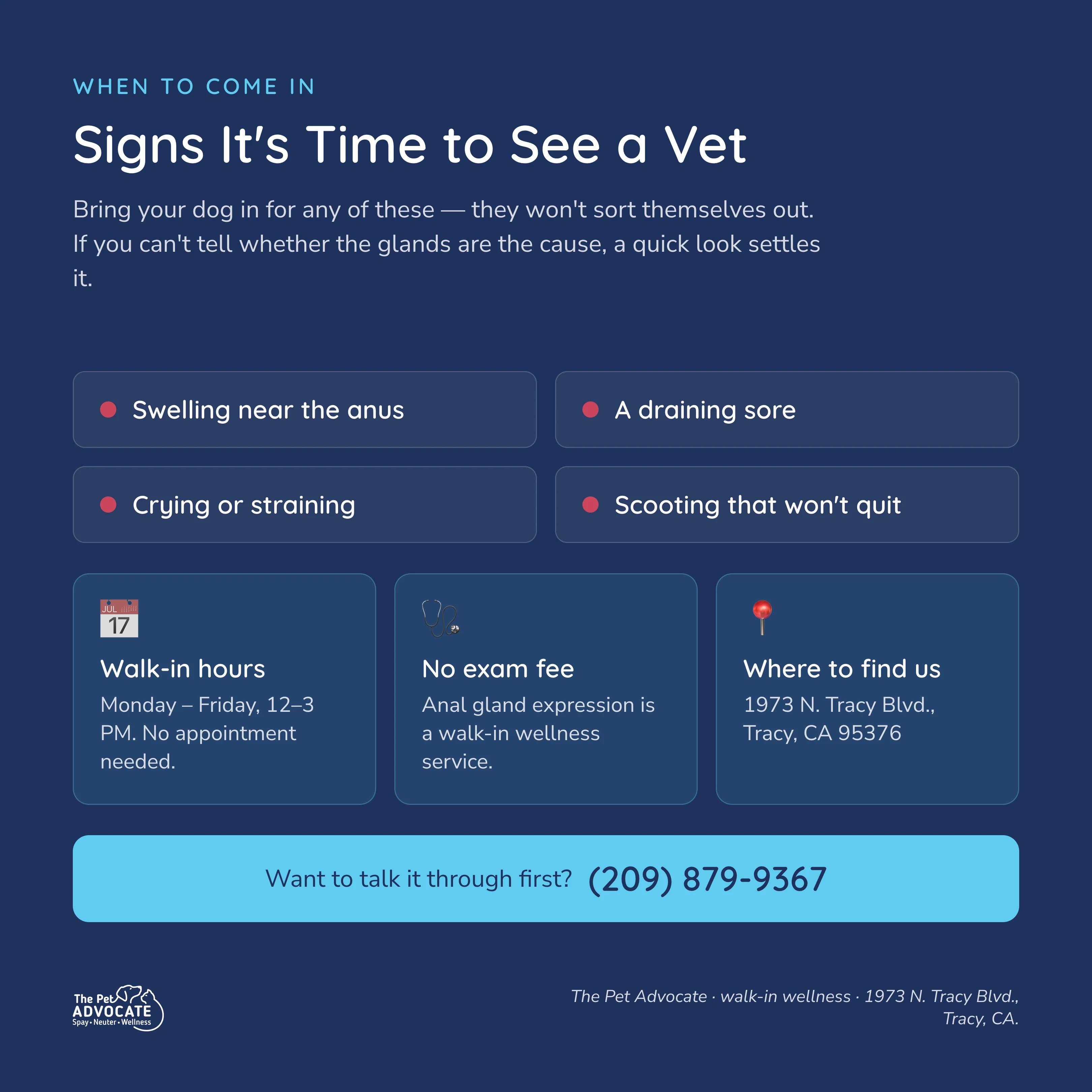
At The Pet Advocate, we handle anal gland expression as a walk-in wellness service. No appointment, and no exam fee. Our walk-in wellness hours run Monday through Friday, 12 to 3 PM. Every visit starts with a quick check to be sure your dog is comfortable for the service that day.
If you cannot tell whether the glands are the cause, that quick look settles it. Call us at (209) 879-9367 if you want to talk it through first. You can also see our wellness services or read the walk-in details before you stop by.
Only when there is a reason. A healthy dog that empties the sacs on its own needs no set schedule. Dogs with repeat problems may need a regular check, and we set that one case at a time.
Most of the time, no. Expressing healthy sacs with no symptoms can irritate the area. Watch for the signs instead, and act once they show up.
Diet plays a part through stool quality. Soft or loose stool keeps the sacs from emptying, and what your dog eats drives that. Firmer, more regular stool from enough fiber can cut down how often your dog needs help.
A simple impaction can turn into an infection, then an abscess, then a rupture through the skin. The early stages are easy to treat, so catching it sooner spares your dog a lot of pain.
Look for repeated scooting, licking at the rear, a fishy smell, or straining. One sign on its own may mean little. Several together, or any sign of pain, means it is time to have a vet look.
Sometimes, but only after a vet confirms your dog is a good candidate and shows you how. An infected or inflamed sac belongs at the clinic, where we can handle it without making things worse.
Most dogs take care of their anal glands on their own. A gland problem is worth a check, and few dogs need this on any routine. The usual drivers are stool quality along with your dog's size and weight, and diet helps around the edges without being a cure.
If your dog is scooting or smells off, a quick walk-in check tells you whether the glands are the cause. Our walk-in hours run Monday through Friday, 12 to 3 PM, with no exam fee, whenever you would like us to take a look.
About the author. Mike Wesselink, DVM, earned his veterinary degree from the UC Davis School of Veterinary Medicine in 2015. He owns The Pet Advocate, a low-cost clinic in Tracy, CA, where his team handles anal gland care as part of walk-in wellness service.